Similar Models, Broken Odds: auditing similarity-dependent odds
CPU L1 arithmetic/audit component; diagnostic only. It computes conditional win probabilities, menu log-odds shifts and interval decisions. It does not fit an Arena ranking, generate judge votes or establish model improvement. The full vote-fitting and 138,400-judgment campaign is not reproduced due to cost (review DONE).
Paper information
| Field | Value |
|---|---|
| Paper | arXiv:2610.19095; fixed v3 |
| Original title | Similar Models, Broken Odds: Where Luce's Axiom Fails in Chatbot Arena |
| Institution/company | First author Soovadeep Bakshi: Independent Researcher, explicitly in the byline; no university affiliation is inferred from an email domain |
| Original publication | October 13, 2026, 19:33:25 UTC, arXiv v1; reviewed v3 updated November 13, 2026, 04:17:37 UTC |
| Authors' code | No verifiable released source link found. Software and Data in v3 says code, generated answers and judgments will be released. Public Arena data are not the authors' implementation |
| License | No released source-code license; paper/original figure CC BY 4.0 |
| Local adapter/key | luce-similarity-audit; adapter=null, promotion_eligible=false, evolve_integrated=false |
| Local code | src/auto_research/post_training/luce_similarity_audit.py: corrected_win_probability, menu_log_odds_shift, heldout_log_loss, transfer_improvement_established |
Original paper
Motivation and changes
Bradley–Terry assigns each model a score and derives pairwise odds. The paper investigates where related versions, sizes and laboratories induce more decisive preferences than global score gaps predict. The Luce/IIA menu property additionally requires odds between two options to remain unchanged when a third option is replaced. The authors separately correct decisiveness among non-ties and tie propensity, examining wording similarity, length gaps and formatting.
This is an evaluation correction, not a method for training a stronger model. Better vote predictions neither establish capability gains nor imply a substantially different leaderboard. Similarity features must not come from the predicted test battle; rival ridge parameters are selected on validation data.
Architecture and protocol
flowchart LR
  V[Public votes and non-test answers] --> B[BT scores and model relations/similarity]
  B --> O[Non-tied decisiveness correction]
  B --> T[Separate tie correction]
  O --> H[Random votes / held-out pairs / later-time splits]
  T --> H
  H --> F[Freeze correction and test release transfer]
  M[Sibling menu and strength-matched placebo] --> D[Menu odds and prompt stratification]
Core equations
Equations 1–2 give
k=1 recovers the baseline; k>1 moves odds away from 50% without changing the sign of the score gap. The paper additionally models ties. The local binary log loss does not implement or replace its three-outcome likelihood. Equation 3 defines
Zero counts are rejected rather than silently adding pseudocounts. Callers must disclose a separate smoothing/statistical procedure. A positive shift pooled across prompts does not establish within-prompt IIA failure.
Reported results and limits
On about 1.8 million votes, v3 reports decisiveness multipliers of 1.37/1.26/1.12 for versions/sizes/same-lab relations. Most predictive gain comes from ties: ties-only contributes +0.91 of the +0.96 millinats/vote overall gain on random 2024 votes. Rank correlation is 0.9999. These are not production A/B results.
The important negative result remains explicit: the frozen 2024→140k lineage correction gains +0.14 millinats in non-tied odds, with a 95% interval [-2.92,+1.68]. Transfer improvement is not established; some frozen multipliers overcorrect. The pooled three-menu shift is +0.10 [0.05,0.16], but the within-prompt estimate attenuates to +0.03 [-0.03,0.09], leaving prompt heterogeneity important.
Key original figure
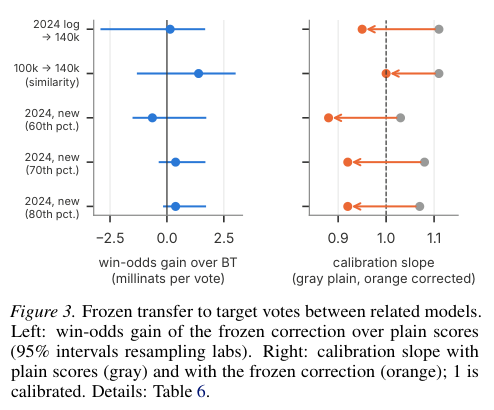
Fixed v3, page 7, Figure 3 and its original caption, without redrawing. Copyright remains with the authors; CC BY 4.0. Source, crop and SHA256. The crossing-zero interval is an author-reported limitation, not a local experiment.
Image from the original paper; copyright belongs to the original authors.
Local implementation
Data contract and mapping
Inputs are supplied score gaps, multipliers, counts and intervals. corrected_win_probability evaluates Equation 2 stably; menu_log_odds_shift evaluates Equation 3; heldout_log_loss handles non-ties only; transfer_improvement_established requires a strictly positive lower interval bound. There is no vote download, parameter fitting, bootstrap, joint six-parameter tie model or paid judge call.
PYTHONPATH=src python -c 'from auto_research.post_training.luce_similarity_audit import diagnostic; print(diagnostic(42, device="cpu"))'
PYTHONPATH=src python -m pytest tests/test_nov18_eval_protocols.py -q
Checks and evidence boundary
Negative controls cover baseline degeneration, equal scores, reversed-pair complements, identical menus, zero counts and inconclusive transfer intervals. All examples are teaching arithmetic, not new Arena measurements; three seeds do not turn fixed inputs into a capability evaluation. Actual execution is recorded in component diagnostic artifacts rather than prefilled here. REQUIRES_GPU_VALIDATION=False; there is no CUDA path or GPU capability claim.
High-cost full experiment
The paper jointly fits million-scale votes over several splits/resampling procedures and obtains 138,400 judgments from eight answer models and four laboratory-specific judges. That complete processing/API campaign exceeds the short single-device/local budget and is not reproduced due to cost (review DONE). It is not automatically retried or presented as a completed full reproduction.