CleanRM: Estimate Noise with Joint Optimal Transport, Then Correct Reward-Model Risk
简体中文 · English
L1 small-feature component with actual joint optimal transport and a signed corrected loss. Known noise rates do not stand in for the core estimator, and synthetic mechanism results are not evidence of actual RLHF safety. Full reward-model and RLHF experiments exceed the cost budget and were not reproduced (review complete).
Paper information
| Field | Details |
|---|---|
| Paper | arXiv 2610.21138; pinned v1 full text |
| Affiliations | First author Licheng Pan, Zhejiang University; collaboration with Xiaohongshu, NUS, NYU, UIUC, and MBZUAI. |
| First public release | 2026-10-15T02:49:51Z (UTC, arXiv v1) |
| Authors' code | The paper links to anonymous CAN-RM-46BB, but it was inaccessible during this review. Its contents, license, and executability were not verified, so it is not marked as integrated. |
| Local adapter / method key | clean-rm; adapter: null |
| Local implementation | clean_rm.py |
| Local implementation directory | src/auto_research/post_training/ |
| Runner | run_oct17_post_components.py |
Original paper summary
Background and main changes
Label noise need not be uniform across preference examples. CleanRM uses a small amount of clean feedback to calibrate two example-level noise rates, one for each flip direction. It performs optimal transport on the joint distribution of semantics and recovered preferences instead of matching only preference histograms. It then freezes the estimator and trains a reward model with a debiased surrogate.
flowchart LR
  A[Noisy features and observed labels] --> B[Two-way noise estimator]
  B --> C[Recovered preferences]
  D[Independent clean calibration subset] --> E[Joint semantic and preference cost]
  C --> E
  E --> F[Optimize estimator with actual OT]
  F --> G[Freeze mu and nu]
  G --> H[Noise-corrected surrogate]
  A --> H
  H --> I[Train reward model]
Key figure from the paper
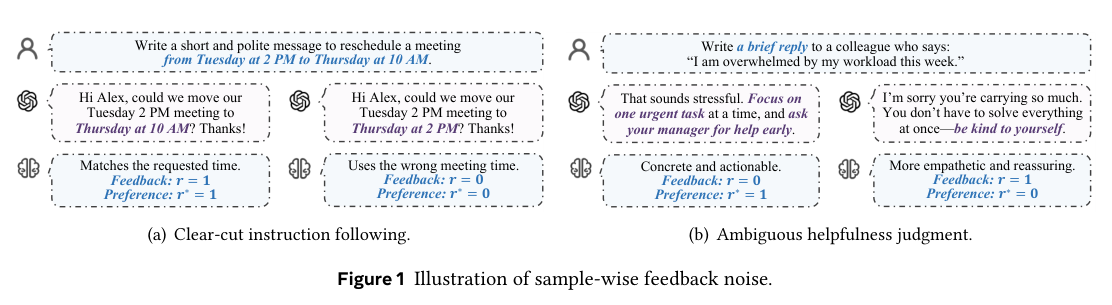
Figure 1 from the paper: Both examples are retained: clear and ambiguous instructions produce different example-level feedback noise. These are not local model outputs. The figure comes from the original paper, © the original authors. Select the image to see the source.
Core equations
Let \(\mu=P(r=0|r^*=1,x)\), \(\nu=P(r=1|r^*=0,x)\), and \(\epsilon=1-\mu-\nu>0\):
The two terms are min–max normalized separately over the entire transport batch. Recovered preferences can lie outside \([0,1]\) and must not be silently clipped. The estimator minimizes \(\min_{T\in\Pi}\langle C,T\rangle\). The reward model uses
This is a signed loss; negative values can be valid. Clamping the loss would invalidate the unbiasedness claim. Unbiasedness depends on correct noise rates and does not guarantee accurate finite-sample estimates.
Reported offline and online results
The paper compares Naive, TrainRef, and other methods on HelpSteer, UltraFeedback, and PKU-SafeRLHF. It reports \(R^2\) gains of .052/.013/.032 over the strongest comparator. It also evaluates multiple backbones and downstream RLHF safety. No online A/B test was reported. The paper's results are not directly comparable to local numerical diagnostics.
Local reproduction
Data protocol and execution
NoiseEstimator uses a three-way softmax to keep both noise rates nonnegative and their sum at most .95. noise_estimation_loss sees only noisy features, observed feedback, and the independent clean calibration subset. It does not receive ground-truth noise rates. Encoded features are treated as fixed; the paper's LLM backbone was not downloaded.
The local solver uses subset DP to find an exact assignment for unregularized OT between equal-mass batches of the same length. It handles at most 12 points in \(O(n2^n)\) and does not import a large-scale OT service. The optimal plan is detached, while \(\langle C,T^*\rangle\) retains the actual cost gradient. Same-length uniform empirical measures admit an optimal permutation, so this is not a nearest-neighbor or diagonal-matrix proxy for OT. However, the solver does not support the paper's arbitrary batch sizes on either side.
PYTHONPATH=src python scripts/run_oct17_post_components.py \
  --methods clean-rm --device cpu --seeds 42,43,44 \
  --output runs/clean-rm-component.json
The runner has six noisy points and six clean calibration points. Under the same model initialization it first updates the noise estimator, then freezes its output to train a small linear reward model. It also trains a Naive comparator without using its result for selection. Each stage runs four updates by default, capped at 12. For CUDA, change only --device cuda. No public language dataset or benchmark is used, so this is not a formal reward-model comparison.
Results, code mapping, and limits
On 2026-10-17, a real NVIDIA A100 completed seeds 42/43/44: per-seed metrics, sanitized GPU receipt. The mean \(L_2\) parameter changes of the noise estimator and reward model were .28969/.32828, respectively. The exact OT reference and marginal errors were 0, and the estimator change in the reward-model stage was 0. This is not noise-rate recovery accuracy or the \(R^2\) of a real reward model. Known noise rates were not training inputs, and no clean held-out labels were used to select configurations.
joint_costpreserves both semantic identity and preferences. A unit test shows that matching preference marginals alone misses semantic mismatches.exact_uniform_transportis compared with an independent exhaustive-permutation reference, checking row and column marginals and the envelope gradient.corrected_reward_losssupports square and logistic base losses with detached noise rates. A unit test enumerates both true feedback states and checks that the conditional expectation recovers the clean loss.- The runner records nonzero estimator and reward-model updates, zero frozen-estimator changes, OT residuals, the no-noise reduction control, and signed final losses. It does not cherry-pick favorable seeds or discard negative results.
Full experiments not reproduced: The paper covers 8–70B reward-model backbones, two stages with up to 600 epochs and hyperparameter search, plus an 8B policy, 256 prompts × 4 rollouts, 20 GRPO steps, and an external safety judge. The full multi-model pipeline is estimated to take hours on one A100/A30 and requires substantial resources and API access. It was closed under the cost policy without a probe run. The component remains diagnostic_only: true, promotion_eligible: false, and evolve_integrated: false.