SIF: Selective updates from ranked self-certainty windows and two-stage voting
L1 eligibility, voting, and dual-mask component. Default eligibility is still 550 tokens; short online updates are a separate short-window diagnostic, not default SIF training. Full experiments were not reproduced due to cost; review is complete.
Paper information
| Field | Details |
|---|---|
| Paper | arXiv 2610.21392; pinned v1 full text |
| Institution | First author Xun Lu's primary affiliation is the Institute of Automation, Chinese Academy of Sciences (superscript 1); University of Chinese Academy of Sciences is also listed (superscript 2). Pengcheng Laboratory is a collaborator. |
| First public release | 2026-10-15T07:08:46Z (arXiv v1, UTC) |
| Author code | No released author method repository was found or confirmed. The component was independently implemented from the equations. |
| Local adapter or method key | sif; adapter: null. |
| Local reproduction code | sif.py under src/auto_research/post_training/. |
| Runner | scripts/run_oct16_post_components.py |
Paper method and evidence
Average self-certainty can rise even for confidently wrong responses. SIF compares ranked certainty profiles within the same prompt rather than treating confidence as a correctness label. It first votes over windows, then derives a binary reward from the fraction of eligible peers beaten. Ineligible responses and constant-reward groups are filtered; policy and KL terms both use the selection mask.
flowchart LR
  A[Response distributions within one prompt] --> B[Token KL from uniform to policy]
  B --> C[550-token eligibility]
  C --> D[Ranked profile and ten 100-token windows]
  D --> E[Eight-window wins and three-quarter peer threshold]
  E --> F[Drop uniform-reward groups and normalize]
  F --> G[GRPO with the same mask for policy and KL]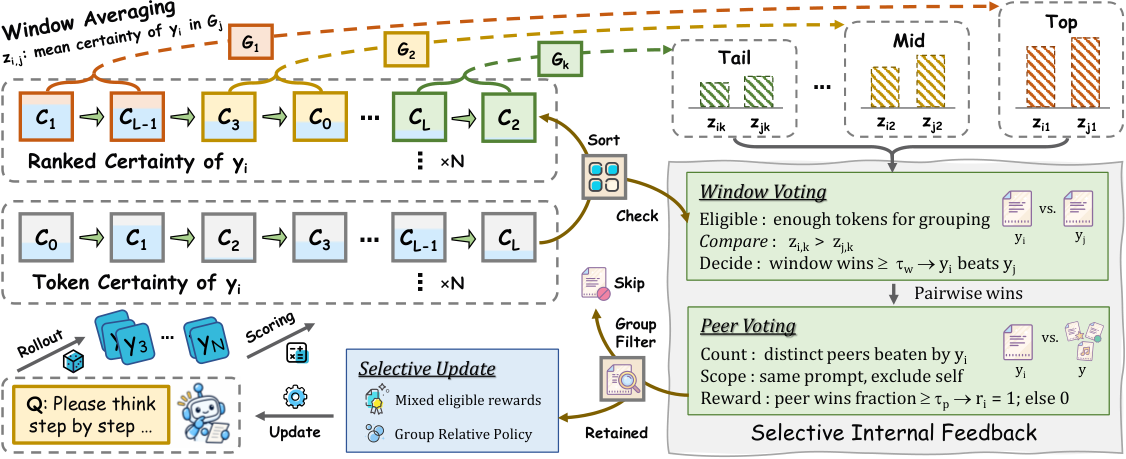
Original Figure 3 from the paper, retaining the original SIF_main.png. Not a local result; copyright remains with the authors.
Core equations
Per-token certainty is \(c_t=KL(U\Vert\pi(\cdot|s_t))=-\log|V|-|V|^{-1}\sum_v\log\pi(v|s_t)\), not entropy or sampled-token probability. Defaults \(K=10,w=100,s=50\) give \(L_{min}=w+(K-1)s=550\). Sort valid certainty values descending; zero-based starts are \(a_k=\lfloor k(L-w)/(K-1)\rfloor\), and \(z_k\) is the mean of the corresponding \(w\) tokens.
Compare eligible peers only, excluding self; ties do not vote. Groups with fewer than two eligible responses or identical eligible rewards do not update. Freeze advantages computed using eligible reward mean and sample standard deviation (\(n-1\)). Retained groups keep Equation 11's original \(1/G\) factor and per-response length normalization; ineligible responses contribute zero rather than changing the factor to \(1/G'\). Clipped policy and low-variance KL use the same token mask.
Reported results
The paper compares three backbones on 12 mathematics and science benchmarks. For Qwen3-1.7B, SIF final averaged 45.29%, versus 39.18% for the original model and 43.46% for Intuitor best-validation. These are not local accuracy scores; no production A/B was reported. Appendix B uses eight A100-40GBs, full-parameter FSDP, 64 × 8 rollouts, 3,072 maximum tokens, and 80/115 steps. The paper used MATH test for online validation; the local diagnostic does not select checkpoints on test data.
Local reproduction
The runner uses public Hamlet 1524 at the SHA-256 revision below, with disjoint 80%/10%/10% byte ranges for training, validation, and test. It does not tune on held-out NLL.
Default 16-token online rollouts are all rejected by the 550-token eligibility check. An explicitly labeled short-window run uses \(K=2,w=4,s=2\), minimum length six, to verify genuine gradients and updates through sorting, both votes, normalization, and both masks. This does not claim equivalence to default SIF; no 550-token generation is used to circumvent the cost gate.
PYTHONPATH=src python scripts/run_oct16_post_components.py \
  --methods sif --corpus-path /path/to/hamlet.txt \
  --corpus-id gutenberg:1524 \
  --corpus-revision sha256:31584c19795779431b5933499a45b9cecb03e8c246b6ea7e245a2b6d65e8e784 \
  --corpus-sha256 31584c19795779431b5933499a45b9cecb03e8c246b6ea7e245a2b6d65e8e784 \
  --device cpu --seeds 42,43,44 --output runs/sif-component.json
Three-seed CPU metrics separately record zero default-eligible responses and actual short-window update gradients and parameter movement. Confidence is not correctness; NLL is not mathematical accuracy. VotingConfig retains original defaults; token_self_certainty accepts full-vocabulary logits; prepare_credit handles eligibility and votes; sif_ppo_loss updates under both masks.
Independent tests cover the true 550-token boundary, first and last of ten 100-token windows, the eight-window threshold, peer and self exclusion, sample standard deviation, constant rewards, and zero KL gradients for filtered responses. No random certainty generator substitutes for a capability model. Long-rollout multi-A100 training on 12 benchmarks was not reproduced due to cost. This is component_only and evolve_integrated: false; multiple short-window seeds do not establish capability.