TF-OPD: Training-free closed-form fusion from teacher-generated statistics
L1 formula component and tiny autoregressive diagnostic, not full reproduction. The full experiment was reviewed and not reproduced because of cost;
adapter: null,evolve_integrated: false.
Paper information
| Field | Details |
|---|---|
| Paper links | arXiv 2610.22236; pinned v1 full text |
| Company / institution | First author Bangji Yang lists University of Illinois Urbana-Champaign first (PDF superscript 1); Tsinghua University collaborates. |
| First public release | 2026-10-15T17:15:01Z (UTC, arXiv v1), not the October 16 announcement |
| Author code | No verified public method repository found. Dependencies and third-party implementations are not author code. |
| Local adapter / method key | tf-opd; standalone formula component, no reproduction adapter |
| Local implementation | tf_opd.py |
| Local implementation directory | src/auto_research/post_training/ |
| Runner | run_oct16_post_components.py |
Paper summary
Background and main changes
Merging linear layers of experts with a common initialization can be written as least squares matching teacher outputs. The key is not arbitrary covariance: use second moments of the inputs each teacher actually sees on its own generated responses after termination and loop filtering. Normalize by token count so longer answers do not dominate other domains.
flowchart LR
  A[Experts from the same base generate independently] --> B[Filter for natural termination and loops]
  B --> C[Each teacher replays its own trajectories]
  C --> D[Token-normalized Gram for each linear layer]
  D --> E[Off-diagonal shrinkage and FP64 solve]
  E --> F[FP32 merged weights and unreproduced update fraction]
Original paper figure
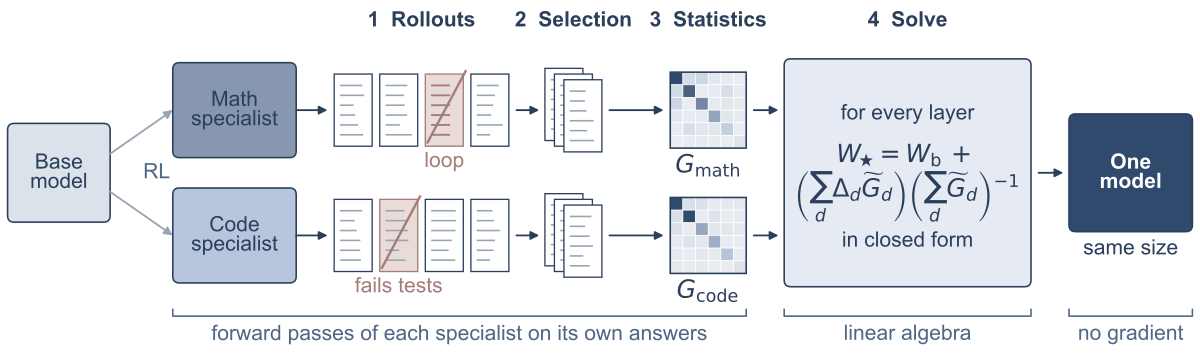
Paper Figure 2, from the original paper. Copyright remains with the authors. The original
overview.svgwas converted to PNG without changing content. Not a local result.
Core equations
Let \(W_d=W_b+\Delta_d\) and \(G_d=X_d^\top X_d/n_d\) for a linear layer. Eqs. 1–4 give
Default \(\alpha=0.9\). Solve the transposed system without explicit inverse, using float64 for the solve and float32 for storage. Nonlinear weights use task arithmetic. The unreproduced fraction for each teacher update is
Identical Grams give a weighted mean rather than a sum of updates. Orthogonal input supports recover each teacher exactly. Tests cover both, normal-equation residuals, actual replay Grams after filtering, and hook cleanup.
Offline and online results reported in the paper
Merged OLMo 3 7B averages 61.1% on seven math/coding benchmarks versus 59.8% for the math expert and 53.6% for the coding expert. Evaluation precision formats differ across models. No online A/B is reported. Appendix B Table 4 reports about ten GPU-hours for two-expert fusion and 2.5–3 GPU-hours per model for AIME25, not local measurements.
Local reproduction
Data protocol and execution
Public Hamlet (Gutenberg 1524), pinned revision sha256:31584c19795779431b5933499a45b9cecb03e8c246b6ea7e245a2b6d65e8e784. No checkpoint downloads. A tiny 257-token byte policy takes eight next-token warm-up updates. From the shared base, two disjoint training segments give four SFT updates each. They are real small teachers, not the paper's RL experts.
Teachers autoregressively sample with natural EOS. Replay only terminated, non-DEFLATE-loop trajectories; no random matrix stands in for teacher statistics. Unlabeled public text has no correctness verdict, so math/code correctness filtering is disabled and this remains a component diagnostic. A real network executes input layer and head, not full-layer production Transformer fusion.
PYTHONPATH=src python scripts/run_oct16_post_components.py \
  --methods tf-opd --corpus-path /path/to/hamlet.txt \
  --corpus-id gutenberg:1524 \
  --corpus-revision sha256:31584c19795779431b5933499a45b9cecb03e8c246b6ea7e245a2b6d65e8e784 \
  --corpus-sha256 31584c19795779431b5933499a45b9cecb03e8c246b6ea7e245a2b6d65e8e784 \
  --device cpu --seeds 42,43,44 --output runs/tf-opd-component.json
Results and limits
See the actual three-seed CPU metrics. Merged parameters change, teacher parameters do not, and closed-form fusion has no optimizer step. NLL checks forward execution only, not cross-domain transfer. Raw byte ranges isolate train/validation/test at 80%/10%/10%, without tuning or checkpoint selection.
sample_teacher_rollout → retain_rollout → collect_teacher_grams → fuse_models/solve_layer is the callable pipeline. Hand-set Grams in low-level solve_layer tests are L0 numerical checks only. The general fusion entry rejects tied embedding/head or other shared storage to avoid silent overwrites between embedding arithmetic and head solve. BytePolicy uses untied weights. CUDA evidence is tracked separately by batch receipt; CPU is not GPU proof. Full 7B experts, real math/code graders, and the benchmark suite were reviewed and not reproduced because of cost, with no Evolve retry or ranking.