Ask to Distill: Learning which questions create useful on-policy supervision
L1 reward and candidate-update formulas; diagnostic only. No full question synthesizer or capability run.
Paper information
| Field | Details |
|---|---|
| Paper | Ask to Distill: Learning to Synthesize Data for On-Policy Distillation |
| Affiliations | First author Jiashuo Sun: UIUC; collaborators include HKUST and Texas A&M. |
| First public release | 2026-10-20 01:00:17 UTC |
| Author code | Ask_to_Distill, Apache-2.0, 1edaf22fc8e2ba35efe6c02fa1a3665875f1f98a. |
| Local key | ask-to-distill; no adapter |
| Local code | src/auto_research/post_training/oct21_followup_distillation.py |
| Local evidence | Local mechanism metrics; A100 validation receipt |
What the paper changes
Train an independent question generator with frozen scoring student/teacher. Reward both disagreement and teacher-favored tokens within student-reachable support. Filter and deduplicate the resulting bank and run OPD from the original student initialization, rather than tuning a student separately to value every question.
Original paper figure
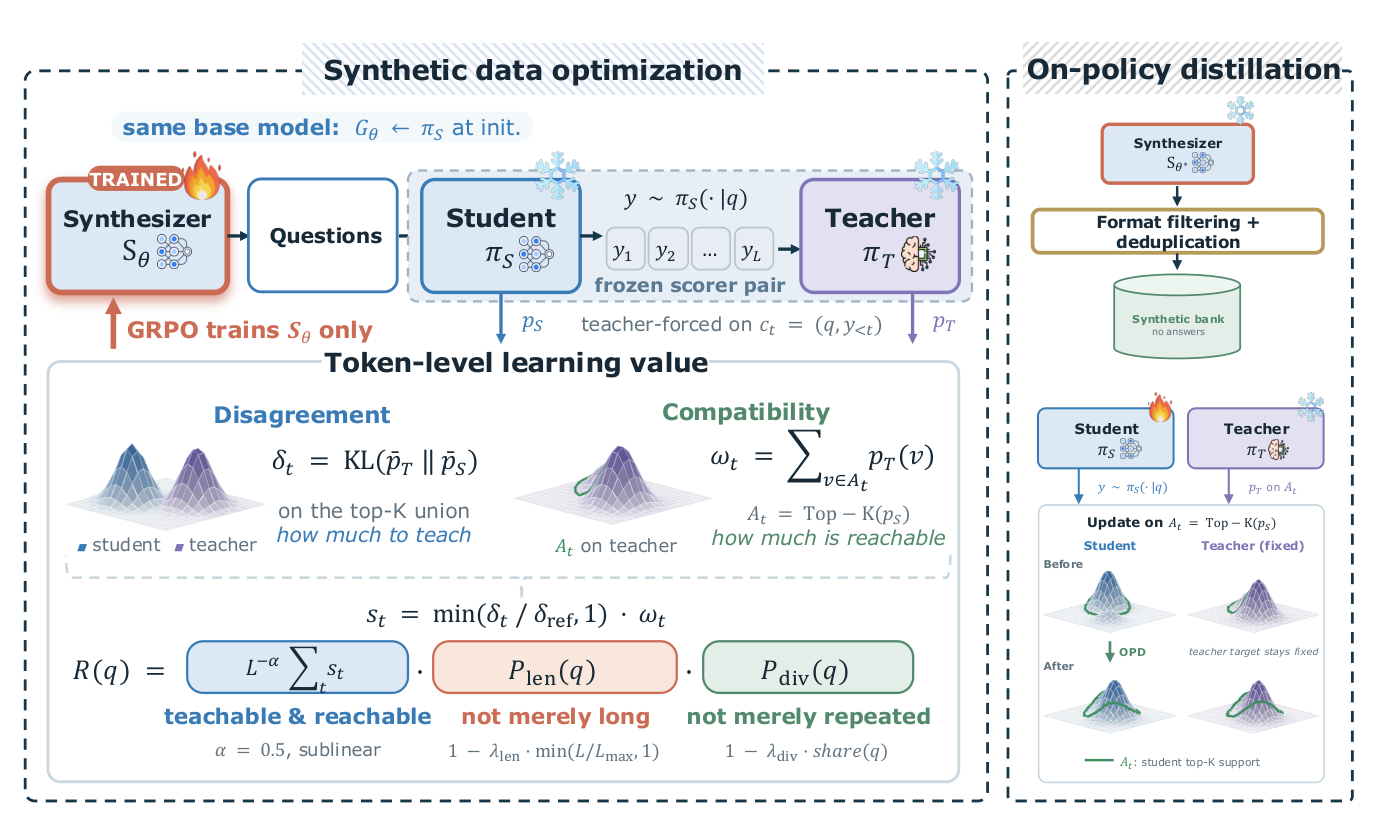
Original figure from the reviewed paper, reused without redrawing.
Core equations
Forward KL uses distributions normalized within union of student/teacher top-K; compatibility uses raw teacher mass on student top-K without renormalization. Freeze the 95th percentile of initial calibration discrepancies. Length, duplicate-cluster share and length power downweight rewards; share is BLEU-distance average-linkage clustering over the full scored batch, not a GRPO group. Downstream fixes rollout student top-K and uses \(r_v=\bar p_{S,old}^{A}(v)(\log p_T-\log p_{S,old})\) with signed PPO clipped minimum and current/old ratios. Sum candidates, average valid tokens, no group advantage renormalization.
Results reported by the authors
Authors report offline math/code/agent improvements, not production A/B. AMC23 and LiveCodeBench select checkpoints, so their results are not isolated test estimates.
Local reproduction and limits
a2d_token_signal, calibrate_a2d_scale, a2d_question_reward and a2d_candidate_opd_loss use random logits, masks and externally provided cluster shares. Checks scalar KL/mass, gradient, wrong support normalization, signed clipping, padding and detach. Caller owns shared tokenizer and same-prefix provenance. No BLEU clustering, synthesizer GRPO, language generation, filtering or complete OPD/Evolve. No CUDA fallback/output overwrite; three seeds remain L1.
PYTHONPATH=src python scripts/run_oct21_followup_post_components.py \
  --device cuda --seeds 42,43,44 --output runs/a2d-projected-components.json
Full experiment: not reproduced
64 questions/step, 60 synthesis steps, budgets 4,096/7,168 prompt/response tokens, 20,000 raw questions and four responses/question for two epochs. Up to 30B/32B teachers, 4B dedup model, documented long-response memory pressure. No model/data download, long trial or retry.
Additional references
Full paper · Paper Figure 2 · run_oct21_followup_post_components.py · oct21_followup_distillation.py