Projected Distillation: On Learning to Solve Hard Problems from Close, Correct Targets
L1 edit alignment, validation interface and loss; diagnostic only. No language editor or online training loop.
Paper information
| Field | Details |
|---|---|
| Paper | Projected Distillation: On Learning to Solve Hard Problems from Close, Correct Targets |
| Affiliations | First author Shripad V. Deshmukh: University of Massachusetts; work during AWS AI Labs internship, with AWS AI Labs collaborators. |
| First public release | 2026-10-20 01:38:01 UTC |
| Author code | No author source found in reviewed text/abstract as of 2026-10-21. Referenced TRL is not this method. |
| Local key | projected-distillation; no adapter |
| Local code | src/auto_research/post_training/oct21_followup_distillation.py |
| Local evidence | Local mechanism metrics; A100 validation receipt |
What the paper changes
All student samples on a hard task may be wrong, leaving RL without a success reward; fitting a wholly external answer can be too off-policy. Project a wrong response to a minimally changed verified correction and apply DPO only to edited spans. Successful student answers separately receive SFT; the paper resamples each round. Minimal editing approximates, rather than exactly solves, finding the most likely correct student answer.
Original paper figure
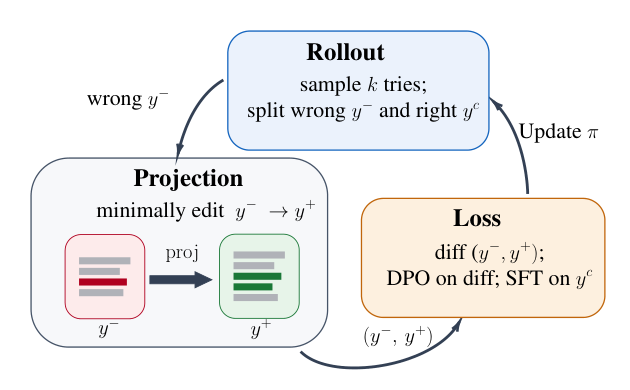
Original figure from the reviewed paper, reused without redrawing.
Core equations
Use complete respective causal prefixes for each edited token, frozen initialization as reference and summed unnormalized span scores. Insertion/deletion may leave one side empty, but at least one edit is required. SFT is on student-correct \(y^c\), not corrected \(y^+\). Unchanged direct gathered gradients are zero, not all shared-parameter or prefix effects.
Results reported by the authors
Authors compare specialization/retention for Qwen3-8B and OLMo-2-7B and report most cells better than GRPO/OPD. Evaluation sampling seeds of one checkpoint are not independent training seeds. No production A/B or local capability reproduction.
Local reproduction and limits
minimal_edit_masks uses unit-cost Levenshtein, capped at one million DP cells; verified_edit_masks rejects already-correct originals and unverified repairs. projected_distillation_loss supports optional self-correct SFT and detached reference. Independent scalar/gradient, incorrect full-sequence DPO, masks, no edit, non-finite inputs and SFT target tests. Synthetic inputs and fixture verifier are not a language projector or benchmark. No real sampling, mining, refresh, ability comparison, gold-aware evaluator or Evolve. Maximum three seeds, no CUDA fallback/output overwrite.
PYTHONPATH=src python scripts/run_oct21_followup_post_components.py \
  --device cuda --seeds 42,43,44 --output runs/a2d-projected-components.json
Full experiment: not reproduced
Appendices C.1/C.4 use eight A100 40GB, seven FSDP2 student plus one rollout device, 7B/8B students, 2,048 generation tokens and up to two paid Claude Opus corrections per wrong answer, across domains and seeds. No checkpoint, paid call, long trial or retry.
Additional references
Full paper · Paper PDF, p. 4 · run_oct21_followup_post_components.py · oct21_followup_distillation.py