AP-OPD: Pulling back supervision after abrupt penalty increases
L1 loss component; diagnostic only. No full math/code capability reproduction.
Paper information
| Field | Details |
|---|---|
| Paper | Adaptive Pullback: Reweighting Supervision at Penalty Jumps in On-Policy Distillation |
| Affiliations | First author Guangyu Liu: Nanjing University; collaborator Shanghai AI Laboratory. |
| First public release | 2026-10-20 13:34:43 UTC |
| Author code | No author source link verified in reviewed HTML/PDF; referenced code is not this method. |
| Local key | ap-opd; no adapter |
| Local code | src/auto_research/post_training/oct21_distillation.py |
| Local evidence | Local mechanism metrics; A100 validation receipt |
What the paper changes
Separate a sustained high OPD penalty from an abrupt increase. Measure adjacent blocks of positive log-ratios from the same student prefixes, then downscale the entire following block without another teacher forward or sign changes. Read raw unweighted previous and next statistics, not recursively downweighted ones.
Original paper figure
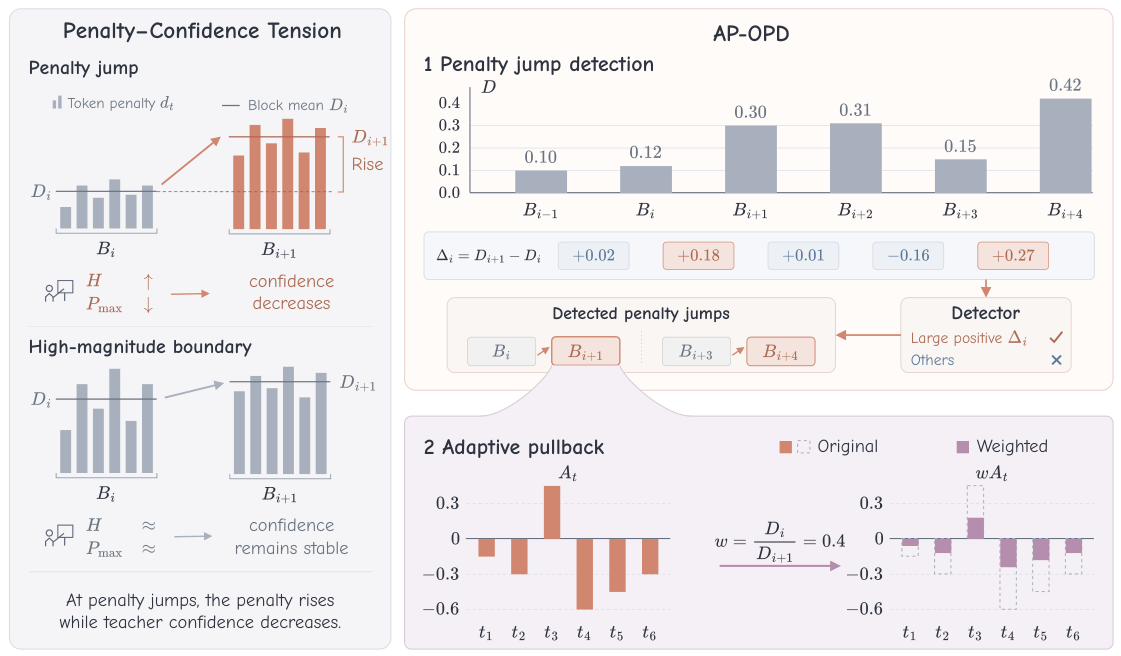
Original figure from the reviewed paper, reused without redrawing.
Core equations
Let \(r_t=\log p_S-\log p_T\) and \(d_t=[r_t]_+\). Block means include zeros; use sample variance, default block length 64 and z=2 with at least two tokens per block. The gate is not a calibrated significance test for dependent tokens. Optional top-alpha selects up to ceiling(alpha × boundaries), default 0.05, by positive raw jump. At selected boundaries use previous/new mean, elsewhere one. Apply even to negative ratios, allow zero weight for zero reference, no floor or renormalization; preserve stop-gradient coefficients and full token mean.
Results reported by the authors
Table 1 six math suites, two runs using Avg@k: vanilla 31.82%, z-gate 32.39%, top-alpha 32.62%. No production A/B or local capability values.
Local reproduction and limits
adaptive_pullback_weights and adaptive_pullback_loss; random width-eight causal GRU, vocabulary 12, real student sampling and frozen same-prefix teacher, three SGD steps per seed. Response length ten and diagnostic block two; general default 64. Scalar/gradient reference plus no-pullback and recursive-reference controls; tests negative coefficient, zero reference, partial block, padding, invalid inputs and frozen teacher. CUDA does not fall back and outputs cannot be overwritten. CPU/receipt evidence is L1, not teacher quality or Evolve.
PYTHONPATH=src python scripts/run_oct21_post_components.py \
  --methods ap-opd --device cuda --seeds 42,43,44 \
  --output runs/ap-opd-component.json
Full experiment: not reproduced
1.7B student/8B math teacher, 17,398 training problems, batch 128, 200 updates, up to 8,192 tokens. Teacher GSPO 200 steps, 512 problems ×16 rolls, plus code and 7,388 math evaluation responses/model. No downloads, long trial or retry.
Additional references
Full paper · Paper PDF, p. 2 · run_oct21_post_components.py · oct21_distillation.py