CSD: Distillation across tokenizers using shared text events
L1 alignment and loss component; diagnostic only. No full LLM capability or Evolve reproduction.
Paper information
| Field | Details |
|---|---|
| Paper | CSD: Common-Support Distillation for Cross-Tokenizer Knowledge Transfer |
| Affiliations | First author Mingyu Yang: NVIDIA |
| First public release | 2026-10-20 20:18:46 UTC |
| Author code | NVIDIA-NeMo/RL PR #4680, Apache-2.0, pinned head. Loss/subtoken utilities visible in the open PR, not a merged release or completed upstream GPU qualification. |
| Local key | csd; no adapter |
| Local code | src/auto_research/post_training/csd.py |
| Local evidence | Local mechanism metrics; A100 validation receipt |
What the paper changes
Align chunks by minimal common character boundaries and decoded text, not token IDs. For 1:1 use shared token events; for 1:N or M:1 hold observed prefixes fixed and enumerate equivalent final completions; M:N defaults to the observed sequence only. The REST event preserves unmatched mass.
Original paper figure
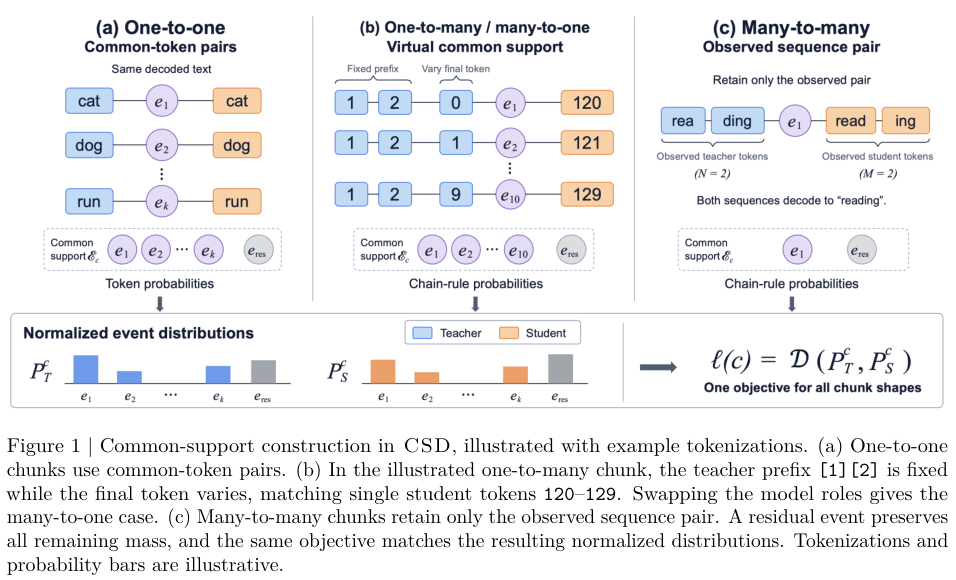
Original figure from the reviewed paper, reused without redrawing.
Core equations
Chain probabilities use full vocabulary and no length normalization or re-softmax, even with teacher top-k. Teacher detached; students differentiate through all chain factors, final token and REST. Default JSD and non-1:1 weight five; divide by unweighted accepted-chunk count. Detach the entire CE/KD scale, reverting to CE for zero KD or no shared events.
Results reported by the authors
The paper compares Qwen/Phi teachers and Llama/Gemma students with different tokenizers, reporting aggregate and per-task scores and top-k efficiency trade-offs. No universal gains or production A/B; MMLU/GSM8K were not run locally.
Local reproduction and limits
align_offsets checks boundaries and full decode; source-verified whitespace gaps may be accepted, gaps without source are skipped, invalid/non-whitespace mismatches rejected. paired_completions maps decoded alternatives; event_distribution and common_support_loss implement the shared event rules. Synthetic Embedding+Linear models use four chunk shapes, frozen teacher and three SGD updates. CPU seeds report ~1.8e-15 loss and 1.1e-13 gradient differences from dense reference; dropping chain or REST differs. Caller owns causal alignment, same textual history and zero-width specials. No semantic-role matching, huge offline tables, distributed TP/CP, teacher transport or full training.
PYTHONPATH=src python -c 'from auto_research.post_training.csd import diagnostic; print(diagnostic(42, device="cpu"))'
python -m pytest -q tests/test_csd.py
Full experiment: not reproduced
Appendix E.3 uses 32 nodes/256 H100s for timings; 1B student 30,000 steps, global batch 768, context 4,096, plus 8B students and up to 14B teachers. No weights, full trial or retry.