CORD: Protecting one gradient when combining RL and distillation
L1 gradient-combination component; diagnostic only. No full agent trainer, capability or Evolve integration.
Paper information
| Field | Details |
|---|---|
| Paper | CORD: Conflict-Aware Optimization for Joint RL and Distillation in Agents |
| Affiliations | First author Wenhao Yu: The Chinese University of Hong Kong; collaborators Tencent and Peking University. |
| First public release | 2026-10-21 16:19:22 UTC |
| Author code | CORD-release, Apache-2.0 at ba09683. |
| Local key | cord; no adapter |
| Local code | src/auto_research/post_training/cord.py |
| Local evidence | Local mechanism metrics; A100 validation receipt |
What the paper changes
The two objectives can cancel. Scale the second by lambda, choose which direction to protect and minimally project only the other. Conflict-only projects negative inner products, whereas always removes parallel components even for aligned gradients. These gates and the two protected-objective choices are distinct configurations.
Original paper figure
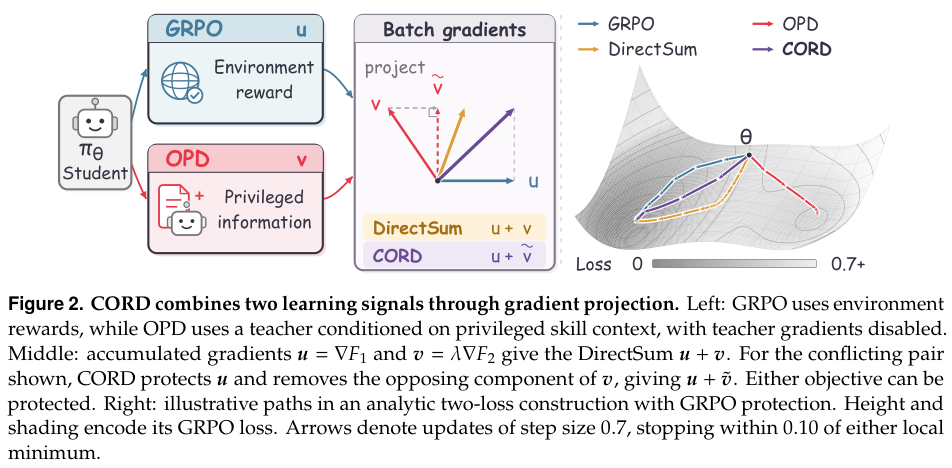
Original figure from the reviewed paper, reused without redrawing.
Core equations
For nonzero protected direction the conflict projection is the nearest vector with nonnegative alignment. A zero protected vector is not projected; lambda zero returns the first gradient directly. The identity is pre-optimizer, first-order and for fixed sampled loss, not an AdamW or finite-step descent guarantee. Aggregate each objective across the optimizer minibatch using fixed weights before one projection, not per microbatch.
Results reported by the authors
Table 1 reports improvement on ALFWorld for all three hosts, not all WebShop settings. The main comparison uses one training seed with four evaluation draws, not four trainings. No production A/B or local environment success rate.
Local reproduction and limits
combine_gradients, accumulate_gradients and objective_gradients operate on real vectors/scalar gradients on one device, not FSDP cross-shard reduction. A tiny two-CE MLP takes three SGD steps. CPU seeds 42/43/44 verify autograd and scalar references with about \(2.3\times10^{-16}\) maximum error; projecting before aggregation produces 0.5 difference. Aligned-gradient control distinguishes gates. The pinned source's first-objective protection/conflict gate/sharded stats do not implement every paper branch; swapped protection and always follow Algorithm 1. No real rollouts, skill bank or benchmark.
PYTHONPATH=src python -c 'from auto_research.post_training.cord import diagnostic; print(diagnostic(42, device="cpu"))'
python -m pytest -q tests/test_cord.py
Full experiment: not reproduced
Eight A100 40GB, Qwen2.5-3B-Instruct, 150 rounds, eight rollouts/question, up to 50 ALFWorld or 15 WebShop actions, plus 7B and other baselines. Full matrix not reproduced; no expensive trial or retry.