Minimal-Edit OPD: Correct unsupported tokens while retaining task rewards for successful rollouts
L1 routing and correction loss; diagnostic only. Full multimodal training not reproduced due to cost.
Paper information
| Field | Details |
|---|---|
| Paper | Edit, Don't Imitate: Minimal-Edit On-Policy Distillation for Multimodal Reasoning |
| Affiliations | First author Wen Ye: Meta Superintelligence Labs (first affiliation) and USC; other affiliations include UC Berkeley, Cornell and UCLA. |
| First public release | 2026-10-21 17:59:28 UTC (announced 2026-10-23) |
| Author code | No verifiable author source in v1 or exact-ID GitHub search as of 2026-10-25. This is not proof no release exists elsewhere. Independent implementation; paper and figure CC BY 4.0. |
| Local key | minimal-edit-opd; no adapter |
| Local code | src/auto_research/post_training/minimal_edit_opd.py |
| Local evidence | Local mechanism metrics; Raw CPU run; A100 validation receipt |
What the paper changes
For visual reasoning, keep useful parts of a student's answer and correct only tokens the privileged teacher supports less than the frozen behavior policy. The teacher sees a training-only diagram description, verified solution and the entire original response, then teacher-forces that response a second time instead of generating a new answer. Correct responses receive task GRPO only; none of the teacher, references or verifier enters deployment.
Original paper figure
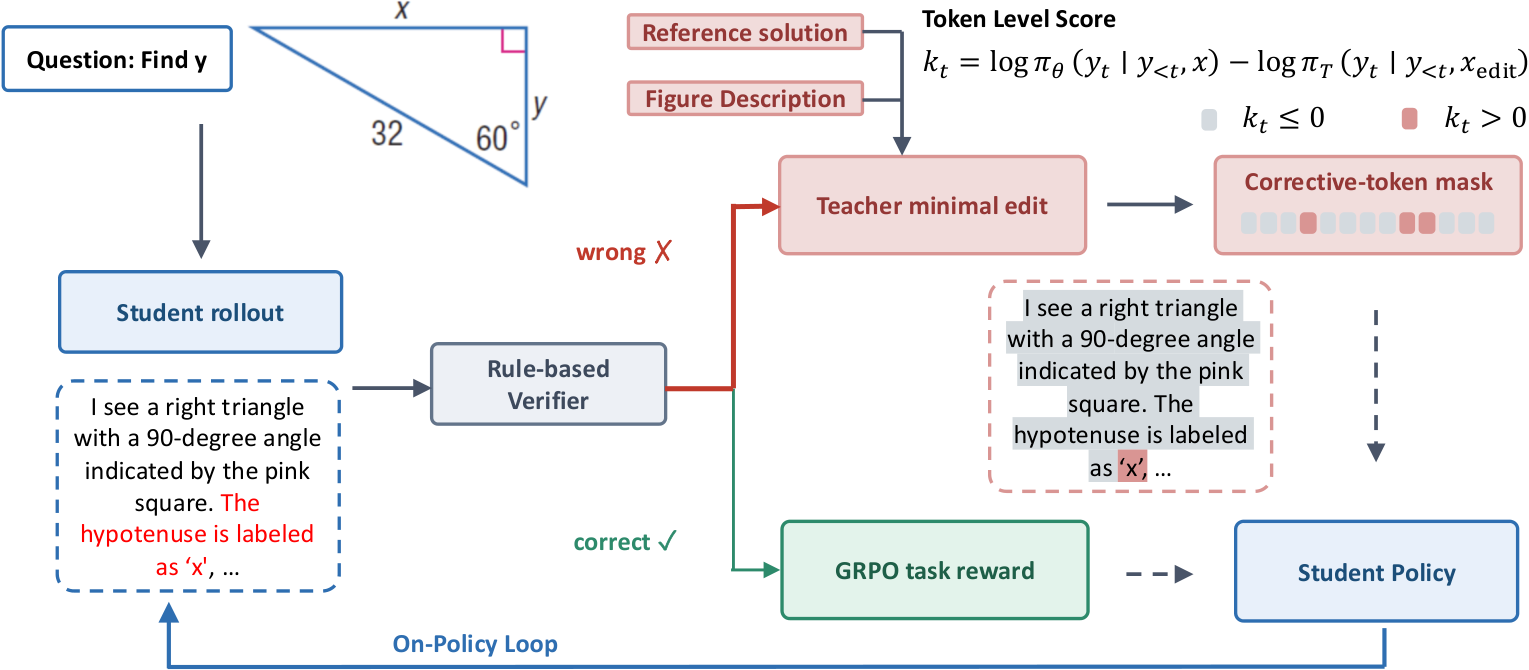
Original figure from the reviewed paper, reused without redrawing. See figure provenance.
Core equations
Compute task advantages over all \(K\) rewards before routing, not over correct-only rewards. Select strict positive old-minus-teacher log-probability on wrong rows and freeze the mask across updates. The linear sampled-token log ratio uses one minibatch-wide selected-token denominator; it is not full-vocabulary KL, REINFORCE or teacher-answer CE. Empty branches contribute differentiable zero. The exact interface accepts caller-computed full-group advantages and correct-only task loss. Paper specifies asymmetric sign branches with clip .2 but not std correction, epsilon, token/sequence reduction or exact verl setup; population SD, \(10^{-6}\) and response means in diagnostics are local choices. Teacher, old policy, rewards and advantages are detached.
Results reported by the authors
Table 1 Geometry3K pass@1/pass@8, MathVerse ALL and Geoperception pass@1: Base .321/.540/37.8/.179; plain GRPO .447/.625/42.1/.279; privileged OPD (8B teacher) .487/.707/40.0/.320; minimal-edit (8B) .554/.794/45.8/.455; minimal-edit (2B self-teacher) .498/.756/46.9/.438. Geometry uses 32 rolls per item; MathVerse uses greedy judging. In Table 2 with 8B student, Geometry3K .699 is below privileged OPD .708. No production A/B or local capability result.
Local reproduction and limits
freeze_rollouts validates/copies supplied verifier labels, advantages and scores; minimal_edit_loss routes aligned sampled logits plus external task loss that must exclude wrong rows. full_group_advantages and correct_rollout_grpo are explicit local helpers. Padded and unused correct-row teacher values cannot contaminate gradients; half promotes to FP32. Independent probability/gradient checks and real synthetic SGD cover sign, old/current separation, routing, reduction, clipping, detach, zeros and invalid/overflow inputs. CPU/A100 three-seed evidence is mechanism-only. No prompt/tokenization pipeline, teacher, verifier, gold reading or Evolve.
OMP_NUM_THREADS=1 MKL_NUM_THREADS=1 PYTHONPATH=src python -m pytest tests/post_training/test_minimal_edit_opd.py -q
PYTHONPATH=src python -c 'from auto_research.post_training.minimal_edit_opd import diagnostic; print(diagnostic(42, device="cpu"))'
Full experiment: not reproduced
The matrix covers Qwen3-VL-2B→8B, 8B→32B, Qwen2.5-VL-7B→32B and self-teachers. Up to 32 reference attempts filter ~2.1K prompts to 1.8K. K=8, max 2,048 tokens, 96-problem minibatch, up to 30 epochs, LR \(10^{-6}\) and correction .01. 1,572,864 tokens is a batch cap, not measurement. Teacher processes \(P_t+2R\); estimated FLOP ratios to naive OPD are .929 for 8B/32B and 1.133 for 2B/8B, not always cheaper. No full matrix, weights, expensive probe or retry.