UserArena / OPTD: Distilling with abstract trajectory intent
L1 loss component; diagnostic only. Not a user simulator, environment or benchmark integration.
Paper information
| Field | Details |
|---|---|
| Paper | UserArena: Benchmarking Interactive User Simulation for Long-Horizon Shopping Agents |
| Affiliations | First author Jujia Zhao: Leiden University; Renmin University of China, Alibaba Group and ICT Chinese Academy of Sciences collaborate. |
| First public release | 2026-10-22 08:54:16 UTC (announced 2026-10-23) |
| Author code | RecGPT-Team/UserArena, environment/evaluation/OPTD at d37e3c062d30950f2a3744c66a18fda9aa72c1f7; non-commercial research/data agreement, no unauthorized redistribution. Independent formula implementation; no source, user records or images copied. |
| Local key | userarena-optd; no adapter |
| Local code | src/auto_research/post_training/userarena_optd.py |
| Local evidence | Local mechanism metrics; Overlap batch audit; A100 validation receipt |
What the paper changes
The 13-action shopping environment measures five fidelity levels in Replay and Rollout: executability, local behavior, trajectory dynamics, individual/group variation and outcomes. OPTD abstracts preferences, concerns and comparison criteria from training trajectories and gives them only to a frozen teacher. Score actual student prefixes with and without intent, constrain the extra information in a token-wise trust region, and add teacher-forced grounding on real responses. Exclude specific actions, item IDs, prices, outcomes, future pages and evidence indices from intent. KL alone cannot prove absence of leakage.
Original paper figure
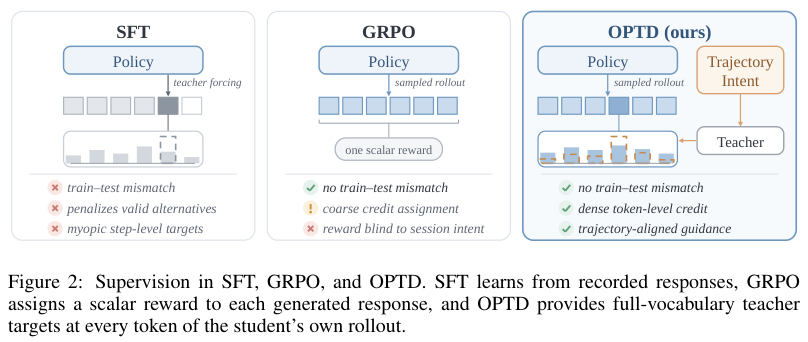
Original figure from the reviewed paper, reused without redrawing. See figure provenance.
Core equations
Use forward budget \(D_{KL}(q^\lambda\|q^0)\) per token, default 0.02 and maximum coefficient one. Eight bisections return a feasible lower endpoint within 1/256 and preserve the full endpoint when feasible. Follow PDF pp.5–6 where HTML drops superscripts. JSD uses \(\beta=0.5\) and grounding \(\gamma=0.1\); average tokens per state, then states equally. Grounding needs separate true-prefix logits, not gold tokens inserted into student-prefix logits. Coefficients and both teacher branches are detached.
Results reported by the authors
For the same Qwen3.5-2B base, Table 2 reports single-session local-action accuracy 0.3204, DM-JSD 0.0156, length error 1.72 and PF 0.8692; cross-session accuracy 0.2969. STA is better on cross-session macro-F1 and CTR error. Appendix C.1 tests consistency for the same two recommendation policies in simulation and a real A/B, not an online deployment gain from OPTD. Simulated effect is 0.713× real (28.7% underestimation), with 10,000 simulated users, 5,000 per arm. Count CTR and production PV-CTR are different.
Local reproduction and limits
trust_region_teacher and optd_loss implement full-vocabulary geometric mixing, token bisection, generalized JSD and separate grounding, with detached teacher/targets, validated budgets/lengths and sanitized padded NaN. Half inputs promote to FP32. Independent probability and gradient checks cover next-grid infeasibility, zero/full endpoints, padding, freezing and genuine updates to both student branches. The interface cannot attest rollout or intent provenance. No extraction, rationale, warmup, online sampling, page environment, ROLL/verl or Evolve. Three frozen seeds verify only L1.
OMP_NUM_THREADS=1 MKL_NUM_THREADS=1 PYTHONPATH=src python -m pytest tests/post_training/test_userarena_optd.py -q
PYTHONPATH=src python -c 'from auto_research.post_training.userarena_optd import diagnostic; print(diagnostic(42))'
Full experiment: not reproduced
The paper uses 11,010 users, 64,729 sessions and 577,670 actions, a Qwen3.5-397B rationale/intent generator, 2B VLM student/frozen teacher, 32k context and distributed SFT/OPTD. No transferable GPU-hour total. No model/data/image download, paid API trial or retry.