MART-GRPO: Keep the failed trajectory prefix through the unrecovered error
L1 event-boundary and clipped-loss component; diagnostic only. Full robot and VLM training not reproduced due to cost.
Paper information
| Field | Details |
|---|---|
| Paper | When to Stop Penalizing Actions? Martingale GRPO for VLA Reinforcement Learning; reviewed full text |
| Affiliations | First author Zongyao Zhao: The University of Hong Kong; collaborators include Tsinghua University. |
| First public release | 2026-10-23 09:56:27 UTC (announced 2026-10-26) |
| Author code | No method repository in the reviewed v1 as of 2026-10-26. Referenced SimpleVLA-RL is not author source. No source license/revision verified; the paper's arXiv license is not a software license. |
| Local key | mart-grpo; no adapter |
| Local code | src/auto_research/post_training/mart_grpo.py |
| Local evidence | Local mechanism metrics; A100 validation receipt |
What the paper changes
Terminal failure does not make every action harmful. After complete rollout, a frozen VLM inspects synchronized three-camera video, robot state and task/frame-to-action alignment to identify the final visible unrecovered error interval. Drop loss only after its upper endpoint, leaving the successful trajectories, original group advantages and original valid-token denominator unchanged. This is not early environment termination, reward editing or regrouping.
Original paper figure
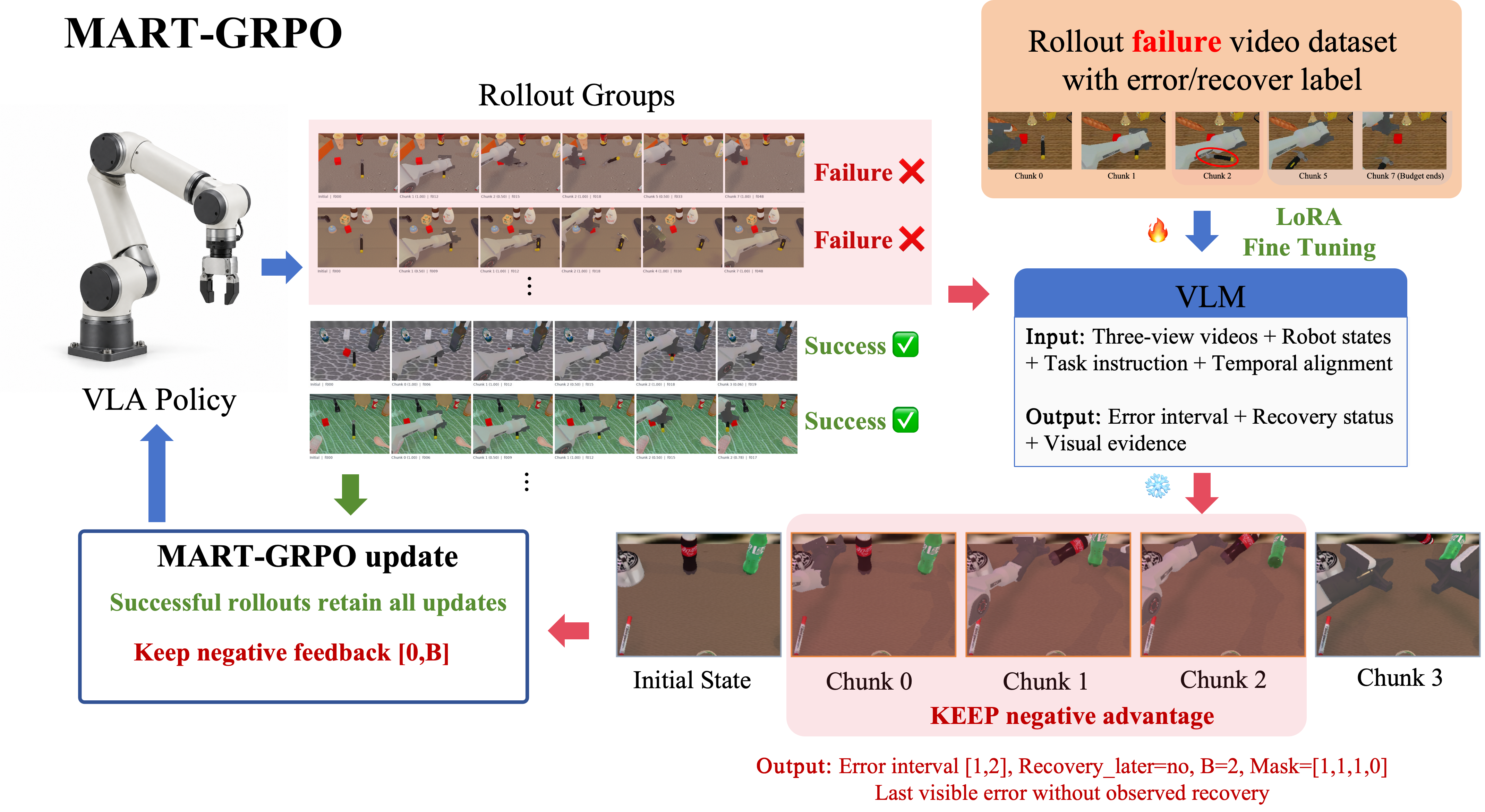
Original figure from the reviewed paper, reused without redrawing. See figure provenance.
Core equations
The external group advantage uses sample SD plus \(10^{-6}\). A well-formed failure, explicit error, in-bounds interval and no recovery permit \(B=u\); success/uncertain, absent localization or observed/uncertain recovery retain full feedback. Malformed schema, identity mismatch, invalid interval and inference failure are errors, not semantic fallbacks. Chunk indices are zero-based; [1,2] yields mask (1,1,1,0) over chunks 0–3. Eq.15 keeps the original valid-token denominator and asymmetric clip 0.8/1.28. Old policy, event and advantages are detached; half arithmetic promotes to FP32 and padding is sanitized. A retrospective VLM sees future frames and is not automatically an ideal stopping time. The paper analyzes conditional projection residuals; no arbitrary-mask unbiasedness or variance guarantee.
Results reported by the authors
The paper reports improved OpenVLA-OFT success over full GRPO across seven RoboTwin 2.0 bimanual tasks. Appendix E.3 reports 72.1% task-macro interval IoU on 220 localizable, unrecovered test failures using a validation-selected event checkpoint. IoU is not actor success. The authors state that test diagnostics influenced training duration, which limits isolation. No production A/B or local task score.
Local reproduction and limits
boundary_from_event, feedback_mask and mart_grpo_loss only consume external training rollout events. They cannot verify the event model's video provenance; never derive boundaries from gold plans or expose them to the evaluated actor. Frozen-source CPU and A100 seeds 42/43/44 check the independent probability-space objective and gradients, original denominator, zero failed-suffix gradient, successful terms, strict event/schema checks, endpoints, empty-prefix boundary, clip, padded NaN and detachment. No robot, VLM or actor load, theoretical proof or Evolve integration.
PYTHONPATH=src python -c 'from auto_research.post_training.mart_grpo import diagnostic; print(diagnostic(42))'
OMP_NUM_THREADS=1 MKL_NUM_THREADS=1 PYTHONPATH=src python -m pytest tests/post_training/test_oct26_post_agent_components.py -q
Full experiment: not reproduced
Appendix D Table 3 lists eight H100s, 512 trajectories/update, 40 updates, seven tasks and 128 seen/held-out episodes each every five updates. Each chunk is 25 control steps × 14 dimensions. The frozen Qwen3.8-27B event model requires LoRA on 1,024 failed videos plus successes and three-camera inference. No weights, expensive trial or retries on one A100/A30 or Mac.