RLiD: assign gradients directly to executable decisions
L1 decision probability / PPO / variance-identity components, diagnostic only. Full multi-environment training, distillation, and capability evaluation are not reproduced because of excessive cost (review DONE).
evolve_integrated=false; a small-array identity is not agent success evidence.
Paper information
| Field | Value |
|---|---|
| Paper | RLiD: Reinforcement Learning in the Decision Plane for Language Agents and LLMs; full text |
| Company / institution | First author Ziyi Chen, University of Illinois Urbana-Champaign; collaborators also list NUS, Zhejiang University, University of Pennsylvania, and University of Rochester |
| Original publication | arXiv v1: 2026-11-02 03:17:51 UTC; announced 2026-11-03 |
| Original author code | No verified public repository found as of 2026-11-04. The official abs/HTML has no author repository URL. ldmrl/ and llmdistill/raw/ are artifact paths, not verified open-source links; exact-title/ID search did not establish one |
| Upstream license / revision | Not applicable without a verified repository; independently implemented here. Paper and original figure: CC BY 4.0 |
| Local adapter / key | rlid; numerical component, not an ALFWorld agent; automatic promotion disabled |
| Local code | src/auto_research/post_training/rlid.py |
| Entry points | menu_log_probabilities, decision_ppo_loss, marginal_label_penalty, credit_variance_audit, diagnostic(seed=42, device='cpu') |
| Validation | Three-seed component metrics and CUDA receipt are integrated with this batch. Unexecuted results must not be recorded as passed |
Original method
Motivation and change
RLiD compiles observations, feedback-derived memory, and executable menus, then chooses labels in one forward pass. Decision-level RL avoids assigning action credit to every wording/format token. Menus, afterstates, and memory change the task interface and must be matched in comparisons. Neither temporal-credit noise nor the benefit of reasoning computation disappears automatically.
Original paper figure
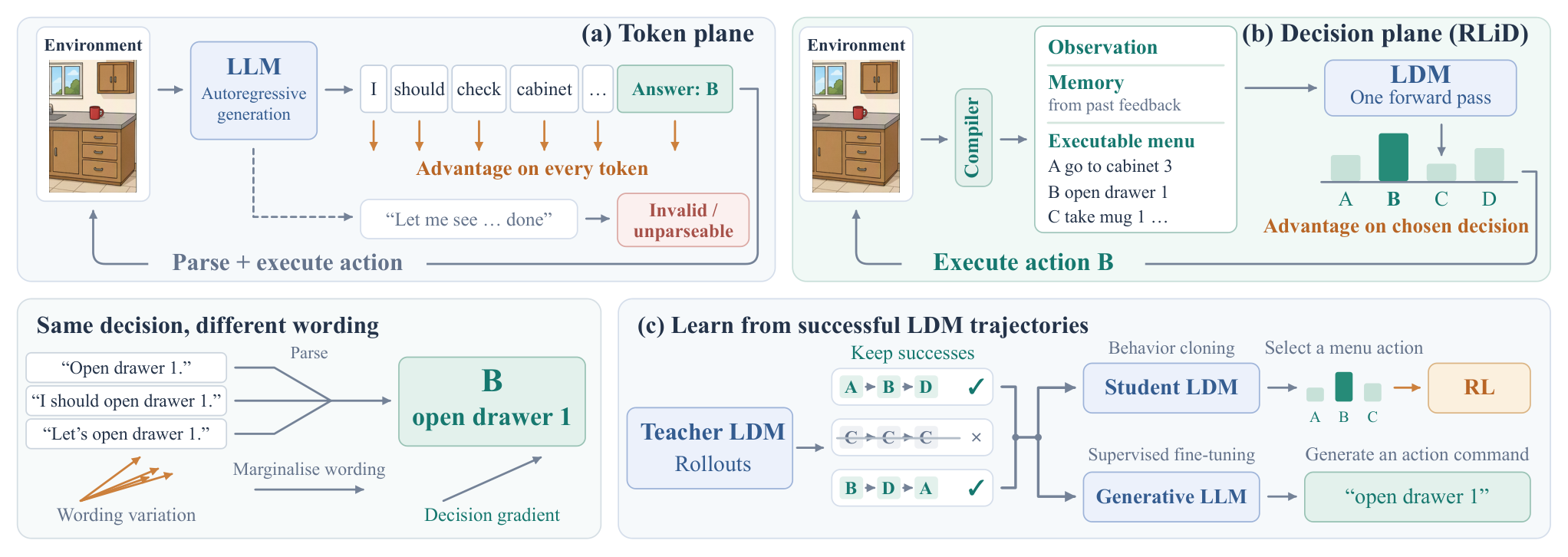
Unmodified PNG from Figure 1, visually checked for generation/parsing, single-pass menus, wording marginalization, and both distillation branches. The environment, LDM, memory compiler, and distillation system are not implemented locally. Attribution, CC BY 4.0, and SHA-256 are in assets/provenance.json.
flowchart TD
    O[Observation and past feedback] --> C[Compiler supplies executable menu]
    C --> H[Real backbone final hidden state]
    H --> P[Label logits minus frozen calibration]
    P --> A[Categorical menu decision]
    A --> E[Execute and collect returns]
    E --> V[External GRPO or GiGPO advantages]
    V --> L[Decision-level clipped PPO]
P --> LEquations
Label calibration or microbatch marginal \(\mathrm{KL}(u\Vert\bar\pi_k)\) addresses label bias; the latter is not per-decision entropy. Menu shuffling, episode balancing, GiGPO anchors, and sampled evaluation are separate requirements.
Proposition 1 applies within one text policy, with \(a=g(y)\):
Advantages must be conditionally independent of wording given the action. This is not a performance theorem comparing differently parameterized models; temporal advantage estimation remains noisy.
Reported outcomes, not local results
The full ALFWorld route reports 99.3% / 12.7 H100 GPU-hours, versus 86.6% / 17.3 GPU-hours for same-LLM token RL. It is not universally better: Qwen3.5-2B ARC yields 84.0% versus token GRPO's 85.8%; Countdown-after does not significantly beat the rationale+decision hybrid. The paper discloses periodic test-curve logging during development and possible adaptive peeking. Local work does not adopt that practice or report task scores. No production online A/B is reported.
Local implementation
Inputs and code mapping
menu_log_probabilities accepts aligned single-label logits, an executable-menu mask, and external frozen calibration. The caller remains responsible for real single-token tokenizer labels, admissible-action provenance, and observation-only memory. No such sources, gold plans, or answers are obtained by this component.
decision_ppo_loss consumes and freezes external old-policy sampled-action log-probabilities and advantages. It implements two-sided clipping with an explicit local decision-mean reduction. Optional frozen \(\bar T/T^{(i)}\) weights support episode balancing without another division by their sum. It does not compute GRPO/GiGPO, returns, or training order. marginal_label_penalty groups identical menu supports, computes mean label probabilities, then uniform-to-marginal KL. Support groups are equally weighted by local convention; no author coefficient or update schedule is claimed.
credit_variance_audit enumerates a finite categorical text policy and its text-to-action partition, computing scores in full softmax-logit coordinates, expected updates, and covariance traces. It audits an identity, not an SAE, real LM, or environment capability.
PYTHONPATH=src python -m pytest tests/post_training/test_nov04_specopd_rlid.py -q
PYTHONPATH=src python -c 'from auto_research.post_training.rlid import diagnostic; print(diagnostic(42, device="cpu"))'
Checks, negative controls, and limits
Seeded random logits undergo actual backward propagation and a small update. Checks cover zero mass/gradient outside menus, unit row mass, frozen old-policy/advantage/calibration, both clipping signs, episode weighting, and the variance identity. Two decisions favoring opposite labels can have a uniform batch marginal and zero penalty despite low individual entropy: this negative control catches an incorrect per-row entropy implementation. Logsumexp stabilizes extreme finite logits.
There is no LM backbone, environment compiler, menu shuffling, memory, online calibration update, GiGPO, LoRA, successful-trajectory collection, or distillation. Diagnostics do not output answer accuracy/plan success, compare actual policies, or support evolve promotion. CPU/CUDA three-seed results remain L1 numerical evidence.
Full-experiment cost decision
The study uses rank-16 LoRA on Qwen2.5 0.5B/1.5B/3B/7B and Qwen3.5 2B/4B/9B, multiple environments/seeds, and ALFWorld groups of eight episodes with up to 50 steps each. The measured full route already costs 12.7 H100 GPU-hours, not a promised A100 runtime. The matrix is not reproduced because of excessive cost (review DONE) on one A100/A30 or the Mac: no weight/data downloads, full training, or automatic retry. The paper and exact local formulas remain useful without claiming unvalidated capability.