P²-MOPD: expert parameters as learnable optimization directions
L1 parameter-update component, diagnostic only. Full multi-teacher LLM distillation is not reproduced because of excessive cost (review DONE). No language model, domain teacher or rollout engine is supplied. Descent on a synthetic objective is not capability recovery;
evolve_integrated=false.
Paper information
| Field | Value |
|---|---|
| Paper | P²-MOPD: Accelerating Multi-Teacher On-Policy Distillation via Parameter Priors; full text |
| Company / institution | First author Sinuo Wang: Australian Institute for Machine Learning, Adelaide University / StepFun, following the original per-author mapping |
| Original publication | arXiv v1: 2026-11-02 20:53:15 UTC; announced 2026-11-04, not first published that day |
| Original author code | No verified implementation repository found as of 2026-11-04. The paper does not link its own implementation; referenced IM-MOPD/Open-MOPD repositories do not establish this method's release |
| Upstream license / revision | Not applicable without a verified repository; independently implemented from equations. The paper uses the arXiv non-exclusive license; figure copyright stays with the authors, not CC BY |
| Local adapter / key | p2-mopd; standalone update component, not a complete LLM adapter |
| Local code | src/auto_research/post_training/p2_mopd.py; PriorModule, ParameterPriorOptimizer, diagnostic(seed=42, device='cpu') |
| Validation boundary | CPU tests/diagnostics do not substitute for real CUDA validation. Actual GPU evidence is integrated by the batch runner; unexecuted checks are not pre-marked passed |
Original method
Motivation and change
Multi-teacher OPD supervises student-generated trajectories with domain experts, yet a merged student can fail to move toward one expert. P²-MOPD does more than change initialization: each projection is a free student tensor plus learnable coefficients over frozen expert task vectors. Free weights can leave their span; coefficient gradients explicitly move along expert directions. Inference capacity does not increase, and coefficients fold into ordinary exported weights.
Original paper figure
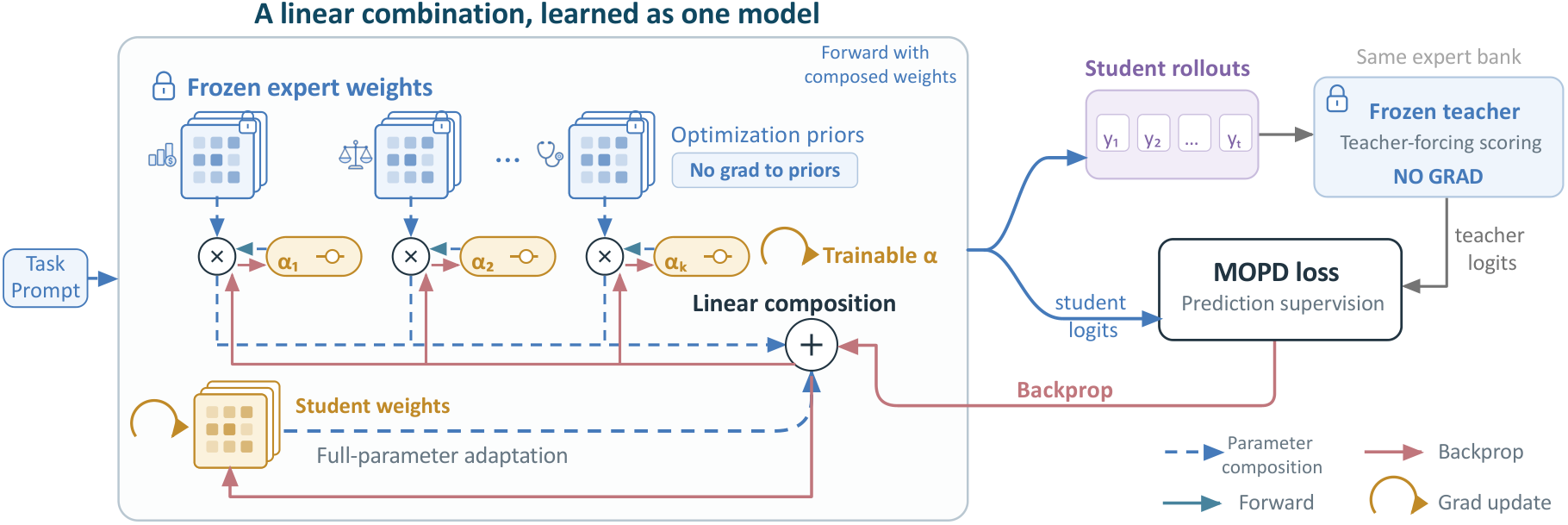
Unmodified original PNG from Figure 2 in the original paper. Copyright remains with the authors; source, license boundary and visual review are in assets/provenance.json. The depicted teacher and rollout systems are not local implementations.
flowchart TD
    T[Frozen expert task vectors] --> W[Materialized student weights W]
    W --> G[Caller computes one objective gradient G]
    G --> A[Unclipped gradient inner products]
    G --> B[Independent global student-gradient clipping]
    A --> C[Independent coefficient clipping and Adam]
    B --> D[Zero-decay AdamW]
    C --> E[Fold coefficient increments into W]
D --> EEquations
For module \(m\), frozen task vectors are \(\tau_{k,m}=W^{(k)}_m-W^{(0)}_m\):
Algorithm 1 / Appendix B stores materialized \(W\), not \(B\):
Both channels use the same pre-update gradient. Compute coefficient inner products before weight clipping, with independent global norm budgets. The student channel includes non-projection parameters \(\phi\). Weight decay must be zero for equivalence to optimizing \(B\). A non-finite gradient/norm in either channel skips both optimizers.
The complete paper's MOPD objective separately uses student-top-16 support, a 0.99 nucleus threshold, frozen rewards, asymmetric PPO and dual clipping. Local code does not rename an arbitrary KL as that complete objective; it implements only the parameter-prior update operator.
Reported outcomes, not local results
Across three training seeds, the 1.7B model reports 94.7% average recovery versus 80.9% for MOPD. Recovery normalizes each domain's base-to-teacher score span; it is not accuracy. Four checkpoints are not four independent seeds. No production online A/B is reported. These scores are not reproduced locally.
Local implementation
Data protocol and code mapping
PriorModule composes caller-supplied base weights, task vectors and coefficients, storing detached cloned directions. ParameterPriorOptimizer implements module-granularity coefficients, two channels from one gradient, independent global clipping, zero-decay AdamW/Adam, all-or-nothing non-finite checks and coefficient folding. It does not implement layer/model coefficient tying, FSDP shards, teacher routing, text sampling or deployment export.
diagnostic executes five actual backward/Adam steps on small random matrices and compares every step with independently maintained \(B,\alpha\). It also checks motion outside the task-vector span and absence of partial updates on non-finite batches. Inputs are seeded synthetic tensors, not capability data, gold labels, model calls or evaluation splits. Multiple seeds remain L1 evidence.
PYTHONPATH=src python -m pytest tests/post_training/test_nov04b_post_training.py -q
PYTHONPATH=src python -c 'from auto_research.post_training.p2_mopd import diagnostic; print(diagnostic(42, device="cpu"))'
Checks, negative controls and limits
Tests cover multi-step explicit/materialized optimizer-state equivalence, unclipped coefficient gradients, independent clip budgets, non-projection participation in global clipping, frozen copied directions and unchanged parameters/state on non-finite steps. Synthetic descent establishes a differentiable, correctly updated operator, not MedQA recovery or OPD improvement. Actual GPU results/receipts are integrated by the batch validation; no numbers are invented here.
High-cost full experiments
Table 7 reports 8-GPU wall times of 4.90 hours for the 1.7B module configuration and 6.51 hours for 4B. The matrix includes four teachers, 65,075 prompts, 100 steps, multiple configurations/three seeds, and additional training for some 1.7B teachers; prompt/response caps reach 15,872/16,384. With one A100/A30 or a Mac, the complete matrix is excessive: not reproduced because of excessive cost (review DONE). These are paper-reported costs, not local timing. No weights are downloaded, costly probe launched or automatic retry scheduled.