DARS: within-group outcome-density reward scaling
Paper information
| Field | Details |
|---|---|
| Paper | arXiv 2611.04792; fixed v1 |
| Original title | Density-Aware Reward Scaling: A Reinforcement Learning Framework for Reward-Proportional Sampling |
| Institution | First author Ria Shekhawat: National University of Singapore; equal contribution with Abhijeet Sinha |
| First publication | 2026-11-03 12:29:58 UTC, not the November 4 announcement date |
| Author code | No verifiable DARS-author source found in fixed v1 or abstract; not found/not released. A GRPO framework is not this paper's release |
| Local key / adapter | dars-density; adapter: null; no executable Evolve mapping; distinct from dars, the key for Dependency-Aware Reward Shaping |
| Local code | src/auto_research/post_training/dars.py |
| Status | component_only, L1 Gaussian KDE/reward-scaling/group-standardization component, not full image-generation training |
| Full experiment | Too costly, not reproduced (review DONE); not_reproduced_high_cost |
Original paper summary
Background and main changes
DARS counters repeated reinforcement of densely sampled outcomes by dividing task reward by within-prompt outcome density, then applying ordinary group advantage normalization. It neither learns a density network nor replaces the policy objective. Conditioning groups, outcome representations and task rewards remain distinct. See Sections 3 and 5.3.
flowchart LR
 Y[Same-prompt outcome representations] --> K[Gaussian KDE including self]
 K --> R[Task reward divided by group density]
 R --> A[Within-group mean/std normalization]
 A --> G[Unchanged GRPO objective]
Key original-paper figure
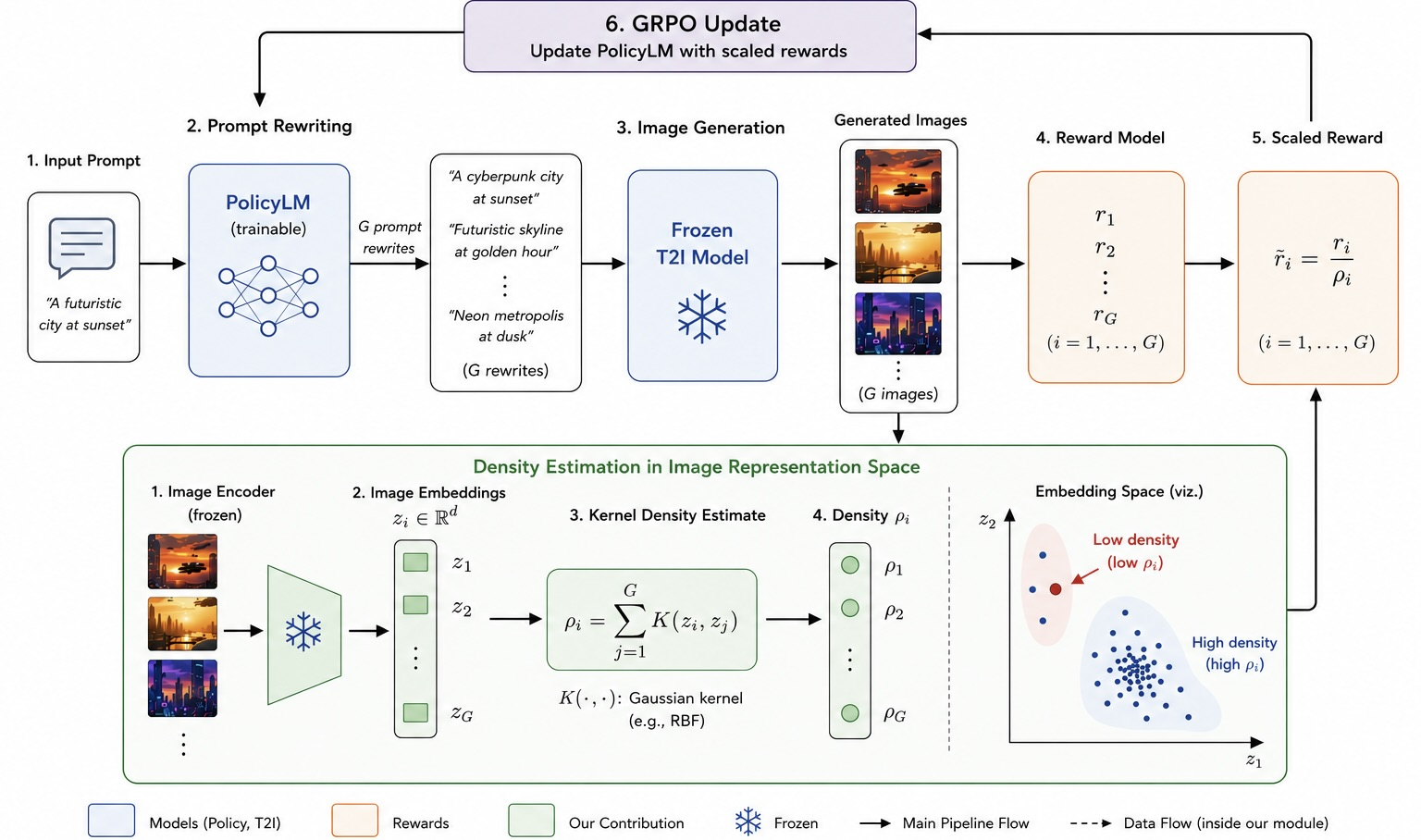
Original fixed-v1 HTML Figure 2 JPEG from the original paper, losslessly re-encoded as PNG with identical pixels and visually checked; not regenerated or cropped. The language policy produces prompt rewrites, frozen image generation/encoding supply rewards and representations, and density-scaled rewards update the policy. Copyright belongs to the authors; CC BY 4.0. Not a local execution screenshot.
Core equations
Self terms ensure density ≥1. At vanishing bandwidth distinct points approach 1, but duplicates retain their multiplicities. Infinite bandwidth gives G, whose common reward scale cancels under normalization.
Paper results
Navigation and text-to-image experiments examine coverage/diversity and quality. Results depend on embeddings, bandwidth and image-generation randomness. Production A/B is not reported. A local KDE check does not establish learned reward-proportional behavior or better image quality.
Local component
Implementation and commands
density_scaled_advantages takes outcomes [...,G,D] and nonnegative rewards [...,G], computes full Gaussian KDE independently per group, scales rewards and normalizes. Following Section 3.1, negative rewards are explicitly rejected; a signed extension is not advertised as reward-proportional sampling. Features/rewards are stop-gradient; returned advantages feed the caller's unchanged GRPO objective. No PPO loss is redefined here.
PYTHONPATH=src python -c 'from auto_research.post_training.dars import diagnostic; print(diagnostic(42, "cpu"))'
PYTHONPATH=src python -m pytest tests/test_nov04b_foundation_components.py -q
Checks and negative controls
The paper does not specify population versus sample standard deviation. The API explicitly defaults to correction=0 and supports correction=1. Groups with constant scaled rewards have undefined 0/0: default zero advantages or explicit zero_variance="raise", without hidden epsilon. Equal original rewards with different densities need not have zero variance.
Tests cover duplicates, isolated points, negative-reward rejection, permutation, group isolation, both bandwidth limits, an independent loop KDE reference, std convention and gradient isolation. A teaching example with outcomes (0,0,100), h=.001 and rewards (1,1,1) yields densities (2,2,1) and scaled rewards (.5,.5,1). This illustrates relative advantages, not learned new modes.
Cost decision
Full experiments combine Qwen3-0.6B/GPT-2 rewriting, Stable Diffusion 1.4, CLIP/DINO evaluation, 64 rewrites per prompt and multiple reward/seed arms on four A100-40GB cards: too costly, not reproduced (review DONE). No models/data are downloaded or navigation/image policies trained. There is no capability/Evolve conclusion; CPU arithmetic checks do not replace an actual A100/A30 receipt.