Targeted Guidance: directional self-distillation only at failed agent turns
L1 gated-loss component, diagnostic only. Full 30B agent RL is not reproduced because of excessive cost (review DONE). No coding agent, textual-feedback judge or actual rollout system is supplied;
evolve_integrated=false.
Paper information
| Field | Value |
|---|---|
| Paper | Stabilizing On-Policy Targeted Guidance in Agentic Reinforcement Learning; full text |
| Company / institution | First author Kevin Frans: Cursor Research / UC Berkeley, not Google/Meta |
| Original publication | arXiv v1: 2026-11-03 17:54:33 UTC; announced 2026-11-04 |
| Original author code | No verified author training implementation found as of 2026-11-04. The cited Quack kernel is not this paper's training release |
| Upstream license / revision | Not applicable without a verified repository; independently implemented from equations. The paper uses the arXiv non-exclusive license; figure copyright remains with the authors |
| Local adapter / key | targeted-guidance; standalone loss, not a complete agent-training adapter |
| Local code | src/auto_research/post_training/targeted_guidance.py; token_failure_mask, targeted_guidance_loss, diagnostic(seed=42, device='cpu') |
| Validation boundary | CPU numerical checks do not replace CUDA validation. Actual three-seed GPU results are integrated by the batch; success is not pre-filled |
Original method
Motivation and change
Scalar RL rewards reinforce explored behaviors but may not communicate how to correct an unfamiliar tool format or communication style. This paper inserts criterion-specific textual feedback immediately before an offending agent turn. The same policy under that feedback becomes a stop-gradient teacher while the student learns on its own actual history. The defining combination is minimal, failed-turn-gated direction plus ordinary per-criterion RL reward, not unrestricted whole-trajectory OPSD, to reduce diversity pressure and primary-task interference.
Original paper figure
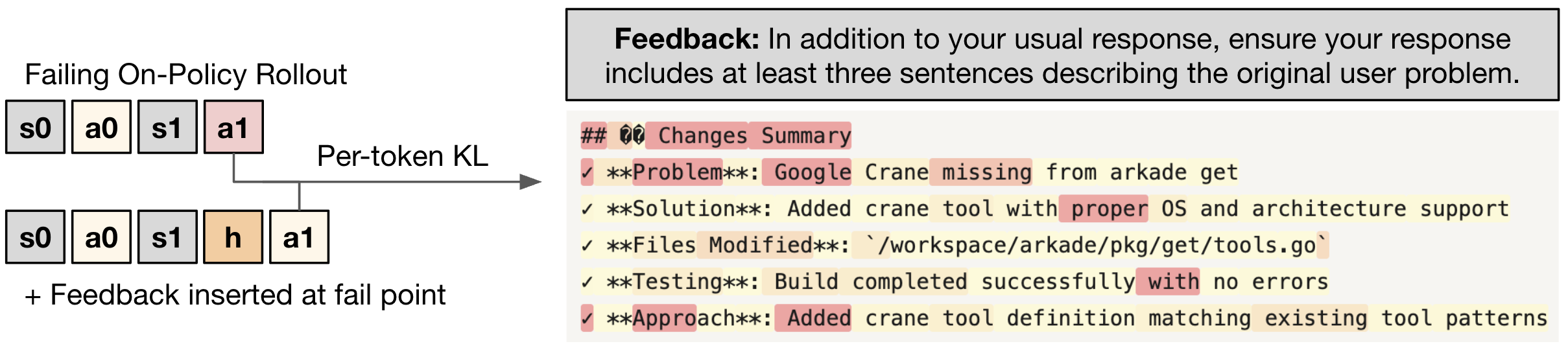
Unmodified PNG from Figure 2 in the original paper. Copyright remains with the authors; source and visual review are in assets/provenance.json. The depicted model, judge and RL pipeline are not locally implemented systems.
flowchart TD
    R[External actual student rollout] --> J[External criterion judgment]
    J --> F[Insert feedback before failed turn only]
    F --> T[Same-weight feedback-conditioned teacher stop-gradient]
    R --> S[Student full-vocabulary distribution on aligned prefix]
    T --> K[Reverse KL at failed turns]
    S --> K
    K --> N[Normalize by all response tokens in each rollout]
    G[External actual GRPO loss] --> L[Combined objective]
N --> LEquations
Section 4, Eq.3:
\(\mathcal F\) contains only criterion-failing agent turns; feedback \(f_t\) precedes that turn. The teacher shares the policy weights under different context, rather than being a stronger external model. Following the accompanying text, local code sums failed-token KL and divides by all valid response tokens of that rollout, then averages rollouts equally. Dividing only by failed tokens would give a single error an entire response's average pressure.
Use full-vocabulary reverse KL (student to teacher), not forward KL or a sampled-token approximation, and stop teacher gradients. When all criteria pass, distillation disappears and the original RL objective remains. The paper also pre-validates that feedback improves mean criterion performance; local code does not fabricate this feedback-screening experiment.
Reported outcomes, not local results
In Table 1, TG maintains coding pass rate 0.33±0.05, matching the coding-only baseline's point estimate while improving several style criteria. Error bars are standard deviations over the final 32 training steps, not independent-seed confidence intervals. The paper analyzes excessive distillation weights, low entropy/oscillation and the importance of including thinking tokens. No production online A/B is reported; no coding or judge scores are reproduced locally.
Local implementation
Data protocol and code mapping
token_failure_mask maps an externally supplied failed-turn table to tokens, with -1 denoting no turn. It does not judge behavior or read gold. targeted_guidance_loss receives aligned student logits, feedback-conditioned teacher logits, response/failure masks and an external GRPO scalar. It computes frozen-teacher full-vocabulary reverse KL only at failed tokens, normalizes over all response tokens and adds it to the gradient-preserving RL term.
No failure or zero guidance weight returns the original RL loss. Padding and nonfailed teacher rows never enter probability computation. FP16/BF16 probability/reduction arithmetic promotes to FP32. Invalid failure positions outside responses, empty responses, non-finite active logits and negative weights are rejected. The caller owns actual sampling, feedback insertion, turn judgments and privacy/evaluation isolation.
PYTHONPATH=src python -m pytest tests/post_training/test_nov04b_post_training.py -q
PYTHONPATH=src python -c 'from auto_research.post_training.targeted_guidance import diagnostic; print(diagnostic(42, device="cpu"))'
Checks, negative controls and limits
Synthetic-logit diagnostics verify an independent scalar formula, failed-turn mapping, frozen teacher, zero auxiliary gradient outside failed tokens, recovery of the original RL loss when no turn fails, and descent after a small update. Tests additionally distinguish KL directions and run gradcheck. No criterion judge, feedback screening, tool environment, LM weights or GRPO sampler is supplied; no agent success-rate claim follows. GPU receipts await actual integrated execution, not hand-entered expected results.
High-cost full experiments
Section 5.2 uses a further-SFT'd Qwen3-Coder-30B, 200 steps, 32 groups×32 rollouts per batch, asynchronous multi-turn code editing, and sweeps over distillation/style-reward weights. A single configuration already implies roughly 204,800 trajectories. The complete long-rollout matrix is excessive for one A100/A30 or a Mac: not reproduced because of excessive cost (review DONE). This is a configuration estimate, not local timing. No weights, costly probes or automatic retries are requested.