Which Successes Make Good References? Action-Sequence Alignment for Multi-Turn On-Policy Distillation
L1 mechanism component, diagnostic only. Full experiment not reproduced due to cost (review DONE). This closes a previously discovered lead, not a November 12 first publication. No Evolve integration.
Paper information
| Field | Value |
|---|---|
| Paper | arXiv:2611.13135v1; fixed v1 full text |
| First author and affiliation | Mufei Li: Georgia Institute of Technology (work during an Amazon Web Services internship), verified from PDF page 1 |
| Original publication | 2026-11-09 19:18:25 UTC, official arXiv v1 submission, not announcement/review date |
| Author code | No verified paper-specific author repository was found in fixed v1. Appendix I lists TCOD/Trinity-RFT/veRL and other upstream infrastructure, not this method's release. |
| Local adapter / key | lcs-reference-opd; adapter: null, independent component |
| Local code | src/auto_research/post_training/lcs_reference_opd.py |
| Entry | select_reference; diagnostic(seed, device='cpu') |
Paper summary
Motivation and main change
A successful trajectory is not automatically a useful corrective reference for every failed student. The paper aligns executed actions: unlike longest common prefix, LCS preserves ordered agreement after recoverable detours and selects a compatible same-task success. References are training-only teacher inputs; the student sees only its own history.
Free-target OT also optimizes reference-use frequencies, so failures independently select their best reference. There is no balanced target marginal, Hungarian matching or one-reference-per-failure constraint. Successful students skip OPD; failures without a same-task success use ordinary reference-free OPD.
Key original figure
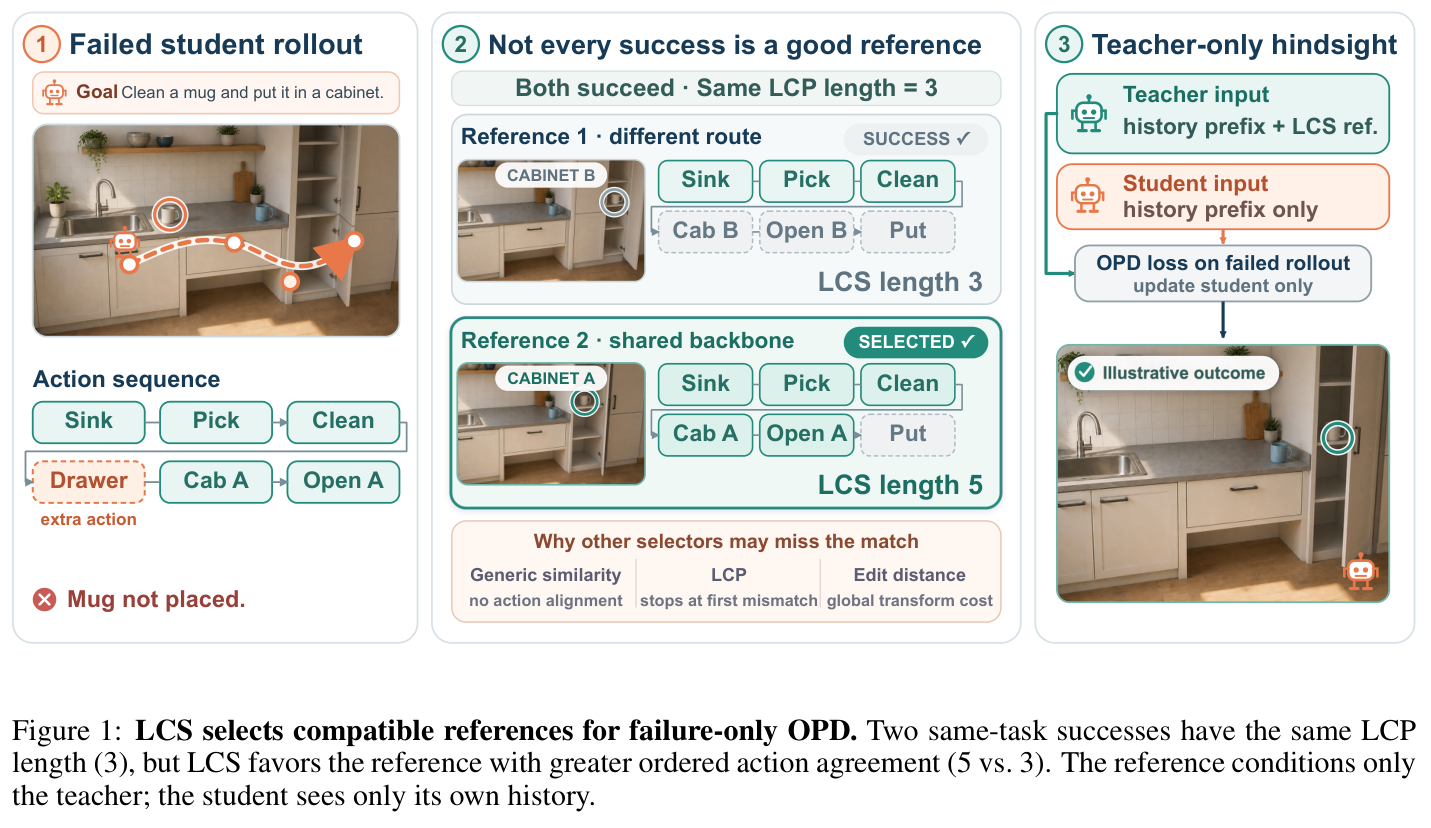
Original Figure 1, PDF page 2, retaining the complete figure and caption. Copyright remains with the authors; provenance records source/page/hashes. The illustrated ALFWorld interactions and outcome are the authors' example, not local agent execution.
flowchart TD
    O[Offline same-task teacher rollouts] --> V[Reward-validated deduplicated successes]
    F[Failed student actions] --> C[Normalized LCS]
    V --> C
    C --> T[Reference for training teacher only]
    F --> S[Student sees own history only]
    T --> L[Failure-only OPD]
    S --> L
Core equations
LCS preserves order and repeated actions while allowing unmatched actions:
Appendix D uses \(Z=\min(T^-,T^+)\) for ALFWorld and \(Z=T^-\) for tau3-bench. They can select different references and must not be silently unified. Training averages over failures, not the complete collected batch:
An all-success batch performs no optimizer step. Matching actions imply matching states only under shared-initial-state and transition assumptions; later LCS matches additionally require recoverable detours. This is not universal state equivalence or a guarantee of better teacher supervision.
Paper evidence and limits
The authors compare two students and seven other selectors on ALFWorld and tau3-airline, with transfer to retail. No production A/B is reported and no model success rate is reproduced locally. The theory requires recoverability and supervision-gain assumptions. High LCS can still hide incompatible latent states or misleading references.
Local implementation
Protocol and code mapping
lcs_length implements exact dynamic programming. compatibility exposes both paper normalizers. reference_pool keeps externally evaluated successes and deduplicates complete parsed sequences within each task, preserving order and repetition. select_reference implements independent argmax, first-tie behavior, successful-student skips and fallback. failure_only_mean returns None for all-success batches; callers must not quietly take a zero-loss optimizer step.
canonical_tool_call only canonicalizes exact tool names/JSON arguments. It is not an ALFWorld parser, semantic matcher or state reasoner. The source assumes positive denominators; empty local sequences explicitly score zero, a boundary convention not attributed to the paper.
PYTHONPATH=src python -c 'from auto_research.post_training.lcs_reference_opd import diagnostic; print(diagnostic(42, device="cpu"))'
PYTHONPATH=src python -m pytest -q tests/test_nov12_post_training_components.py
Checks and boundaries
Independent exhaustive subsequences check DP. Tests cover detours, repetitions, normalizer-dependent selection, exclusion of exact cross-task matches, shared reference reuse, full-sequence deduplication, ignored NaN success losses and all-success no-update behavior. Three-seed loss values are reduction inputs, not model outputs or task success.
Real offline references, student rollouts, teacher scoring, the OPD loss/trainer and environments are absent. Returned references belong only to the training-teacher interface, not student-visible context. No Evolve integration or CUDA capability is claimed.
High-cost full experiment
Appendix J specifies eight 80 GB A100s: four for training, two for teacher scoring and two for model updates. ALFWorld training takes about 10 hours and tau3-airline about 1 hour, with roughly 4500 A100 GPU-hours across reported runs. The matrix also includes multiple students/selectors, up to 200 environment steps and 10,000 output tokens. Too costly; full experiment not reproduced, review DONE. These are source disclosures, not local timing; no checkpoints, environment/LLM probes or retries are attempted.