LGPO: current-policy likelihood gating without importance ratios
L1 exact gated-loss / gradient component, diagnostic only. Full LLM RL training is too costly and is not reproduced (review DONE). Not eligible for Evolve promotion.
Paper information
| Field | Value |
|---|---|
| Paper | Is the Importance Ratio Necessary for Stable Reinforcement Learning in LLMs?; fixed v1 |
| Company / institution | First author Shuibai Zhang, University of Wisconsin–Madison; work during a KRAFTON internship, with KRAFTON coauthors. No verified Google/Meta affiliation |
| Original publication | 2026-11-11 12:31:55 UTC, arXiv v1; not first published on this review's November 15 date |
| Authors' code | No verified method repository found in the fixed source or author entry points as of 2026-11-15; using verl does not establish an LGPO release |
| Code license / revision | No verified method code; not applicable |
| Local adapter / key | lgpo, standalone loss, not a complete training adapter |
| Local code | src/auto_research/post_training/lgpo.py: loss, diagnostic(seed, device) |
| Local evidence | CPU seeds, CUDA seeds, real GPU receipt; small-tensor mechanisms, not capability |
Original paper summary
Background and main changes
GRPO's importance ratio combines sampling-distribution correction and clipping. Removing correction while retaining a constraint need not destroy stability, whereas fully on-policy ratios equal one and cannot activate clipping. LGPO avoids old-policy probabilities and gates each response using its current-policy mean token log probability.
This is not token-level top-k or positive-advantage-only filtering. Both positive- and negative-advantage high-likelihood responses are gated; low-likelihood responses remain. The local minimum-KL perturbation analysis explains sensitivity near deterministic distributions, not a global trust-region guarantee for arbitrary finite updates.
flowchart LR
    P[Current valid token logp] --> M[Response mean logp]
    M --> G[Detached threshold gate]
    P --> S[Sum logp times detached external advantage]
    G --> L[Zero gated response contributions]
    S --> L
    L --> B[Mean over all responses then negate]
Key original figure
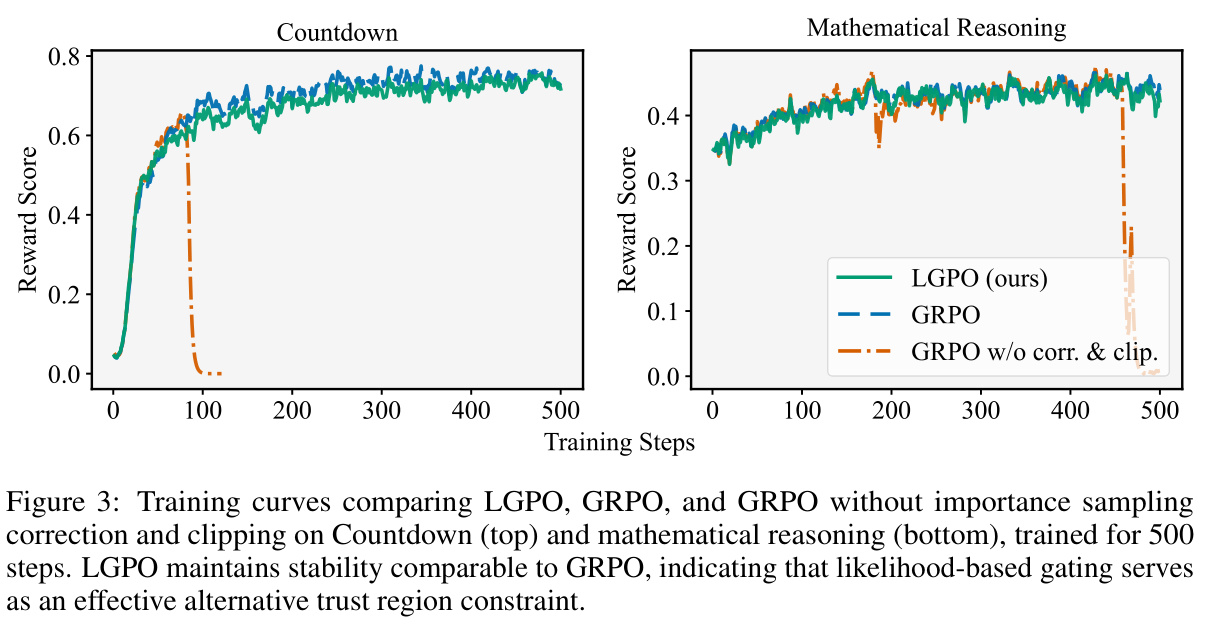
Original figure and caption from fixed v1 PDF page 6, Figure 3, rendered and cropped without redrawing. Copyright belongs to the authors. Coordinates and SHA256 are in assets/provenance.json. These are author results, not local training.
Core equations
Fixed v1 Section 4 and Appendix D Algorithm 1:
The default threshold is -0.15, about 0.86 geometric-mean token probability. Gating uses mean log probability, but the loss sums tokens and divides by all B responses, not survivors. Padding contributes to neither. Advantages and gates are detached; no old-policy forward or importance ratio is used. Rewards, advantage estimation and rollouts are external.
Offline and online results
Table 1 reports Qwen2.5-3B-Instruct MATH500 64.4→65.2 and OlympiadBench 29.2→30.7, but AIME24 5.0→4.2. Improvements are not universal. Section 5 reports one approximately 7.5K-example epoch on two H100s: 2.85 hours for LGPO versus 3.37 for GRPO. The comparator recomputes old-policy likelihoods; the approximately 18% claim is not a universal framework speedup. No production A/B is reported, and these scores/speeds are not reproduced locally.
Local reproduction
Data protocol and code mapping
Inputs are current-policy log probabilities, supplied token advantages and a Boolean response mask. Positive log probabilities, nonfinite values, empty responses and shape/device/dtype mismatches are rejected. There is no LM checkpoint, task dataset or verifier. This implements a loss, not the entire on-/off-policy sampling system.
PYTHONPATH=src python -m pytest tests/post_training/test_nov15_post_components.py -q
PYTHONPATH=src python -c 'from auto_research.post_training.lgpo import diagnostic; print(diagnostic(42, device="cpu"))'
Results, negative controls and boundaries
Four independent tiny-logit responses cover high-likelihood gating for both advantage signs and retained positive/negative update directions, with real backward and one parameter update. Tests also check equality at the threshold, the all-response denominator, token sums, padding gradients, detached advantages and a differentiable all-gated zero. Seeds change fixture amplitudes, not LLM training. The CUDA path requires the linked real A100/A30 receipt. Mechanism checks imply neither reasoning improvement nor Evolve integration.
High-cost full experiment
Section 5 / Appendix D.1 use 3B and 1.5B models, groups of 8, prompt batches 128/256, 300/500/800+ updates and multiple baselines, tasks and ablations. The authors' two-H100 epoch already takes hours. The full matrix is too costly, not reproduced (review DONE) on one A100/A30 or a Mac. No large weights/data, exploratory training or automatic retries are used.