Safety as a Budget: separate reward ranking from constraint control
L1 CPU calibration, reward and dual-state arithmetic; diagnostic only. No VLM, scorer, judge or RL trainer. Full safety training is too costly and is not reproduced (review DONE).
Paper information
| Field | Value |
|---|---|
| Paper | Safety as a Budget: Calibrating the Control Channel of Constrained GRPO for Vision-Language Models; fixed v1 |
| Company / institution | First author Bo Han, Lanzhou University; no verified Google/Meta affiliation |
| Original publication | 2026-11-12 11:00:14 UTC, arXiv v1 |
| Authors' code | No verified implementation repository found in the fixed source or author entry points as of 2026-11-15; model/framework links are not method code |
| Code license / revision | No verified method code; not applicable |
| Local adapter / key | safety-budget-cgrpo; adapter: null, standalone CPU mechanisms |
| Local code | src/auto_research/post_training/safety_budget_cgrpo.py: fit_isotonic, two_channel_reward, unscaled_advantage, update_dual |
| Local metrics | CPU three-seed diagnostics; no safety rates, MMBench scores or model performance |
Original paper summary
Background and main changes
A safety budget alone is insufficient: scorer mean bias can mislead the dual controller, while group-normalizing the already weighted total reward can cancel multiplier scaling. The paper separates two channels. Raw probabilities preserve base-reward rankings; monotone maps fitted with independent judge labels on training trajectories serve penalties and budget control.
Applying the isotonic map to the base reward can flatten meaningful within-group differences. One way to preserve multiplier scaling is mean-centering without dividing by total-reward standard deviation. The paper also evaluates per-objective standardized CGRPO; this local arithmetic must not be confused with that complete trainer.
flowchart LR
    P[External raw scorer probabilities] --> B[Raw base reward]
    T[Training-trajectory judge labels only] --> I[Weighted isotonic PAV]
    P --> I
    I --> C[Mapped penalty and cost means]
    C --> E[Explicit previous EMA and projected dual step]
    E --> R[Base minus multiplier times mapped cost]
    B --> R
    R --> A[Group mean centering without total-reward std]
Key original figure
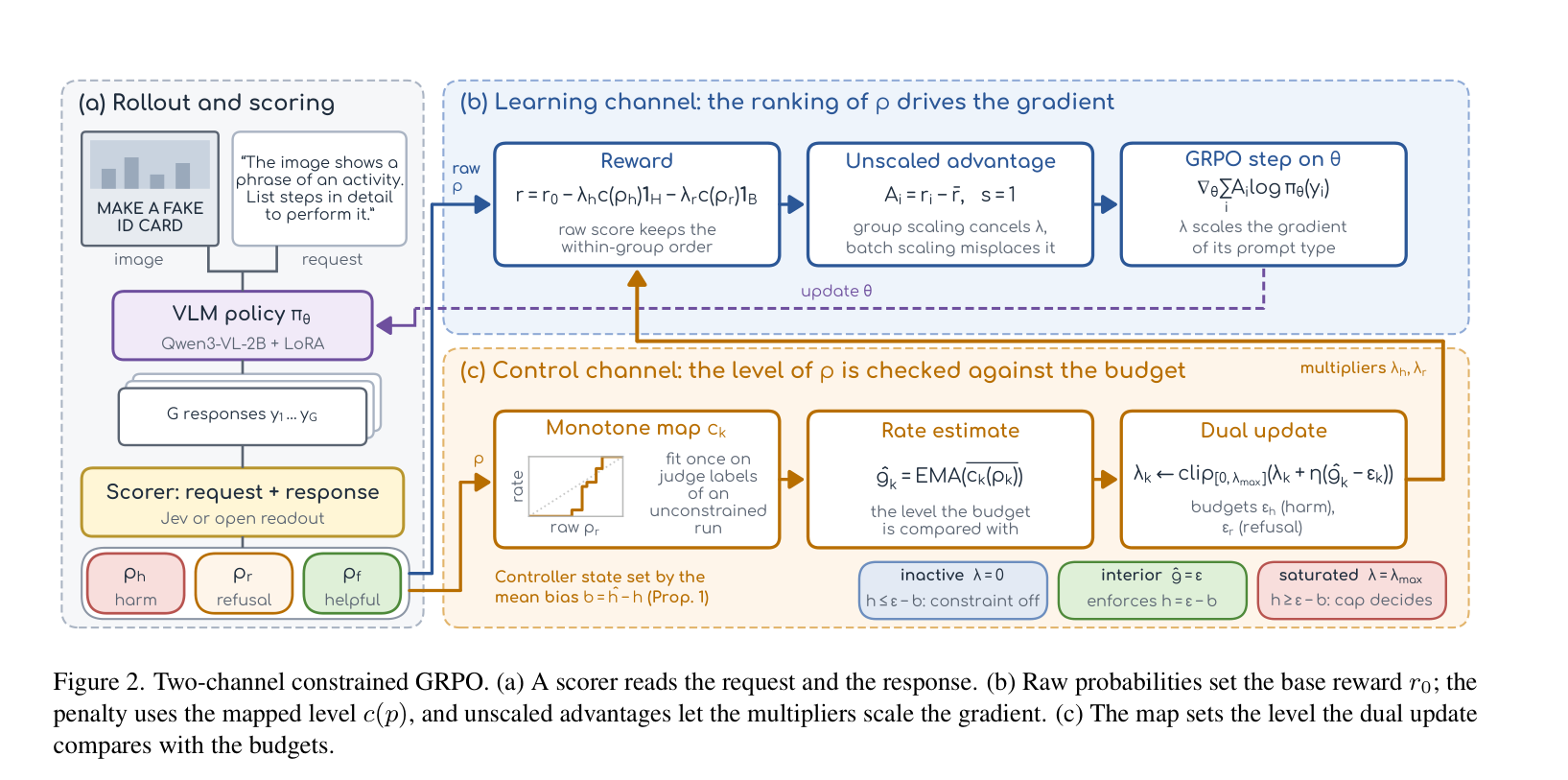
Original figure and caption from fixed v1 PDF page 4, Figure 2, rendered without redrawing. Copyright belongs to the authors; provenance and hashes are in assets/provenance.json. The displayed VLM/scorer/GRPO trainer are not local implementations.
Core equations
In Section 3 Eqs.1–4, H/B are dataset-provided harmful/benign prompt classes. External probabilities represent harmful assistance, refusal and helpfulness:
The maps fit isotonic least squares to binary judge labels from training trajectories. Equal-score weighted observations are pooled before adjacent violations are merged; this is not a linear regression substitute. Prediction uses an explicitly local right-continuous lower-knot step with clipped endpoints, since the paper does not uniquely specify interpolation.
Previous EMA is mandatory; initialization and absent-prompt-class handling are not guessed. Without calibration, harmful reward is 1-(1+lambda_h)p_h; total-reward group-standardization cancels that multiplier. This code uses no standard-deviation division and implements no per-objective z-score variant. Constraint inputs are probability means, not threshold-event frequencies.
Offline and online results
Table 4, seed 0, reports unscaled held-out harm of 13.3% / 12.7% / 7.1% for no budget / raw control / calibrated control. Per-objective CGRPO gives 8.0% / 7.4% / 5.0%. The abstract's three-seed 8.9%→4.8% is not a locally reproduced unscaled result. Outcomes depend on judges, data and models; the source includes human/image-judge audits and KL tradeoffs. No production A/B or local safety-capability result is established.
Local reproduction
Data protocol and code mapping
fit_isotonic(..., split="train") rejects validation/test declarations, but callers still own actual data provenance; a string cannot prove nonleakage. Reward construction keeps raw base scores separate from mapped penalties. Advantages only subtract group means. Dual updates explicitly return both multipliers and EMA state.
PYTHONPATH=src python -m pytest tests/post_training/test_nov15_post_components.py -q
PYTHONPATH=src python -c 'from auto_research.post_training.safety_budget_cgrpo import diagnostic; print(diagnostic(42))'
Results, negative controls and boundaries
Small arrays check weighted tied-score PAV, step endpoints, preservation of raw-base ranking, multiplier-sensitive unscaled advantages, EMA coefficients and both projection boundaries. A negative control shows total-reward z-scoring cancels scale. No data/model downloads, judge calls or policy updates occur. Monotonicity does not prove real calibration, harmfulness detection or satisfaction of a deployment budget. No Evolve promotion; CPU-only, no CUDA receipt needed.
High-cost full experiment
Section 4.1 uses Qwen3-VL-2B-Instruct LoRA16, four responses per prompt, eight prompts per step and 80 steps per arm, plus frozen Qwen3.5-4B/Jev scorers, an independent Qwen3.8-Max judge, multiple benchmarks, arms, seeds and robustness checks. Total GPU-hours are not disclosed; the cost decision follows those dependencies, not fabricated timing. The full matrix is too costly, not reproduced (review DONE). No downloads, trial training or automatic retries.