RA-Eval: qualify judges, swap orders, and audit bias transduction
CPU L1 annotation protocol; diagnostic only. It processes externally supplied verdicts. No LLM is called, no capability scores are fabricated and no 0.6B model is trained. The full speech/preference-training and judge campaign is not reproduced due to cost (review DONE).
Paper information
| Field | Value |
|---|---|
| Paper | arXiv:2611.19840v1; fixed text |
| Original title | Grounding Language Models in Speech Does Not Fix "AI Flavor": Calibrated LLM Judges, Goodhart Traps, and a Preference-Tuning Fix |
| Institution/company | First/sole author Dongwu Qian: Independent Researcher |
| Original publication | November 15, 2026, 06:42:48 UTC, arXiv v1 |
| Authors' code | Released RA-Eval v0.1, Zenodo DOI 10.5281/zenodo.24237533. The small ra-eval-v0.1-code-data.zip was inspected for benchmark/blind/join/judge scripts and calibration files; this is not a GitHub repository |
| License | MIT code; CC BY 4.0 annotations; human reference texts have separate noncommercial/takedown restrictions, not a blanket MIT license. Only the small code archive was inspected; no model weights downloaded |
| Fixed upstream version | RA-Eval v0.1; archive SHA256 6e2777051b06a90a73edbf4fb21555448ce82c5bc3bf243e5ef13602259f32c0 |
| Local adapter/key | calibrated-judges-protocol; adapter=null, promotion_eligible=false, evolve_integrated=false |
| Local code | src/auto_research/post_training/calibrated_judges_protocol.py: qualify, join_swapped_judgments, check_split_isolation |
Original paper
Motivation and changes
Three negative results precede the judge protocol: phoneme-interleaved pretraining does not improve perceived spoken style and increases repetition; prosody-plan adherence falls below its gate; rule-based prosody reward is near chance under human and judge blind evaluations. RA-Eval therefore combines objective features, power-limited human judgments and calibrated LLM judges. Objective feature gains alone do not establish perceptual improvement.
Layer 3 first requires sensitivity of at least 0.75 on known-answer catch trials. Two isolated judges with A/B order swapping then annotate ordinary pairs, with disagreements scored 0.5. Judge-agree labels directly supply preference pairs, without an additional reward model. Each training round must check whether annotation bias became a length shortcut. Independent judges here mean isolated processes/contexts, not independently validated model families.
Architecture and protocol
flowchart LR
  K[Evaluator-only catch answers] --> C[Judge qualification gate]
  P[Blind text pairs with keys removed] --> J1[Isolated judge 1: AB and BA]
  P --> J2[Isolated judge 2: AB and BA]
  C --> J1
  C --> J2
  J1 --> U[Canonicalize order and require consistency]
  J2 --> U
  U -->|agreement| D[Eligible preference pair]
  U -->|missing/inconsistent/disagreeing| T[Tie 0.5 and no hard preference pair]
  D --> R[External DPO then length/style/held-out audits]
Core equations
Qualification uses \(\mathrm{sensitivity}=\mathrm{correct}/N\ge0.75\). Catch answers belong only to the evaluator; they must not enter evaluated-policy or annotator prompts. BA verdicts are mapped to canonical A/B. The local combination rule emits a hard preference only when all four verdicts from two qualified judges agree; otherwise \(p_A=0.5\). This is an explicitly stricter local composition than joining two raw passes, enforcing Section 3.3's isolated-judge and swapped-order requirements. Different identity strings alone cannot prove runtime isolation.
Section 5.4 uses a chosen-CE anchor:
That 0.6B training is not implemented here, nor is w=0.1 claimed universally optimal. Calibration/training/held-out IDs must be pairwise disjoint. ID checks are a minimum interface guard, not a substitute for near-duplicate or same-prompt leakage audits.
Reported results and limits
The paper reports 16/16 catches, 22/24 pilot single-text detections and 24/24 same-topic pairs, not local measurements. DPO with 89 pairs achieves held-out blind win 0.833 [0.699,0.972]; scaling to 240 pairs causes a median-75-character collapse. An SFT anchor partly repairs the problem; final win is 0.771 [0.600,0.923]. These are not production A/B results.
Section 5.4 reports a length statistic of 213, whereas Table 1 gives final median 156 on 32 prompts under identical generation settings; the different summaries must not be collapsed into a single guarantee. The paper covers one Chinese short-essay genre, a 0.6B model and one judge model, with residual length bias and power-limited final human confirmation. Local fixtures validate none of these capability claims.
Key original table
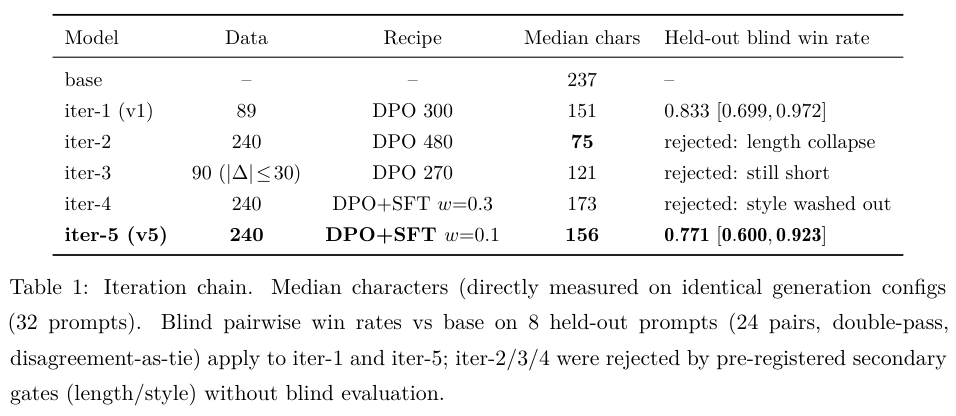
Fixed v1, page 8, original Table 1 and caption, without rearranged data or redrawing. Rejected iterations are not presented as completed blind evaluations. Copyright remains with the author; CC BY 4.0. Source and SHA256.
Image from the original paper; copyright belongs to the original authors.
Local implementation
Data contract and mapping
qualify takes evaluator-only catch verdicts plus canonical expected sides. join_swapped_judgments takes ordinary verdicts and qualification records, never gold answers. Catch IDs cannot be reused for training annotations. Missing orders, order inconsistency, judge disagreement or unqualified judges fail closed to ties; duplicate judge/order combinations and mixed pair IDs raise errors. It processes verdicts; it is not an AI-style detector.
PYTHONPATH=src python -c 'from auto_research.post_training.calibrated_judges_protocol import diagnostic; print(diagnostic(42, device="cpu"))'
PYTHONPATH=src python -m pytest tests/test_nov18_eval_protocols.py -q
Checks and evidence boundary
Explicitly named fixture judges test order restoration, the 0.75 gate, disagreement/missing-order ties, duplicate rejection and split overlap. Values 1 and 0.5 are protocol mappings, not LLM capability scores. Component diagnostic artifacts record actual execution; no blind-win, calibration or GPU result is fabricated. REQUIRES_GPU_VALIDATION=False; CPU dictionary arithmetic requires no CUDA validation.
High-cost full experiment
The full study includes multiple 0.6B CPT/DPO/SFT rounds, speech/TTS features, repeated judge annotations and restricted human texts. That complete training/call matrix is expensive relative to the short single-device/local budget and is not reproduced due to cost (review DONE). Low-cost qualification/join interfaces are implemented, but no paid judge is called or approximately 2.3GB model archive downloaded. Review DONE does not mean an experiment succeeded.