Learning Design Taste through Verifiable Synthetic Environments and Agentic Reinforcement Learning¶
l0_interface standalone component; diagnostic only. Full experiments are not reproduced due to high cost (review DONE). No automatic retries or Evolve promotion.
Paper information¶
| Field | Value |
|---|---|
| Paper | arXiv 2611.20612v1; fixed v1 |
| First author / institution | Sujay Choubey; The fixed v1 does not state the first author affiliation; not inferred from another author email. |
| Original publication | 2026-11-16 06:37:24 UTC; original submission, not announcement/review date |
| Original source code | Author repository; verified revision a3f98e4375df17d3631df9ee9b68762980e30a71; no project-level licence verified; upstream source not copied. Release evidence only; upstream training not executed. |
| Local adapter / key | design-taste-admission; adapter: null |
| Local code | src/auto_research/post_training/design_taste_admission.py |
Original paper summary¶
Background and defining changes¶
Even spacing metrics can be gamed. Admission requires expert agreement, causal perturbation/repair sensitivity, hack-trap resistance and stability. Failed signals remain evaluation-only.
No. Experts determine signal admission and score blinded canaries. Reward aggregates only function/design/rubric/preference channels, while build/render/anticheat and other V0 gates multiply it.
Original paper figure¶
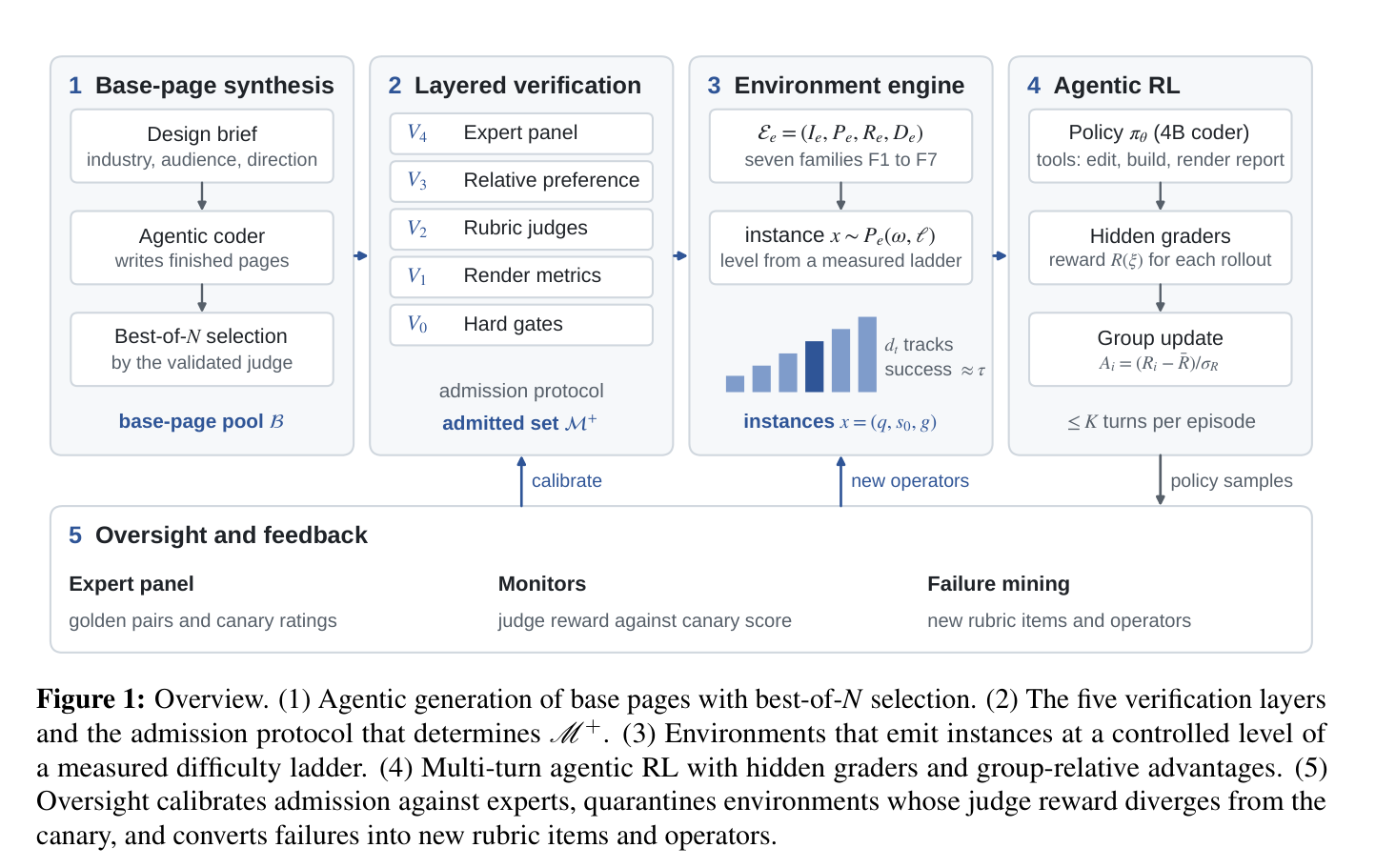
From fixed v1, PDF page 3. Copyright belongs to the original authors. The original panel and caption are preserved without scientific edits; source/crop/SHA are in provenance. Author results are not local measurements.
Core equations¶
Read source locations: §4 Eq.3–4;§5–8 training/evaluation.
Paper results and production evidence¶
Only seven of sixteen render signals and six of ten rubric dimensions are admitted; distinctiveness fails its criterion, and much of the gain depends on the multi-turn inference loop. Experts do not enter the reward, so failed dimensions cannot be dropped to claim all design taste is verifiable. No production A/B is reported.
Local component¶
Data contract and code mapping¶
Four admission tests for expert agreement, causal sensitivity, hack resistance and stability; multiplicative V0 hard gates and admitted-score composite reward, not a browser or design judge.
No. It consumes external observation rates/admitted scores and executes four gates and reward algebra. There is no Chromium, expert panel, judge ensemble or 4B model. The starting-state <=.4 rule admits tasks; it does not clip final rewards.
PYTHONPATH=src python -c 'from auto_research.post_training.design_taste_admission import diagnostic; print(diagnostic(42, device="cpu"))'
PYTHONPATH=src python -m pytest -q tests/post_training/test_nov18_latest_post_components.py
Results, negative controls and limits¶
CPU seeds 42/43/44 were executed. Metrics contain operator/control results, not task-success rates. CPU-only protocol; no CUDA path is advertised.
all_four_boundaries_are_inclusive, high_agreement_does_not_override_hack_trap, integrity_is_multiplicative, starting_state_floor_is_separate.
High-cost full experiment¶
The original configuration is recorded verbatim with source locations in the cost assessment. It involves a 4B multi-turn editing policy, real Chromium builds/renders, independent judge ensembles and about 385 expert pairs per dimension.
The high-cost full experiment is not reproduced (review DONE). This is a source-configuration assessment, not a local timing claim. Only declared tiny-operator checks are allowed; no large-model probe is run to prove cost. No capability comparison or Evolve integration is claimed.