Contrastive Activation-Guided Zeroth-Order Preference Optimisation for Memory-Efficient LLM Alignment¶
l1_mechanism standalone component; diagnostic only. Full experiments are not reproduced due to high cost (review DONE). No automatic retries or Evolve promotion.
Paper information¶
| Field | Value |
|---|---|
| Paper | arXiv 2611.20635v1; fixed v1 |
| First author / institution | Weiyun Huang; Uppsala University |
| Original publication | 2026-11-16 06:55:27 UTC; original submission, not announcement/review date |
| Original source code | No verifiable method-source release found in fixed v1 or the bounded author entry points checked. Referenced trainers, models and libraries are not this paper's source release. |
| Local adapter / key | ca-zodpo; adapter: null |
| Local code | src/auto_research/post_training/ca_zodpo.py |
Original paper summary¶
Background and defining changes¶
The loss remains the chosen–rejected policy/reference margin. The update uses forward-only search directions from contrastive input activations instead of isotropic full-parameter perturbations.
The factor keeps perturbation scale comparable across ranks. Removing it conflates a larger subspace with a larger search step and changes the source's comparison.
Original paper figure¶
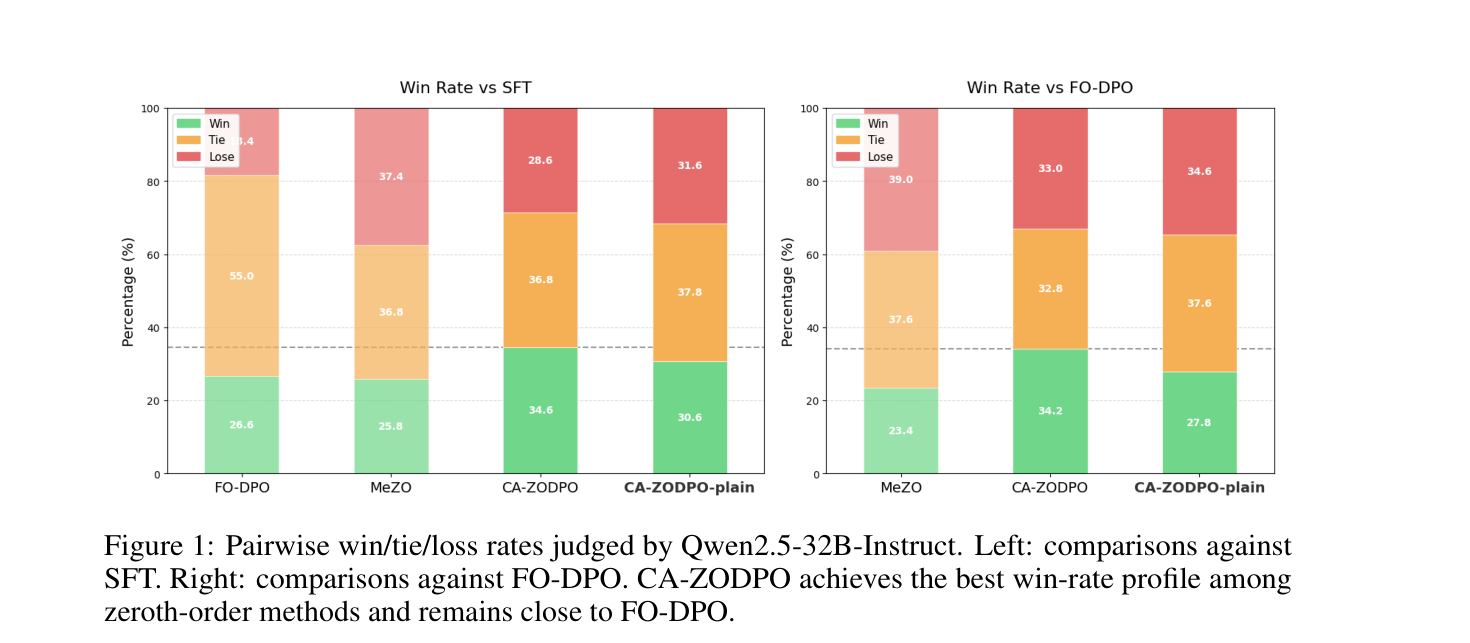
From fixed v1, PDF page 4. Copyright belongs to the original authors. The original panel and caption are preserved without scientific edits; source/crop/SHA are in provenance. Author results are not local measurements.
Core equations¶
Read source locations: §2 Eq.1–5;§3 HH-RLHF setup.
Paper results and production evidence¶
On Qwen2.5-1.5B and HH-RLHF the authors compare ZO variants with first-order DPO; contrastive activations outperform a preference-agnostic subspace and memory scales more weakly with sequence length. Fewer low-rank state elements alone prove neither alignment quality nor measured peak-memory reduction. No production A/B is reported.
Local component¶
Data contract and code mapping¶
Power-iteration subspace of chosen/rejected activation differences, rank-normalized two-point finite differences and basis-transported low-rank momentum.
No. Coordinates change with the basis, so the old buffer is transported through A_old-transpose A_new before accumulation. The same coefficients otherwise represent a different full-weight direction.
PYTHONPATH=src python -c 'from auto_research.post_training.ca_zodpo import diagnostic; print(diagnostic(42, device="cpu"))'
PYTHONPATH=src python -m pytest -q tests/post_training/test_nov18_latest_post_components.py
Results, negative controls and limits¶
CPU seeds 42/43/44 were executed. Metrics contain operator/control results, not task-success rates. A real A100/A30 receipt must pass the batch GPU gate before CUDA validation is claimed.
orthonormal_contrastive_basis, two_point_slope_matches_oracle, basis_transport_preserves_reconstructed_momentum, low_rank_update_executes.
High-cost full experiment¶
The original configuration is recorded verbatim with source locations in the cost assessment. It involves Qwen2.5-1.5B HH-RLHF SFT and several ZO/first-order DPO comparisons, with basis extraction and two perturbed forwards each update.
The high-cost full experiment is not reproduced (review DONE). This is a source-configuration assessment, not a local timing claim. Only declared tiny-operator checks are allowed; no large-model probe is run to prove cost. No capability comparison or Evolve integration is claimed.