Rethinking Supervision Scaling in On-Policy Distillation: From Dense Supervision to Stochastic Horizons¶
l1_mechanism standalone component; diagnostic only. Full experiments are not reproduced due to high cost (review DONE). No automatic retries or Evolve promotion.
Paper information¶
| Field | Value |
|---|---|
| Paper | arXiv 2611.20687v1; fixed v1 |
| First author / institution | Xinhao Yao; Renmin University of China |
| Original publication | 2026-11-16 07:51:25 UTC; original submission, not announcement/review date |
| Original source code | Author repository; verified revision 98467d23930e2197dd0b240af9e37cc7c5c3f505; licence MIT. Release evidence only; upstream training not executed. |
| Local adapter / key | sh-opd; adapter: null |
| Local code | src/auto_research/post_training/sh_opd.py |
Original paper summary¶
Background and defining changes¶
It samples one generation cap per batch, broadcasts it to all rollout workers and stops at EOS or that cap. It does not generate a full long answer and only trim its loss afterward.
SH-OPD retains the original token-mean objective and accepts systematic depth reweighting. Inverse-probability compensation belongs to its comparison STOPD, not this algorithm.
Original paper figure¶
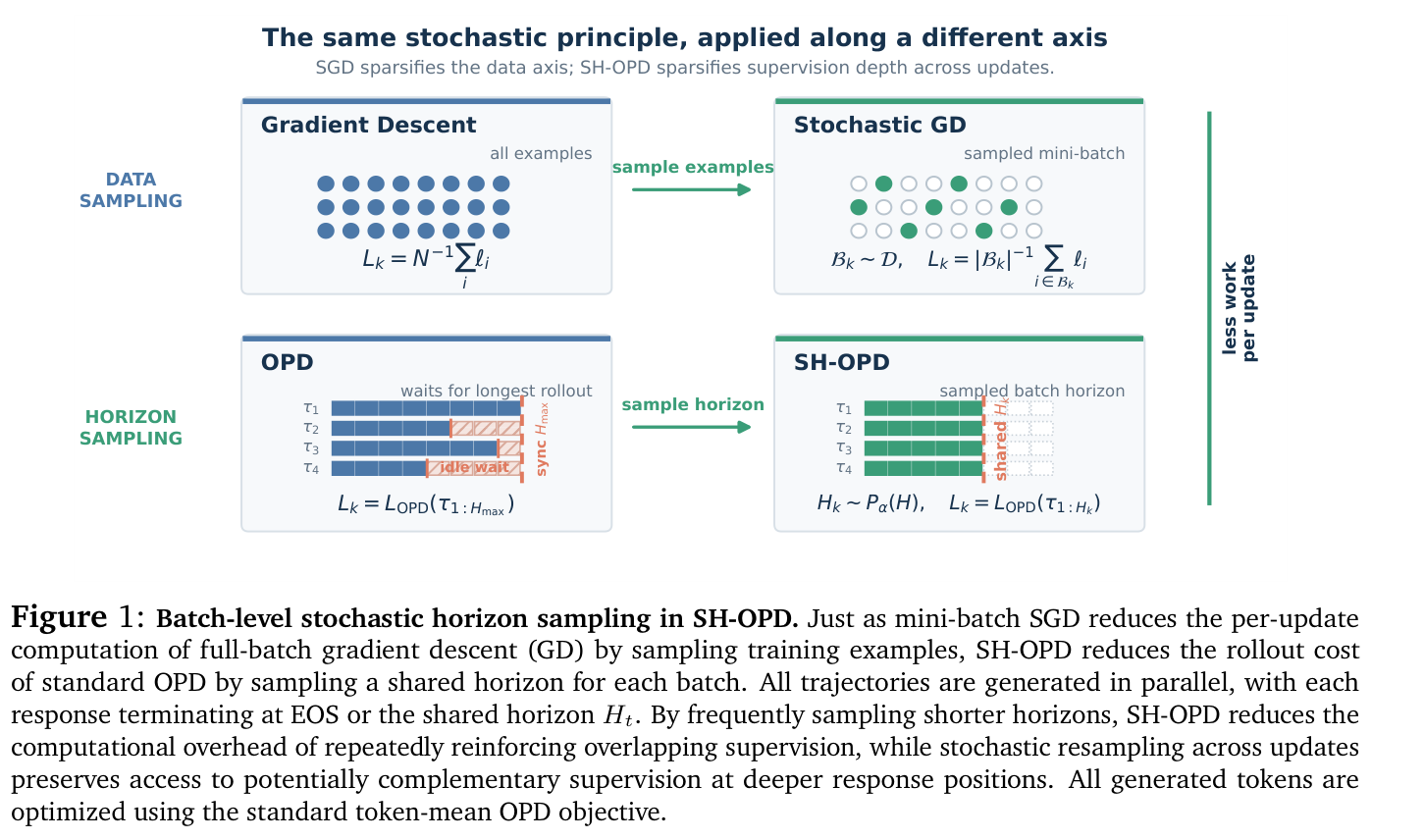
From fixed v1, PDF page 1. Copyright belongs to the original authors. The original panel and caption are preserved without scientific edits; source/crop/SHA are in provenance. Author results are not local measurements.
Core equations¶
Read source locations: §4 Definition1, Algorithm1, Eq.5–8;§5;AppendixA.1.
Paper results and production evidence¶
The preferred alpha differs between math and code. The math alpha=1 setting reports 45.5% of full-OPD per-update wall time, while more aggressive truncation hurts quality. These are author results with 1.5B models and long rollouts, not speedups inferred from the local sampler. No production A/B is reported.
Local component¶
Data contract and code mapping¶
Power-survival distribution, one actual generation cap per batch, standard token-mean OPD and implicit position weights; no inverse-probability correction.
Algorithm 1 averages all supervised generated tokens together. With unequal EOS lengths, per-response averaging changes token weights. The component checks caps, PMFs and masks, not real rollout throughput.
PYTHONPATH=src python -c 'from auto_research.post_training.sh_opd import diagnostic; print(diagnostic(42, device="cpu"))'
PYTHONPATH=src python -m pytest -q tests/post_training/test_nov18_latest_post_components.py
Results, negative controls and limits¶
CPU seeds 42/43/44 were executed. Metrics contain operator/control results, not task-success rates. A real A100/A30 receipt must pass the batch GPU gate before CUDA validation is claimed.
pmf_normalized, alpha_zero_is_full_opd, true_shared_generation_cap, token_not_sequence_mean, padding_zero_gradient, implicit_early_weight_not_debiased.
High-cost full experiment¶
The original configuration is recorded verbatim with source locations in the cost assessment. It involves 1.5B teacher/student, math/code sweeps, batch 64, 7,168 response tokens and roughly 45 million supervised math tokens.
The high-cost full experiment is not reproduced (review DONE). This is a source-configuration assessment, not a local timing claim. Only declared tiny-operator checks are allowed; no large-model probe is run to prove cost. No capability comparison or Evolve integration is claimed.