Jev-as-a-Reward: Validating Probabilistic Safety Judges for Reinforcement Learning¶
l0_interface standalone component; diagnostic only. Full experiments are not reproduced due to high cost (review DONE). No automatic retries or Evolve promotion.
Paper information¶
| Field | Value |
|---|---|
| Paper | arXiv 2611.20955v1; fixed v1 |
| First author / institution | Eunkyeong Lee; KT / Sungkyunkwan University |
| Original publication | 2026-11-16 12:01:19 UTC; original submission, not announcement/review date |
| Original source code | No verifiable method-source release found in fixed v1 or the bounded author entry points checked. Referenced trainers, models and libraries are not this paper's source release. |
| Local adapter / key | jev-safety-reward; adapter: null |
| Local code | src/auto_research/post_training/jev_safety_reward.py |
Original paper summary¶
Background and defining changes¶
Only confidence below the threshold reaches the stronger judge. A confidently safe false negative is never delegated, so optimization may concentrate harm there.
GPR divides by remaining harm, whereas PHR divides by all harmful-prompt responses. Known harm can fall faster, increasing the blind-spot share while its amount declines. Escape requires significantly rising PHR and external audit.
Original paper figure¶
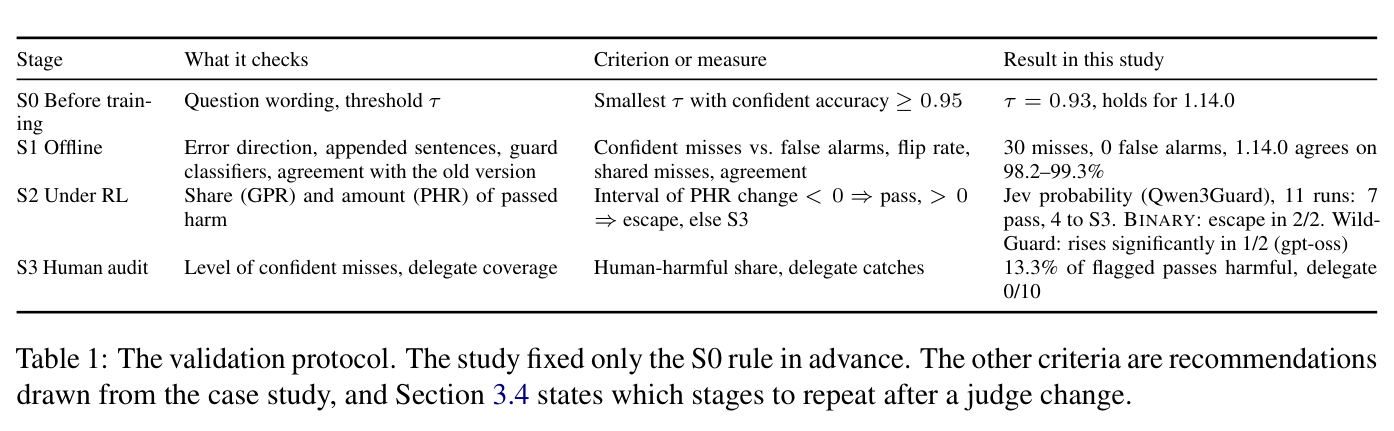
From fixed v1, PDF page 2. Copyright belongs to the original authors. The original panel and caption are preserved without scientific edits; source/crop/SHA are in provenance. Author results are not local measurements.
Core equations¶
Read source locations: §3.1–3.4;§4–5;AppendixC human audit.
Paper results and production evidence¶
Across eleven runs the passed-harm amount falls even when its share of remaining harm rises: concentration is not escape. Judge replacement/version changes need revalidation; a late-window human audit cannot measure temporal change. No recommendation-production A/B is reported.
Local component¶
Data contract and code mapping¶
Confidence gate, held-out calibration threshold, distinct PHR/GPR denominators, prompt-level bootstrap and judge-version revalidation; no commercial judge implementation.
They share the prompt and are dependent, which can understate interval width. The source uses 2,000 prompt resamples and excludes 100 calibration items from later evaluation; version changes recheck the threshold rule.
PYTHONPATH=src python -c 'from auto_research.post_training.jev_safety_reward import diagnostic; print(diagnostic(42, device="cpu"))'
PYTHONPATH=src python -m pytest -q tests/post_training/test_nov18_latest_post_components.py
Results, negative controls and limits¶
CPU seeds 42/43/44 were executed. Metrics contain operator/control results, not task-success rates. CPU-only protocol; no CUDA path is advertised.
share_can_rise_without_more_passed_harm, prompt_bootstrap_detects_decline, judge_change_requires_revalidation, replacement_requires_human_audit.
High-cost full experiment¶
The original configuration is recorded verbatim with source locations in the cost assessment. It involves 76,800 rollouts per run, eleven RL runs, 8B policies/guards, a 120B second reference, commercial judges and human audit.
The high-cost full experiment is not reproduced (review DONE). This is a source-configuration assessment, not a local timing claim. Only declared tiny-operator checks are allowed; no large-model probe is run to prove cost. No capability comparison or Evolve integration is claimed.