Margin Dynamics for Large Language Model Alignment¶
l1_mechanism standalone component; diagnostic only. Full experiments are not reproduced due to high cost (review DONE). No automatic retries or Evolve promotion.
Paper information¶
| Field | Value |
|---|---|
| Paper | arXiv 2611.21766v1; fixed v1 |
| First author / institution | Xingzi Xu; Amazon |
| Original publication | 2026-11-16 19:02:17 UTC; original submission, not announcement/review date |
| Original source code | No verifiable method-source release found in fixed v1 or the bounded author entry points checked. Referenced trainers, models and libraries are not this paper's source release. |
| Local adapter / key | margin-dynamics-tpo; adapter: null |
| Local code | src/auto_research/post_training/margin_dynamics_tpo.py |
Original paper summary¶
Background and defining changes¶
An ordinary sigmoid preference loss can keep increasing the margin. Saturated easy examples leave concentrated hard-example interference. TPO seeks restoring force near a target and bounded distant gradients.
Label smoothing balances the two forces at delta*=log((1-epsilon)/epsilon). The original length-normalized score gap must divide by beta and add mu; the margin shift cannot be omitted.
Original paper figure¶
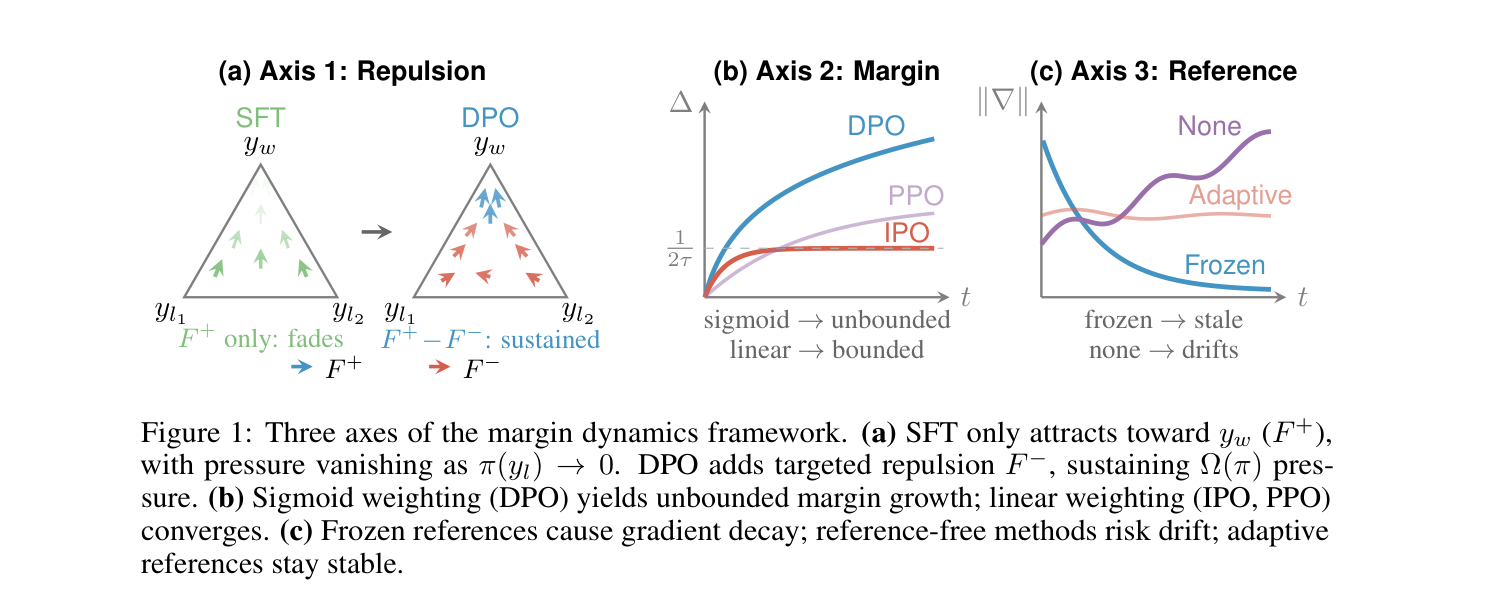
From fixed v1, PDF page 3. Copyright belongs to the original authors. The original panel and caption are preserved without scientific edits; source/crop/SHA are in provenance. Author results are not local measurements.
Core equations¶
Read source locations: §2.1 Eq.3;AppendixB Eq.25;§3 experimental setup.
Paper results and production evidence¶
The paper connects SFT, DPO/SimPO and IPO through margin dynamics and constructs finite-attractor TPO-H/S losses. Two-completion gradient-flow theory is only an effective approximation for shared-parameter LoRA training; fitted beta_eff is not a full-model theorem. No production A/B is reported.
Local component¶
Data contract and code mapping¶
TPO-S label-smoothed sigmoid on length-normalized scores and Appendix-B normalized-Huber TPO-H; finite-attractor and bounded-gradient checks.
Neither without checking normalization. Appendix B uses error squared/(2 delta), then absolute error-delta/2. Distant per-example gradient magnitude is one before batch averaging.
PYTHONPATH=src python -c 'from auto_research.post_training.margin_dynamics_tpo import diagnostic; print(diagnostic(42, device="cpu"))'
PYTHONPATH=src python -m pytest -q tests/post_training/test_nov18_latest_post_components.py
Results, negative controls and limits¶
CPU seeds 42/43/44 were executed. Metrics contain operator/control results, not task-success rates. A real A100/A30 receipt must pass the batch GPU gate before CUDA validation is claimed.
below_attractor_pushed_up, attractor_zero_gradient, overshoot_restoring_force, huber_gradient_bounded, huber_target_is_stationary.
High-cost full experiment¶
The source configuration in Appendix E totals approximately 153 GPU-hours using eight A100-40GB GPUs. Individual Qwen3-8B LoRA-rank-64 runs peak near 24GB. The standard replication additionally uses one SFT epoch on UltraChat-200k, 60K preference pairs for 5,000 steps and five seeds per method. This is a full data-size/noise/method campaign, not a scalar-loss check.
The high-cost full experiment is not reproduced (review DONE). This is a source-configuration assessment, not a local timing claim. Only declared tiny-operator checks are allowed; no large-model probe is run to prove cost. No capability comparison or Evolve integration is claimed.