Regularized Score Centering¶
l1_mechanism standalone component; diagnostic only. Full experiments are not reproduced due to high cost (review DONE). No automatic retries or Evolve promotion.
Paper information¶
| Field | Value |
|---|---|
| Paper | arXiv 2611.21791v1; fixed v1 |
| First author / institution | Hao Bai; University of Illinois Urbana-Champaign |
| Original publication | 2026-11-16 19:12:50 UTC; original submission, not announcement/review date |
| Original source code | Author repository; verified revision 2fd280c420faa875809d4bb632ad1d2367e229cc; no project-level licence verified; upstream source not copied. Release evidence only; upstream training not executed. |
| Local adapter / key | regularized-score-centering; adapter: null |
| Local code | src/auto_research/post_training/regularized_score_centering.py |
Original paper summary¶
Background and defining changes¶
No. It subtracts the behavior expectation of a weighted log-policy gradient at the same history. Response advantages may already be centered while the behavior-averaged learner score remains nonzero.
No. Sample and auxiliary reward ratios are independently computed and TIS-clipped. The KL term has its own cap. Coefficients are detached in the score surrogate and behavior remains fixed within an inner fit.
Original paper figure¶
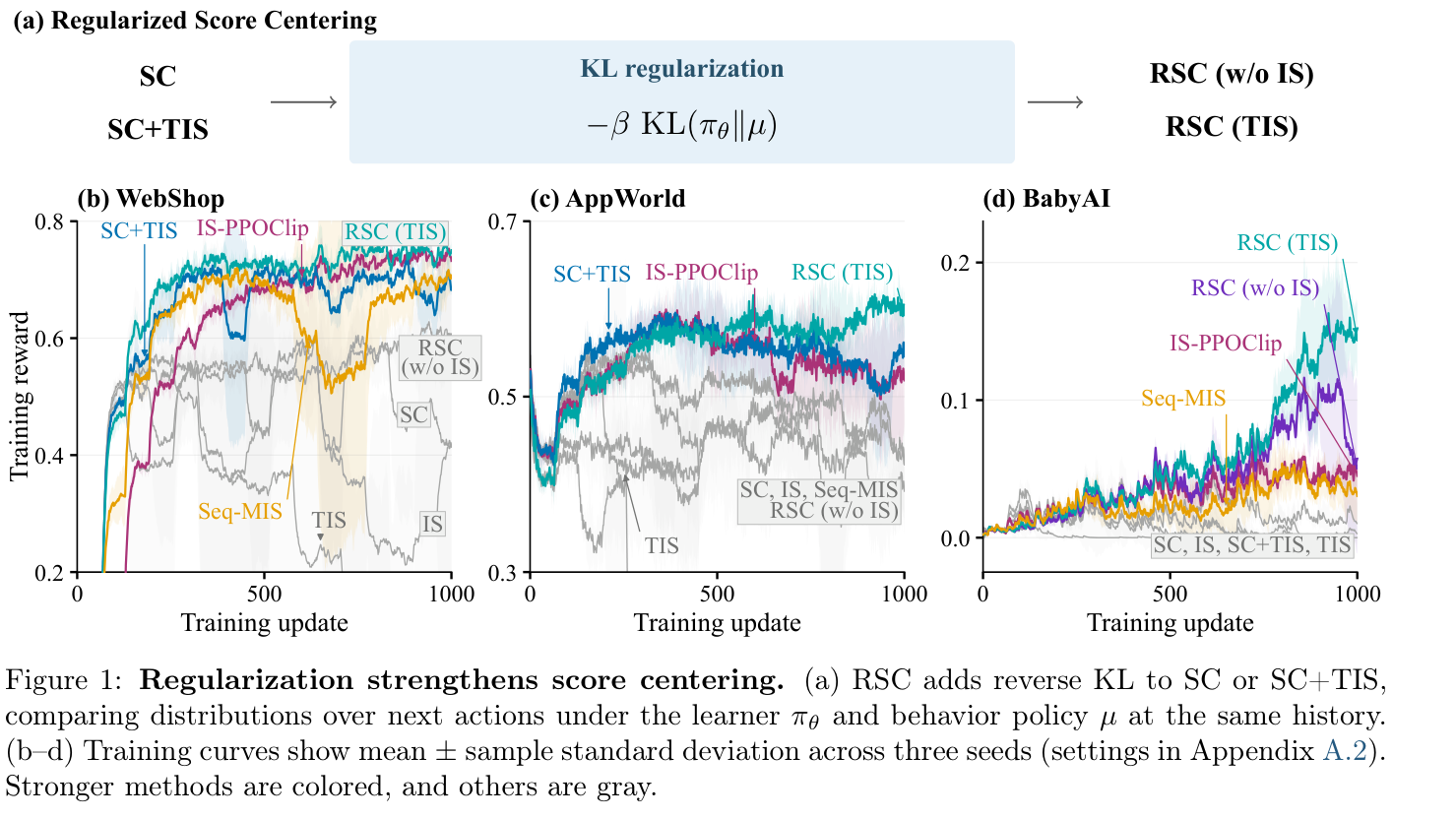
From fixed v1, PDF page 1. Copyright belongs to the original authors. The original panel and caption are preserved without scientific edits; source/crop/SHA are in provenance. Author results are not local measurements.
Core equations¶
Read source locations: PDFp1 author superscripts;§3 Eq.3–8;§5.2 and AppendixA sampling.
Paper results and production evidence¶
The source studies stale behavior policies and train/inference numerical mismatch on math and six agentic tasks. SC reduces baseline-induced drift but can still leave the behavior policy; reverse KL constrains that movement. Auxiliary estimator cost, ratio caps and refresh cadence jointly matter. No production A/B is reported.
Local component¶
Data contract and code mapping¶
Weighted score centers from independent auxiliary actions, detached TIS weights and reverse-KL gradient estimator with an independent KL cap; not reward centering.
It is a detached-score surrogate with the prescribed gradient, not an unbiased numerical estimate of W. Tests compare gradients against full-action enumeration and a no-center control, not agent returns.
PYTHONPATH=src python -c 'from auto_research.post_training.regularized_score_centering import diagnostic; print(diagnostic(42, device="cpu"))'
PYTHONPATH=src python -m pytest -q tests/post_training/test_nov18_latest_post_components.py
Results, negative controls and limits¶
CPU seeds 42/43/44 were executed. Metrics contain operator/control results, not task-success rates. A real A100/A30 receipt must pass the batch GPU gate before CUDA validation is claimed.
exact_action_enumeration_gradient, center_is_not_reward_mean, external_advantage_frozen, finite_gradient.
High-cost full experiment¶
The original configuration is recorded verbatim with source locations in the cost assessment. It involves Qwen3-32B, 64 rollouts per prompt, 32/64/128 auxiliary actions per token and six agent environments.
The high-cost full experiment is not reproduced (review DONE). This is a source-configuration assessment, not a local timing claim. Only declared tiny-operator checks are allowed; no large-model probe is run to prove cost. No capability comparison or Evolve integration is claimed.