TAILROLL: Tail-Aware Rollout Acceleration for RL-Based LLM Post-Training¶
Review only; no local model implementation. Full experiments are not reproduced due to high cost (review DONE). No automatic retries or Evolve promotion.
Paper information¶
| Field | Value |
|---|---|
| Paper | arXiv 2611.22206v1; fixed v1 |
| First author / institution | Niloofar Gholipour; École de technologie supérieure, Canada |
| Original publication | 2026-11-17 04:44:20 UTC; original submission, not announcement/review date |
| Original source code | No verifiable method-source release found in fixed v1 or the bounded author entry points checked. Referenced trainers, models and libraries are not this paper's source release. |
| Local adapter / key | tailroll; adapter: null |
| Local code | None; no placeholder model |
Original paper summary¶
Background and defining changes¶
The longest tail response can set rollout-step duration. TailRoll migrates in-flight requests at chunk boundaries and separately terminates stragglers once enough siblings finish.
It uses stateless in-flight migration: the destination reconstructs state from prompt/generated tokens and resumes after one re-prefill, guarded by costs, reservations, hop limits and post-migration checks.
Original paper figure¶
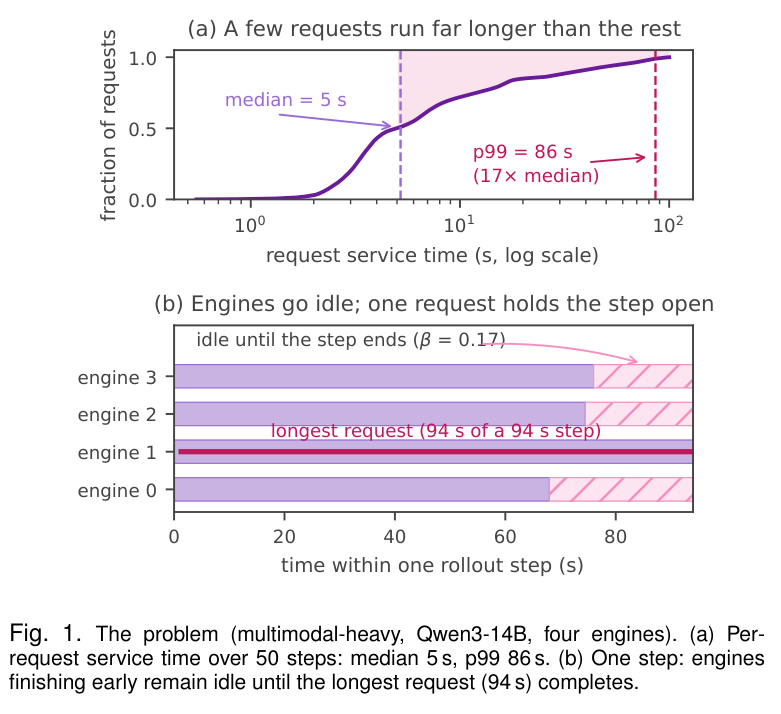
From fixed v1, PDF page 1. Copyright belongs to the original authors. The original panel and caption are preserved without scientific edits; source/crop/SHA are in provenance. Author results are not local measurements.
Core equations¶
Read source locations: §V migration policy and sufficiency termination;§VI–VII Ascend setup and 300-step results.
Paper results and production evidence¶
The authors compare multi-engine 14B/32B runs on Ascend 910C and report improved bubble/imbalance and rollout/step time. Such gains require real queues and KV state; sufficiency termination also needs reward-retention controls. No recommendation-production A/B is reported.
Cost decision and local status¶
Data contract and code mapping¶
Review actual multi-engine in-flight migration, one-time re-prefill and partial-output loss masking; no offline scheduler simulation claims system speedups.
It lacks real multi-engine recovery, decode contention, re-prefill cost and training-reward effects. The source uses multiple Ascend 910Cs; a single A100/A30 numerical rule cannot establish that system result, so the full experiment is not reproduced.
Results and limits¶
No local model run, checkpoint/data download, paid API call or invented metric file. Review DONE does not mean implementation completed.
High-cost full experiment¶
The original configuration is recorded verbatim with source locations in the cost assessment. It involves Qwen3-14B/32B, multiple Ascend 910Cs and real engine migration/re-prefill across ten configurations and 300-step training.
The high-cost full experiment is not reproduced (review DONE). This is a source-configuration assessment, not a local timing claim. Only declared tiny-operator checks are allowed; no large-model probe is run to prove cost. No capability comparison or Evolve integration is claimed.