Ambient LLMs: Data-Efficient Supervised Fine-tuning via Temperature Matching¶
l1_mechanism standalone component; diagnostic only. Full experiments are not reproduced due to high cost (review DONE). No automatic retries or Evolve promotion.
Paper information¶
| Field | Value |
|---|---|
| Paper | arXiv 2611.23229v1; fixed v1 |
| First author / institution | Giannis Daras; Massachusetts Institute of Technology |
| Original publication | 2026-11-17 18:59:37 UTC; original submission, not announcement/review date |
| Original source code | No verifiable method-source release found in fixed v1 or the bounded author entry points checked. Referenced trainers, models and libraries are not this paper's source release. |
| Local adapter / key | ambient-sft; adapter: null |
| Local code | src/auto_research/post_training/ambient_sft.py |
Original paper summary¶
Background and defining changes¶
The aim is to retain a coarse distribution during small-data SFT, not copy every base-model detail. Temperature reduces trust in erroneous details while clean CE supplies the adaptation signal.
The source has no T-squared factor: KL vanishes as temperature grows, recovering SFT. Adding it changes that limit and the temperature-controlled bias–variance trade-off.
Original paper figure¶
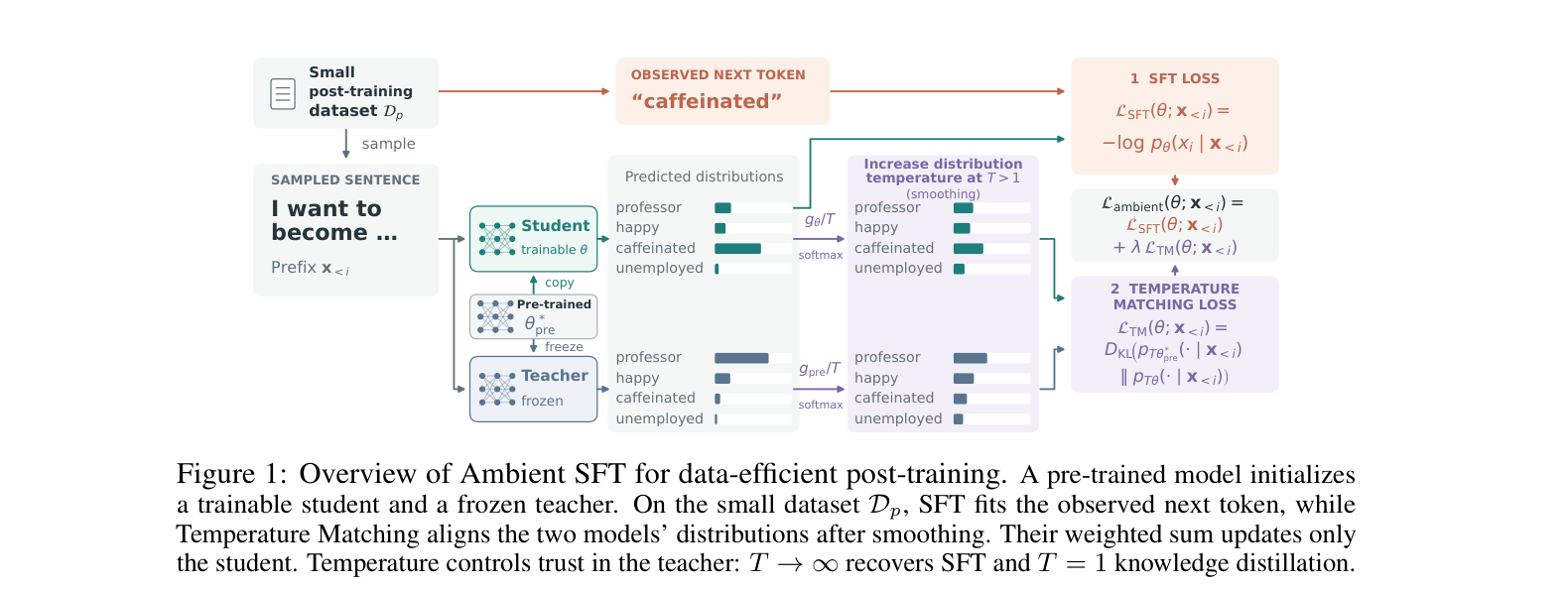
From fixed v1, PDF page 2. Copyright belongs to the original authors. The original panel and caption are preserved without scientific edits; source/crop/SHA are in provenance. Author results are not local measurements.
Core equations¶
Read source locations: §3.1 Eq.4 and practical implementation;§4 Tables2–5.
Paper results and production evidence¶
The authors compare a frozen base, vanilla SFT and temperature matching across domain adaptation, instruction tuning and reasoning. The Qwen3 1.7B–14B matrix reports average relative gains, but the temperature depends on task and data; the largest reported gain is not a universal guarantee. No production A/B is reported.
Local component¶
Data contract and code mapping¶
Exact CE and same-position tempered forward KL, frozen teacher and stochastic clean/matching branches; no T-squared multiplier.
No. They execute the exact loss, frozen-teacher and masked-gradient controls, without checkpoint adaptation or capability scores. The stochastic objective equals p_c times the stated objective in expectation, so learning-rate comparisons must disclose that overall scale.
PYTHONPATH=src python -c 'from auto_research.post_training.ambient_sft import diagnostic; print(diagnostic(42, device="cpu"))'
PYTHONPATH=src python -m pytest -q tests/post_training/test_nov18_latest_post_components.py
Results, negative controls and limits¶
CPU seeds 42/43/44 were executed. Metrics contain operator/control results, not task-success rates. A real A100/A30 receipt must pass the batch GPU gate before CUDA validation is claimed.
teacher_frozen, exact_unscaled_combination, masked_tokens_have_zero_gradient, high_temperature_recovers_sft, stochastic_branch_boundary.
High-cost full experiment¶
The original configuration is recorded verbatim with source locations in the cost assessment. It involves Qwen3 1.7B–14B plus OLMo/Llama, multiple domains/temperature baselines and a frozen teacher forward.
The high-cost full experiment is not reproduced (review DONE). This is a source-configuration assessment, not a local timing claim. Only declared tiny-operator checks are allowed; no large-model probe is run to prove cost. No capability comparison or Evolve integration is claimed.