How Reward Gain Imbalance Shapes Ranking: Rethinking Rubric-Based Reward Aggregation¶
Independent L1 mechanism component, diagnostic only. The high-cost full experiment is not reproduced (review DONE), with no automatic retry or Evolve promotion.
Paper information¶
| Field | Content |
|---|---|
| Paper link | arXiv 2611.24005v1; fixed v1 |
| Company / author institution | First author Zhengyuan Fan: Northwestern Polytechnical University, verified from the fixed-v1 byline rather than cited model names |
| Original publication date | 2026-11-18T07:56:58Z (UTC original submission); the November19 announcement/review is not the publication date |
| Original source code | No verifiable method-source release found in fixed v1 or the bounded author entry points checked. Referenced models and trainers are not this paper's source release. |
| Local adapter / key | dcc-aggregation; adapter: null |
| Local reproduction code | src/auto_research/post_training/dcc_aggregation.py |
Original paper summary¶
Background and main changes¶
Equal rubric weights do not imply equal contributions: each criterion's mean satisfied-versus-unsatisfied score gap is its reward gain. The paper decomposes pairwise reward differences into a base satisfaction signal, gain imbalance and residuals. Equalizing every gain to one can amplify noise in small-gain criteria.
DCC neither retrains the judge nor learns rubric weights. It pools all candidate-by-criterion scores for one prompt, fits exact one-dimensional two-medians by minimum absolute deviation and uses the two centers as a shared clipping interval, selecting the smallest split on ties. Scores are clipped before optional criterion-weighted averaging; weights do not influence the center fit.
Key original figure¶
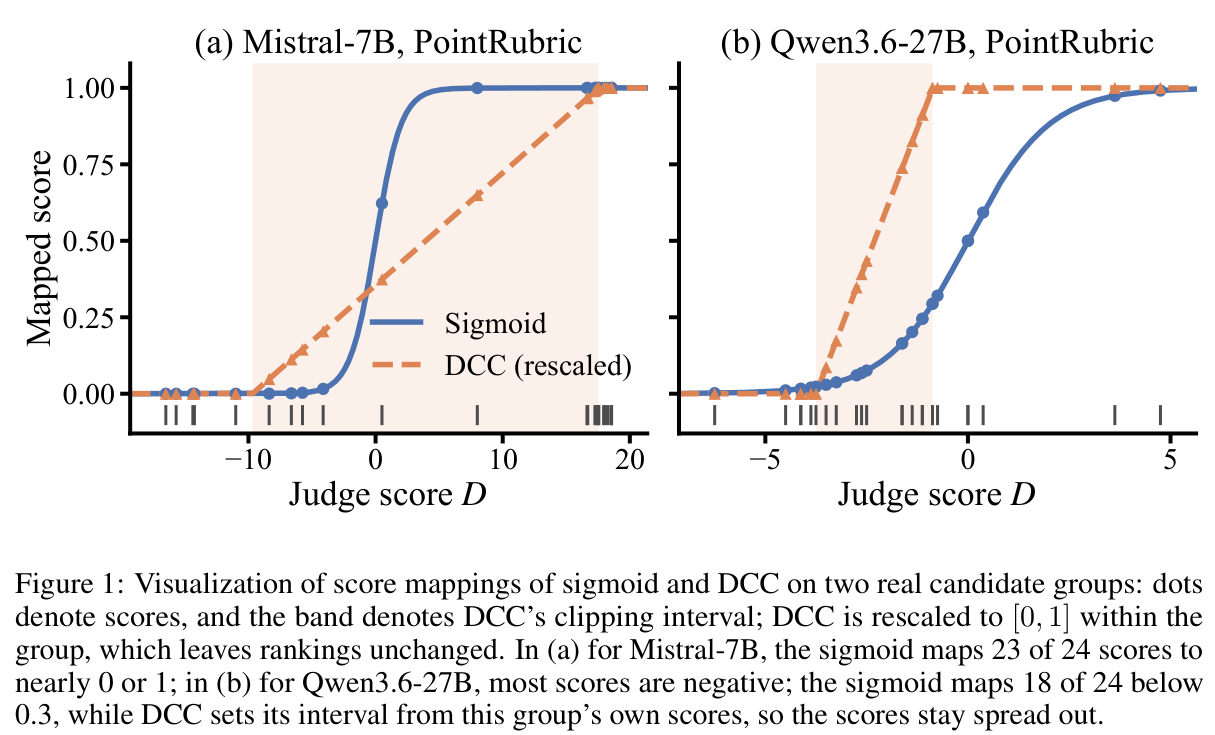
Original figure and full caption from fixed-v1 PDF page7; copyright belongs to the original authors. No scientific content was redrawn or changed. Crop and hashes: provenance. Author results are not local experiments.
Core formula¶
Source locations: §3 Eq.1–7 reward decomposition; §4 Eq.8–13; Appendix C GRPO configuration.
Paper results and online evidence¶
The authors compare aggregation on PointRubric, RubricHub-6 and WritingBench GRPO, reporting stronger ranking metrics and writing evaluation under the tested settings. The non-expansive bound does not guarantee improved rankings on arbitrary data: an isolated extreme can itself form the high-score cluster. No production online A/B is reported.
Relation to existing methods¶
DynamicRubric changes evaluation criteria and weights while co-evolving with the policy. DCC treats rubric, judge and weights as given, fitting shared clipping endpoints from the current group's numeric scores. They address different levels—evaluator adaptation versus score-scale effects—and an aggregator is not a dynamic judge.
Local reproduction¶
Data protocol and code mapping¶
CPU exact 1D two-medians, shared clipping, constant-score degeneracy, smallest-split tie breaking and optional weighted reduction. It consumes existing legitimate judge scores, without calling or simulating a judge or training GRPO.
PYTHONPATH=src python -c 'from auto_research.post_training.dcc_aggregation import diagnostic; print(diagnostic(42))'
PYTHONPATH=src python -m pytest -q tests/post_training/test_nov19_post_components.py
Results, negative controls and limits¶
Independent CPU seeds42/43/44 were executed: metrics. These test formulas, boundaries and negative controls, not capability or ranking performance.
This is a CPU scalar/sequence algorithm without an advertised CUDA path; GPU testing would not turn it into a model experiment.
Two-medians can isolate an extreme in its own cluster, making that value the upper endpoint. DCC offers a conditional contribution bound, not universal outlier removal or capability improvement.
High-cost full experiment¶
Appendix C uses three 96GB RTX PRO6000 GPUs per GRPO run (two policy/rollout, one judge), a 7B policy and 27B judge, eight responses per prompt, three seeds and multiple aggregation controls. Full judge inference and RL are not run; scalar aggregation requires no GPU.
High cost: not reproduced (review DONE). Resource and timing statements come from the paper, not local measurements. No checkpoint/data download, full-experiment probe or automatic retry is performed. The budget is one A100 or A30, or a Mac; multiple GPUs or simultaneous hosts are not assumed.