Spatial Ads: LP and Randomized Rounding for Spatial Externalities
Paper information
| Field | Details |
|---|---|
| Paper | Online Advertising with Spatial Interactions |
| Organization | Google Research; first-listed author Gagan Aggarwal. |
| First public release | 2026-02-12 (arXiv v1); a printed August date does not replace v1. |
| Authors' code | No author code link was found in the reviewed paper. |
| Adapter / method | spatial-ads; standalone CPU component, no reproduce adapter. |
| Local reproduction code | src/auto_research/reproductions/spatial_ads_components.py |
Method overview
Neighboring ad placements affect ad value. The local component implements the paper's grouped pseudo-disk LP relaxation and two-stage randomized rounding, checking group exclusivity and that no selected disk's center is covered by another selected disk. It does not reproduce full matching, live auctions, or the end-to-end factor-18 approximation.
Original paper
Motivation and method
Independent slot auctions ignore spatial interference. The paper reduces nearest-neighbor externalities to grouped pseudo-disk selection and rounds an LP to a feasible set. It also studies simple auctions for decomposable value, a 2D PTAS, and hardness of the product-distance model. Local scope is v1 Section 2.2, Algorithm 1 and Eq. 2.
flowchart LR
  A[Grouped disks and metric distances] --> B[LP with coverage and group constraints]
  B --> C[Independently sample with x divided by 3]
  C --> D[Check conflicts against the whole sample]
  D --> E[Eq. 2 second thinning]
  E --> F[Verify weak constraint II]
Key figure from the paper
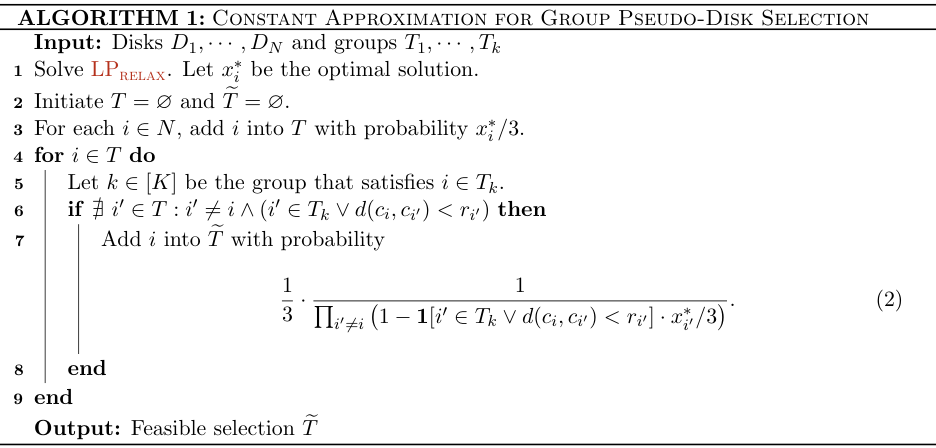
Algorithm 1, PDF p. 10: Original sampling, full-sample conflict checks, and second thinning. The screenshot is a mathematical algorithm, not a model diagram. From the original paper; copyright remains with the authors.
Core equations
The first stage samples independently with \(x_i/3\); an unconflicted item survives with probability:
The indicator in the formula is one when the other disk is in the same group or covers the center. SciPy HiGHS solves the actual LP. Conflicts are evaluated against the entire original sample, not a greedily accepted subset, and coverage uses strict inequality. Invalid distances or probabilities fail without heuristic fallback.
Paper results
This theoretical algorithm paper reports no production A/B or full-traffic evidence. The factor-18 approximation requires the complete reduction and reverse matching; this component does not establish that guarantee. There is no expensive neural training experiment to reproduce.
Local reproduction
pip install -e '.[research-components]'
PYTHONPATH=src python scripts/run_google16_statistics.py --seed 42 --output runs/google16-statistics.json
Data protocol and results
A constructed three-point metric and three disks test LP feasibility, constraint II for all samples, and marginal retention near \(x_i/9\) under independent seeds. This is L1 mechanism evidence, not ad performance. CPU only. Stable record: metrics/component-cpu-seed42.json.
Implementation and limits
constraints and solve_relaxation implement the LP, round_solution implements Algorithm 1, and feasible_ii checks feasibility independently. The full ad-matching reduction, Myerson payments, and 2D PTAS are out of scope. full_experiment_status=not_applicable_theoretical_paper records that no training experiment exists, rather than labeling it costly. This user-selected theoretical component does not become an industrial adapter or Evolve operator automatically.