OneLatent: Latent Reasoning for Efficient Foundation Recommendation Models
Reference entry only. No executable local model or diagnostic proxy. Full experiments not reproduced due to cost.
Paper information
| Field | Details |
|---|---|
| Paper | OneLatent: Latent Reasoning for Efficient Foundation Recommendation Models |
| Affiliations | Co-first authors Hao Jiang, Peiru Du and Pengfei Yao: Kuaishou Technology. |
| First public release | 2026-10-22 03:39:38 UTC |
| Author code | No OneLatent-specific repository, revision or license verified. OpenOneRec data and the OneReason base are not its training implementation. |
| Local key | onelatent; no adapter |
| Local code | No executable local implementation. |
| Local evidence | No local experiment, metrics or GPU receipt. |
What the paper changes
Explicit recommendation CoT adds latency and can overthink or inherit a rigid template. Use exploration, evaluation and attribution views to generate adaptive teacher supervision, learn three latent tokens, and serve three-level SIDs without long text. Alignment reconstructs single-view reasons, then multiple views, then predicts next SID from request context.
Original paper figure
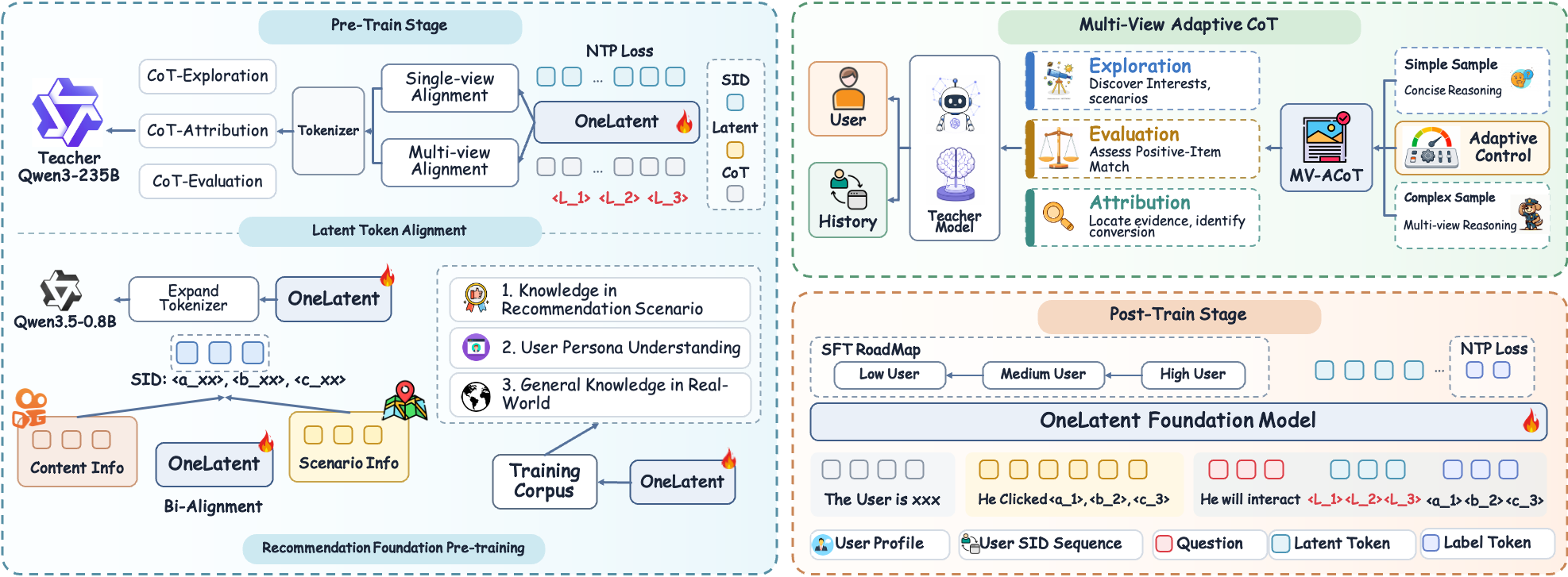
Original figure from the reviewed paper, reused without redrawing. See figure provenance.
Core equations
Average tokens inside each rationale and then available views equally. No separate encoder/projector/decoder or strict latent bottleneck: ordinary causal masking, all student weights trainable, outputs still see profile/history. Evaluation/attribution teachers may see the positive item; the student prefix excludes target SID and its description. Curriculum goes high to low user activity, then mixes with/without latent SFT 1:1. Behavior-triggered deduplication, rate limiting and async cache move inference off the request path; candidates merge with existing retrieval and share ranking.
Results reported by the authors
Section 4.6/Table 9 reports seven days, Sep 3–10 2026, 5% per arm: impressions +2.566%, ad spend +5.157%. The 9.6% revenue gain is an estimate from a global posterior estimator, not observed A/B revenue. The paper reports full rollout afterward. 17.49× throughput is an 872-example comparison against explicit CoT, not local. Similarity of reconstructed reasons does not prove faithful reasoning.
Local reproduction and limits
Literature, original figure and cost/production evidence only; no model, benchmark metrics, GPU receipt or Evolve mapping.
Full experiment: not reproduced
Appendix A.1 uses seven nodes × eight GPUs, full-parameter BF16, 4,096 tokens and two effective epochs, Qwen3-235B-A22B teacher and industrial data. No weights, scaled-down proxy, full trial or retry.