WeSearch: Cluster-constrained candidate spaces and atomic-document matching
L1 CPU index/numerical components; diagnostic only. The full model and production experiments are not reproduced due to cost (review complete). No executable Evolve integration.
Paper information
| Field | Details |
|---|---|
| Paper | Fixed v1, full text |
| Title | WeSearch: A Unified Model-Centric Retrieval Framework for WeChat Search |
| Affiliation | First author Kepu Zhang, Tencent / WeChat Search Group. Yuzhe Cai and Yue Shu are also equal contributors. |
| First publication | October 31, 2026, 01:35:20 UTC (v1); announced November 3, not first published on this review date. |
| Author code | No WeSearch author release was found/verified in the reviewed paper and arXiv links. Referenced frameworks are not its implementation. |
| Local adapter / key | wesearch; adapter: null, standalone CPU component |
| Local code | src/auto_research/reproductions/wesearch_components.py; tests/test_nov04_wesearch.py |
| Evidence | Three-seed CPU component metrics; no GPU training or capability evaluation |
What the paper changes
A cluster constrains the candidate space rather than becoming an irreversible semantic-ID prefix. The union retains atomic documents for a coarse-to-fine ranker. The learned OPQ artifacts and rolling index updates matter; random fixed codebooks cannot replace the training pipeline.
Original paper figure
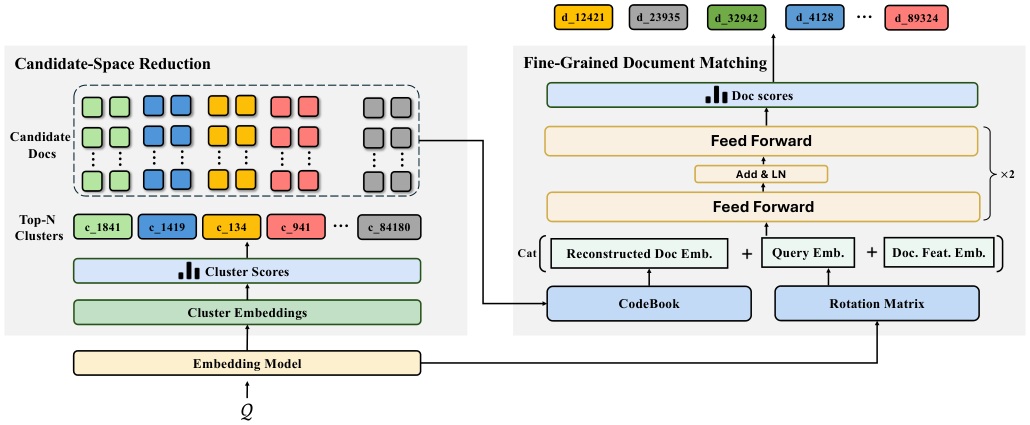
Unmodified image from v1 Figure 2. Copyright belongs to the authors; the paper has an arXiv non-exclusive license. See assets/provenance.json for source and hash.
flowchart LR
  Q[External query embedding] --> C[Select clusters by negative L2]
  C --> U[Union member documents]
  U --> A[ADC lookup with fixed OPQ codes]
  A --> P[Coarse shortlist]
  P -. Not implemented locally .-> F[Trained feature-aware FFN]
  N[Fresh document embedding] --> M[Fixed-cluster and codebook assignment]
  M --> S[New snapshot preserves the previous version]
Core equations
Equations 2–3/13 select clusters and take their document union:
Equations 7–11 rotate and quantize each subspace. Reconstruction stays in rotated space. Equation 26 computes squared distance by table lookup:
Equation 15 scores with \(-\sqrt D\). Its ranking matches negative squared distance but numerical thresholds do not. The caller supplies trained rotation, centroids and codebooks; local code does not fit OPQ or RQ-KMeans.
Reported results, not local measurements
Section 6.5.2/Table 5 reports a one-month full-traffic production A/B: relative CTR +0.68%, per-user article clicks +2.27% and dwell time +0.71%, with \(p<0.05\). Whole-system resource cost falls 41% and graphic-text retrieval latency 19 ms. These are not CPU-component results or isolated ADC effects.
Local execution and boundaries
PYTHONPATH=src python -c 'from auto_research.reproductions.wesearch_components import diagnostic; print(diagnostic(42))'
Data and interpretation
Small matrices from seeds 42/43/44 test the ADC/reconstruction identity, candidate union, shortlist ordering, invalid-code rejection and snapshot isolation. This is not a retrieval benchmark, split-based tuning or recommendation-quality comparison. Stable cluster order/document IDs resolve ties by a local deterministic convention.
Code mapping
quantize/reconstruct map to Equations 7–11; adc_squared_distance to Equation 26; candidates/coarse_shortlist to Algorithm 1 steps 5–8. mount constructs a fresh immutable snapshot with fixed artifacts. The caller must perform any visibility swap; distributed atomicity is not implemented.
Full experiment: not reproduced due to cost
The private corpus scales from hundreds of millions to billions of documents, plus tens of millions of fresh items. Private teachers, query encoders/FFNs, rolling training and month-long production testing exceed the single A100/A30 or Mac budget. Full GPU-hours are undisclosed; this is a resource assessment, not a local runtime estimate. No models/corpus are downloaded or automatically retried. CPU checks do not reproduce the encoder, FFN, lexical tree or service stack.