ReuseGR: shared prefix planning and request-specific personalization
L1 CPU mechanism components; diagnostic only. The complete experiment is too costly and is not reproduced (review DONE). No generator or branch policy is trained; no executable Evolve integration is claimed.
Paper information
| Field | Details |
|---|---|
| Paper | Pinned v1, full text |
| Original title | ReuseGR: Offline–Online Decoupled Generative Retrieval via Adaptive Prefix Reuse |
| Company / institutions | First author Xujing Wang, Xidian University; collaboration with Alibaba International Digital Commerce Group, with Yufeng Chen as project leader |
| First public date | 2026-11-03 03:51:38 UTC; announced and first collected here on November 4, not first published on November 4 |
| Author code | No author implementation found in the pinned paper or its arXiv links; cited retrieval systems are not this paper's code |
| Local adapter / key | reusegr; adapter: null, standalone CPU mechanism components |
| Local code | src/auto_research/reproductions/reusegr_components.py; tests/test_nov04b_recommendation.py |
| Local evidence | Three-seed CPU contracts, not a retrieval-quality comparison |
Original paper
Motivation and changes
An all-online generator repeatedly predicts similar coarse SID prefixes when different users submit the same query. ReuseGR moves query-level 7B planning offline and gives the current user's history to a 0.5B online suffix model. Prefix depth is a coverage–cost boundary, not a quantity to maximize. Path KD trains the suffix scorer before freezing it; OPD and GRPO then train BudgetCut. A branch's usefulness depends on the branches already admitted, so static score ranking is not a substitute for the learned admission policy.
Original figure
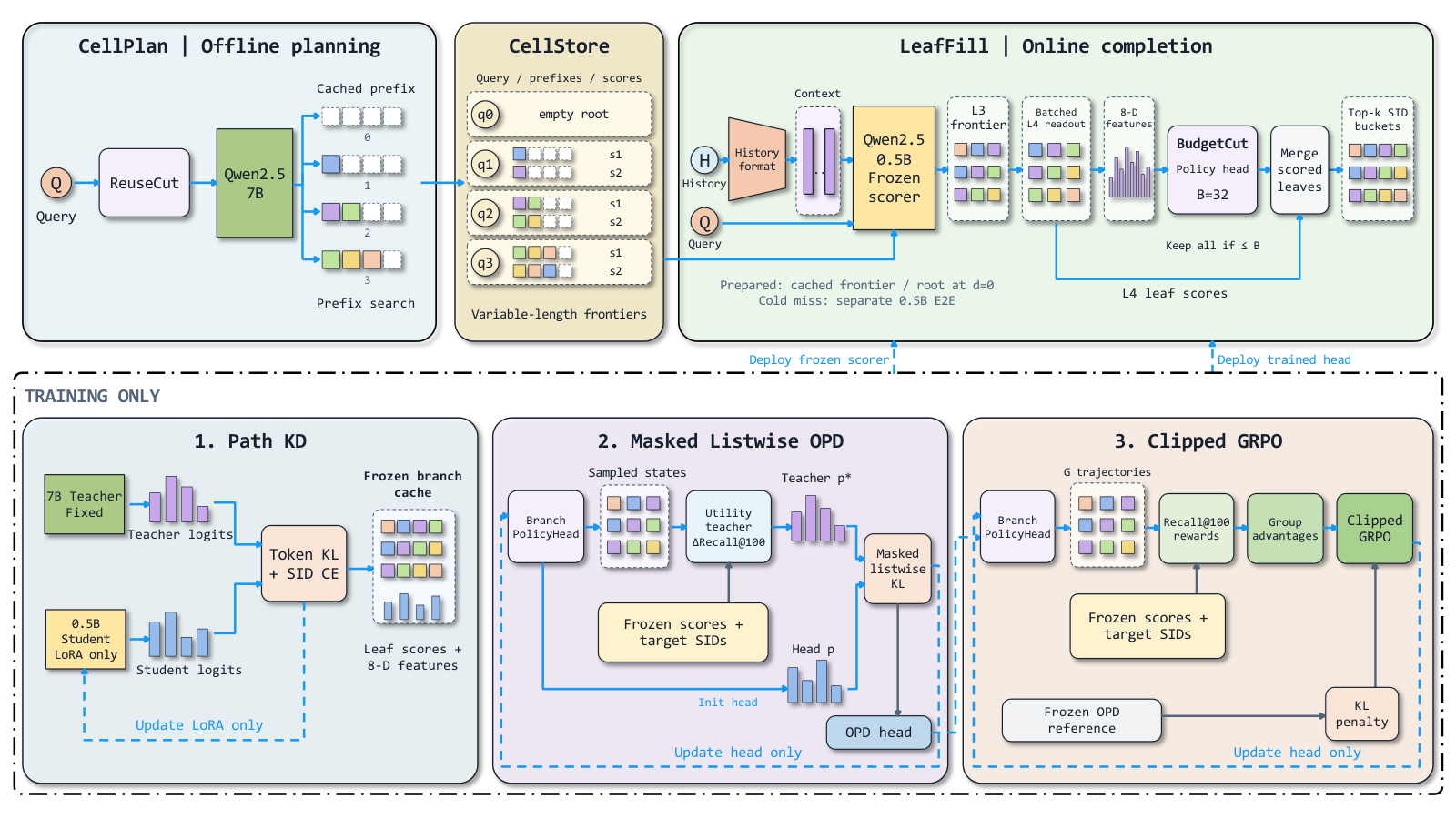
From pinned v1, Figure 2, without redrawing. Copyright remains with the authors; the paper is CC BY 4.0. Source and checksum are in assets/provenance.json.
flowchart LR
  H[Fit click rows only] --> L[Whole-row leave-one-out coverage]
  L --> D[Per-level Wilson criterion and depth labels]
  Q[Query] -. Not trained locally .-> P[7B planner and depth classifier]
  P --> C[Prepared query prefixes]
  C --> F[0.5B completion with current history]
  F -. Not trained locally .-> B[Learned BudgetCut]
  B --> R[Complete SID ranking]
M[Cold cache miss] --> E[Separate 0.5B E2E fallback]Equations
In Eqs. 5–6, prefix top-N sets are ranked by the click mass of other aggregated rows, whereas coverage gives each original aggregated row equal weight. Fit-side leave-one-out removes every click in the held-out row, not a single repeated click. Apply the Wilson lower endpoint with \(z=1.96\) at each level, then choose
Queries with fewer than five rows are Unknown, use depth zero in training-cache construction, and are excluded from classifier fitting. A deeper passing level cannot bypass a failed shallower level. The Wilson endpoint is the paper's finite-support criterion, not an IID confidence guarantee for dependent LOO estimates.
Eq. 10 combines an offline prefix log-probability with online suffix log-probabilities:
A prepared depth-zero query starts at the empty root with the Path-KD scorer. A genuine cold miss uses a separate E2E model. Having no stored prefix does not make these routes equivalent.
Published offline and online results
Section 5.7 and Appendix D report a 14-day user-randomized production A/B test, 10% search-advertising traffic per arm, against the 0.5B E2E retriever. Other channels, quotas, ranking, and bidding are unchanged. Relative changes are CTR +0.93%, RPM +1.05%, orders/request +0.78%, and CVR -0.21%; the negative result is retained. Offline HR@100 improves by 3.83 percentage points over the 0.5B baseline, with mean online latency -38.9% when the cache is prepared. That latency boundary excludes the complete offline-planning cost. None of these are local measurements.
Local components and boundaries
PYTHONPATH=src python -c 'from auto_research.reproductions.reusegr_components import diagnostic; print(diagnostic(42))'
Data protocol and code map
ClickRow/label_reuse_depth implement Fit-side whole-row LOO and the sequential depth criterion in Eqs. 5–6. cache_route distinguishes prepared depth zero from a cold miss; composite_score implements Eq. 10. Inputs are explicit external rows and model log-probabilities. The caller must supply real training data, time-respecting histories, and cache updates. Test labels must not fit depths or complete candidate sets.
Results, negative controls, and limitations
Seeds 42/43/44 generate small contract inputs checking whole-row removal, row-macro weighting, non-skippable shallow failures, Unknown versus cache miss, and score identities. We do not train the query classifier, 7B/0.5B models, Path KD, OPD, or GRPO. Learned BudgetCut is not implemented. No retrieval improvement or complete serving system is claimed.
High-cost complete experiment
Appendix A requires roughly two million private query–item records, 3.38 million items, multi-stage 7B/0.5B LoRA training (eight KD epochs), multiple baselines, and 14 days of production A/B testing. These are outside a lightweight single-A100/A30 or Mac reproduction. One A100 used for latency measurement does not establish cheap complete training. Too costly; not reproduced (review DONE). No model/log download or automatic retry.