SPADE: business-aligned tokenization and bounded diversity decoding
L1 CPU tokenization/decoding operators; diagnostic only. The complete experiment is too costly and is not reproduced (review DONE). This is not a local-search model or online-result reproduction; no executable Evolve integration is claimed.
Paper information
| Field | Details |
|---|---|
| Paper | Pinned v1, full text |
| Original title | SPADE: Spatiotemporal Preference Alignment and Diversity Enhancement for Local Search |
| Company / institutions | First author Chenxu Wang, Meituan; Shuxian Bi is an independent coauthor |
| First public date | 2026-11-03 10:50:31 UTC; announced and first collected here on November 4 |
| Author code | No author implementation found in pinned v1 or arXiv resources; unrelated same-name projects are not evidence |
| Local adapter / key | spade-local-search; adapter: null |
| Local code | src/auto_research/reproductions/spade_components.py; tests/test_nov04b_recommendation.py |
| Local evidence | Three-seed CPU contracts, not query-quality evaluation |
Original paper
Motivation and changes
A local-service homepage must suggest executable, location/time-appropriate and distinct search intents before the user types. SPADE changes four stages together: business-weighted OA-BPE merges; multiscale spatial/temporal STAR representations with soft gates; MARS-DPO alignment to production impression/click preferences; and a bounded parent-rank bonus in SDBS. Locally we implement only OA-BPE primitives and the SDBS expansion step. Omitting the other stages cannot count as reproducing complete SPADE.
Original figure
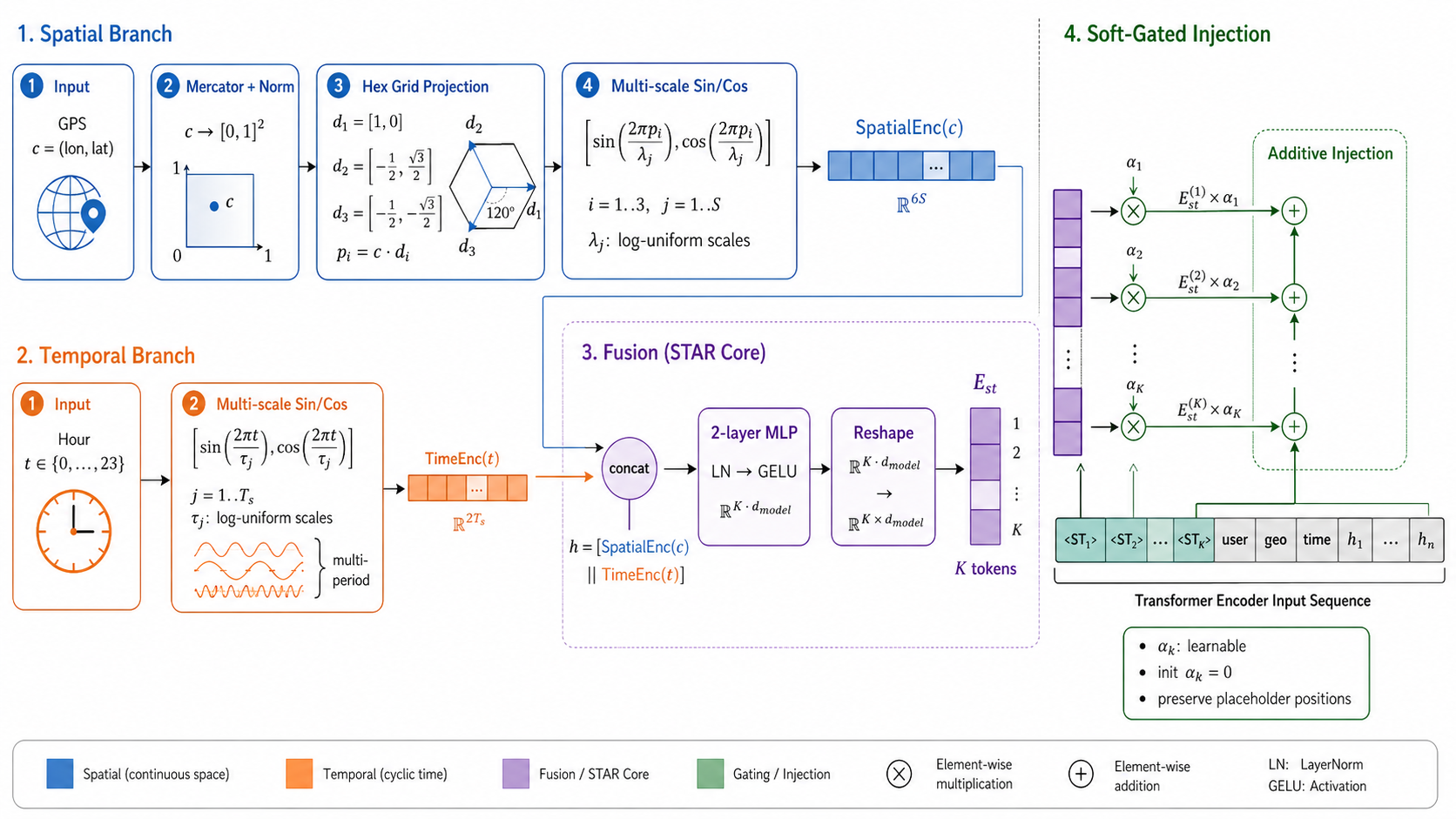
From pinned v1, Figure 2, without redrawing. Copyright remains with the authors under the paper's arXiv non-exclusive license. This illustrates STAR, which is not implemented locally. Source and checksum are in assets/provenance.json.
flowchart LR
  V[Fit business weights] --> B[OA-BPE weighted pair counts and merging]
  B --> T[Generation token space]
  S[Location time history] -. Not implemented .-> G[STAR gates]
  T -. Not trained .-> L[Generator and MARS-DPO]
  G --> L
  L --> P[External next-token logp]
P --> D[SDBS parent-rank bonus and pruning]Equations
Section 3.2, Eq. 1 is \(\operatorname{score}(a,b)=\sum_s w(s)\operatorname{count}_s(a,b)\). Unit weights recover ordinary pair frequency. Adjacent occurrences may overlap when counting, while an actual merge scans non-overlapping pairs. The caller supplies weights; we do not learn them from private CTR/CVR or provide a complete byte tokenizer.
Section 3.5, Eq. 17 and Algorithm 1 use
Here \(\alpha>0,\beta\ge0,0<\gamma\le1\), and \(b\) is the parent-beam rank after sorting at this step. Each parent contributes its top-\(2B\) tokens; merge and retain the top-\(B\) expansions. Accumulated scores retain previous bonuses. We permit \(\beta=0\) as the ordinary-beam negative control. Although \(\phi(0)=0\), a rival receiving a bonus can overtake the original top continuation. The paper itself conditions top-1 preservation on a margin larger than the maximum bonus; it is not unconditional.
Published offline and online results
Section 4.8 reports one week of production A/B testing, 20% traffic per arm against the production baseline: relative Module CTR +1.88%, Search Volume +0.177%, and Search DAU +0.105%, all with \(p<0.05\). Section 4.1 trains on 30 days, validates on the next day, and tests on the following day. Relative offline changes against the strong baseline are HR@5 +5.6%, GeoC@5 (distance; lower is better) -40.3%, and Exec@5 +1.9%. Exec uses an independent Qwen3-32B judge but remains a proxy, not observed business response. We do not rerun these results.
Local components and boundaries
PYTHONPATH=src python -c 'from auto_research.reproductions.spade_components import diagnostic; print(diagnostic(42))'
Data protocol and code map
oa_pair_scores/merge_pair implement weighted pair statistics and a local merge. sigmoid_bonus/sdbs_step implement Eq. 17 and one step of Algorithm 1. Callers supply model readouts, stopping tokens, length budgets, and full tokenization. Evaluation results must not select business weights or bonus parameters.
Results, negative controls, and limitations
Synthetic contracts check weighted rare-pair ordering, overlapping counts versus non-overlapping replacement, a monotonic bounded concave bonus, the \(\beta=0\) limit, and a rival overtaking an unbonused top parent. No real queries, semantic diversity, or geographic consistency are evaluated. Parent-rank bonuses do not compute semantic distances between candidates.
High-cost complete experiment
Section 4.1 uses private production data: 100K users, 1.48 million queries, 7.79 million pretraining samples and 3.08 million alignment samples. The six-layer, width-512 model trains for 3+1 epochs on eight data-center GPUs, with a 32B judge and a production retrieval system. Too costly; not reproduced (review DONE). Only model-free CPU operators are delivered; no private data/model downloads or automatic retry.