OneTrans-GSR: business constraints and multi-objective rewards in unified slate generation
L1 CPU constraint/reward arithmetic references; diagnostic only. The complete experiment is too costly and is not reproduced (review DONE). No OneTrans policy or RM is trained and no online A/B test is run; no executable Evolve integration is claimed.
Paper information
| Field | Details |
|---|---|
| Paper | Pinned v1, full text |
| Original title | OneTrans-GSR: A Generative Slate Ranking Paradigm Unifying Reranking and Mix-Ranking with One Autoregressive Transformer |
| Company / institutions | ByteDance Global E-Commerce Recommendation Foundation Team; Appendix A lists equal contributors Feng Cheng, Yu-Hsuan Huang, Fengyi Wang, and the other authors in order |
| First public date | 2026-11-03 11:42:02 UTC; announced and first collected here on November 4 |
| Author code | No author implementation found in pinned v1 or its arXiv links; original OneTrans or third-party code is not evidence of a GSR release |
| Local adapter / key | onetrans-gsr; adapter: null |
| Local code | src/auto_research/reproductions/onetrans_gsr_components.py; tests/test_nov04b_recommendation.py |
| Local evidence | Three-seed CPU contracts, not a slate-policy capability comparison |
Original paper
Motivation and changes
A conventional Generator–Evaluator system proposes slates through multiple rules and lets a small model choose among them. OneTrans-GSR uses one autoregressive policy to select products, short videos, livestreams and ads from a unified pool, handling reranking and mix-ranking together. A larger slate RM is used only for offline training. At serving, the system selects the generated slate with the highest accumulated sequence log-probability rather than rescoring all slates with the RM. Hard constraints remain in decoding and soft preferences enter rewards; the method does not remove every rule.
Original figure
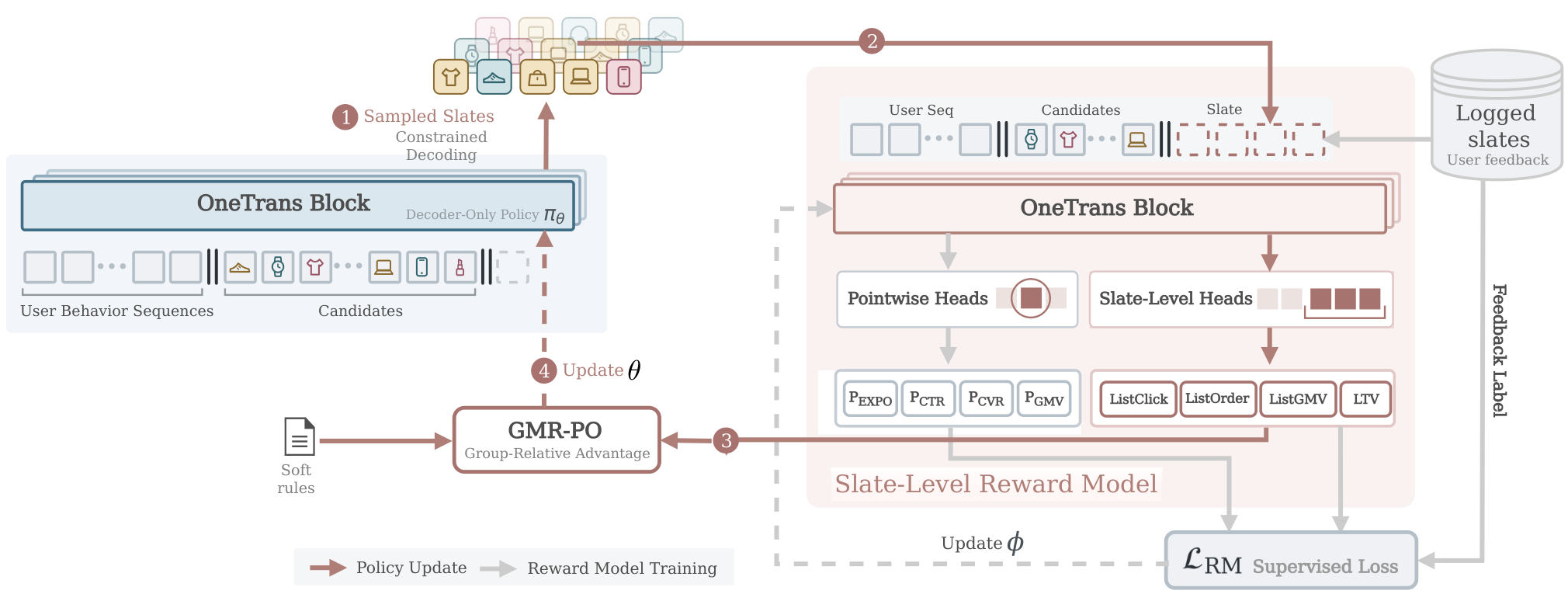
From pinned v1, Figure 2, without redrawing. Copyright remains with the authors under the paper's arXiv non-exclusive license. Source and checksum are in assets/provenance.json.
flowchart LR
  P[External policy logits] --> C[Hard deduplication and mandatory masks]
  C --> S[Finite quota and similarity penalties plus ad boost]
  S --> N[Next-candidate distribution]
  R[External RM and LTV scores] --> M[Per-request min-max and positive floor]
  M --> G[Weighted geometric mean across objectives]
  G --> A[RM group standardization]
  B[Soft business reward] --> D[Separate group standardization]
  A --> J[Linear advantage combination]
  D --> J
J -. Not implemented locally .-> U[Actual policy RL update]Equations
Section 5.3, Eqs. 9–10 add rule contributions to each candidate logit. A rule is locally violated when a tagged candidate exceeds the window maximum, or an untagged choice leaves too few future tag opportunities to reach the minimum. A soft rule adds only \(-\eta_r\) (default 0.1); mandatory rules use \(-\infty\), as does item deduplication. Passing separate checks does not guarantee a jointly feasible completion. An all-masked set raises explicitly rather than silently relaxing rules.
Section 5.4, Eqs. 13–15 normalize each objective across the rollout group for the same request, then apply a positive floor:
Positive weights sum to one. A constant objective puts every value at the floor without inducing a within-group preference. Eq. 11 uses \(A=A^{RM}+0.1A^{rule}\) after separate group standardization, with population variance and \(10^{-8}\) inside the square root. Mixing raw rewards before normalizing is a different method. A geometric mean guarantees neither Pareto improvement nor real GMV gains. The ensemble's \(\mu-0.01\sigma\) is a conservative heuristic, not a statistically calibrated LCB.
Published offline and online results
Section 6.7/Table 11 report account-randomized production A/B testing over one week with equal eligible traffic shares, against the production G-E cascade. Upstream retrieval, fine ranking, and the rule set are unchanged. Relative gains are GMV/u +2.63%, advertiser value +2.06%, and repurchase rate +2.03%, all with \(p<0.05\). Repurchase is evaluated only after the full 14-day observation window. End-to-end latency across reranking and mix-ranking falls by 13%, excluding upstream stages. Offline relative RM gains are proxy-score ratios, not observed click/order lift; unexposed counterfactual slates have no observed labels.
Local components and boundaries
PYTHONPATH=src python -c 'from auto_research.reproductions.onetrans_gsr_components import diagnostic; print(diagnostic(42))'
Data protocol and code map
business_logits consumes external logits, the current prefix, explicit rules, and a bound on future tagged availability. It implements local quotas, deduplication, similarity penalties, and ad boosts. geometric_reward/separate_advantages are float64 CPU mathematical references for Eqs. 11/13–15. The paper accumulates FP32 statistics; bitwise equivalence is not claimed. Different requests must be processed separately rather than normalized together.
Results, negative controls, and limitations
Synthetic contracts distinguish finite penalties from hard masks and check all-masked rejection, constant-objective flooring and separate standardization. RM scores, embeddings, and model logits are external inputs. We do not train the reward, long-term-value, or autoregressive models; execute GMR-PO; share KV caches; or run production mix-ranking. No observed business effect is claimed.
High-cost complete experiment
Three months of private exposure logs, a three-member RM ensemble, 32 slates per request, a 1,024-request global batch, multiple training/serving comparisons and the complete online observation window exceed a lightweight single-A100/A30 or Mac budget. Unexposed slates are RM estimates, not a justification for replacing production counterfactuals with synthetic feedback. Too costly; not reproduced (review DONE). No large downloads or automatic retry.