URED: Recycling highly scored unshown candidates into Taobao feed retrieval¶
Local delivery: an L1 CPU candidate-processing component. The complete production experiment is not reproduced due to cost (review DONE).
Paper information¶
| Field | Details |
|---|---|
| Paper | arXiv:2611.05997v1 · Pinned full text |
| Original title | From Waste to Discovery: Recycling High-Scored Unexposed Candidates in Taobao Feed Recommendation |
| First author and affiliation | Ge Fan, Alibaba Taobao & Tmall Group |
| First public date | 2026-11-04 05:45:30 UTC; November 5 arXiv bulletin |
| Author code | No public implementation found in pinned v1 or its links. Generic storage software mentioned in the paper is not its implementation |
| Local key | ured; adapter: null |
| Local source | src/auto_research/reproductions/ured_components.py |
| Evidence | CPU three-seed mechanism metrics |
Original paper¶
Motivation and method¶
Boosting cold candidates directly can amplify errors the ranker already makes. URED instead accumulates candidates that the ranker scored highly but did not show. A per-user recent-exposure category filter targets discovery. The mined pool is an extra recall channel through the unchanged downstream ranker.
Original figure¶
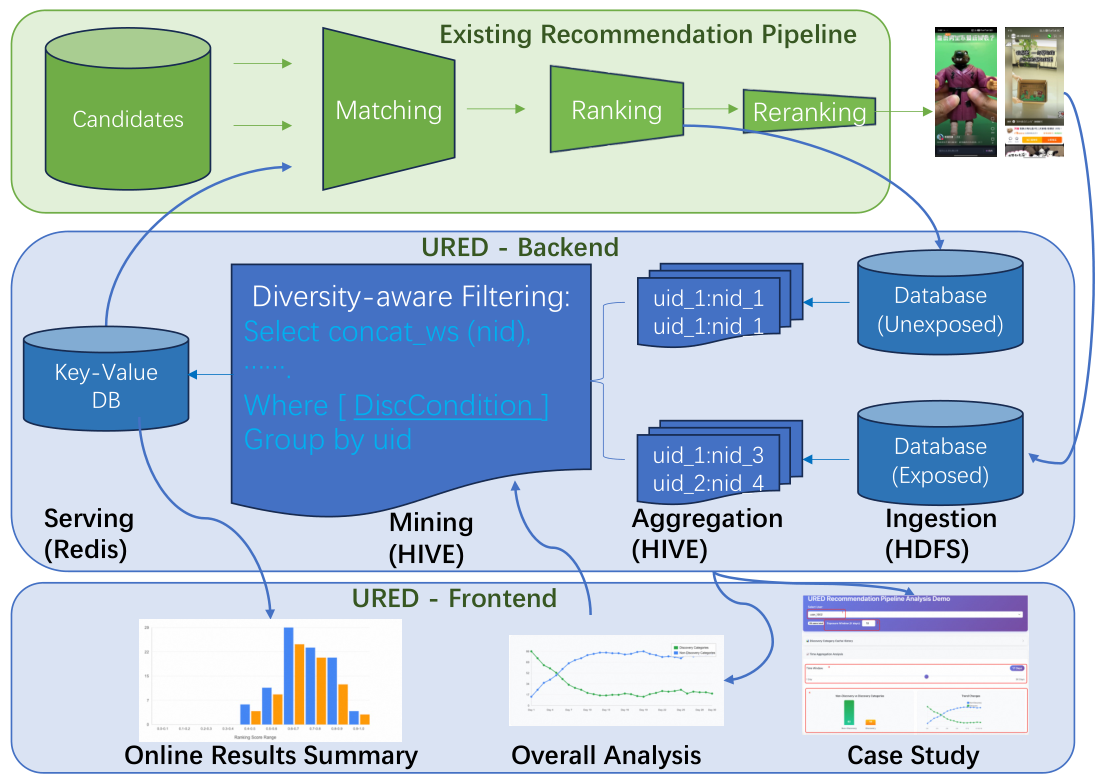
Unmodified author PNG from the original paper, Figure 1. Copyright remains with the authors.
Mechanism¶
Keep the highest-scoring \(k_1\) unshown entries per session. Aggregate over \(t\) days, retain the newest observation per item, then truncate the user pool to \(k_2\). Filter categories seen in the previous \(d\) days and already exposed items, then apply serving quota \(k\). The paper uses \(k_1=200,t=30,k_2=10000,d=15,k=1000\). The per-user cap is applied before discovery filtering, not after it.
Published offline and online results¶
Table 1 reports PCOC of 1.147 for discovery candidates before boosting versus 1.042 for nondiscovery candidates. In §5, users were randomized between the existing pipeline (10% of traffic) and URED treatment buckets (5–10%), for over a week per experiment. Table 2 reports discovered categories +3.47%, richness +8.47%, and completed views +2.62%; +0.36% total views is not significant. The paper reports under 1% serving latency overhead, not measured in this local component.
Local reproduction boundary¶
mine_ured consumes ranker-scored sessions and separately supplied observed exposures. A left-closed, right-open window excludes events at or after the cutoff. Score determines session selection and breaks timestamp ties; a high old score cannot replace the newest item record. Exposed-item deduplication is limited to the supplied history.
Three-seed diagnostics check 30-day versus one-day retention, future-data isolation and quota ordering. There is no learned ranker, distributed storage, display policy or online treatment. The original evaluation requires private Taobao logs, batch parallelism up to a thousand cores, and randomized production traffic serving tens of millions of daily users. This full experiment is not reproduced (review DONE).