ICE: From display through impression to click in slate evaluation¶
Local delivery: L1 tensor mechanisms. The complete production experiment is not reproduced due to cost (review DONE). This is not a trained evaluator.
Paper information¶
| Field | Details |
|---|---|
| Paper | arXiv:2611.07591v1 · Pinned full text |
| Original title | Beyond Independent Predictions: Learning the Browsing Journey for Sequence-Level Re-ranking |
| First author and affiliation | Jiayi Zhang, Alibaba Taobao & Tmall Group; collaboration with Xi'an Jiaotong University |
| First public date | 2026-11-05 07:41:22 UTC; November 6 arXiv bulletin |
| Author code | No public implementation found in pinned v1 or its links. The paper's CC BY 4.0 license does not establish a code release |
| Local key | ice; adapter: null |
| Local source | src/auto_research/reproductions/ice_components.py |
| Evidence | CUDA three-seed mechanism metrics · A100 receipt |
Original paper¶
Motivation and method¶
Displaying a slate does not mean its entire length was seen. ICE separates whether a user reaches a position from whether the user clicks after reaching it. A depth distribution constrains reach probabilities, which then dampen click-branch context from positions unlikely to be seen. The listwise click distribution models competition between positions. The production generator is unchanged; the evaluator scores the expected utility of candidate slates.
Original figure¶
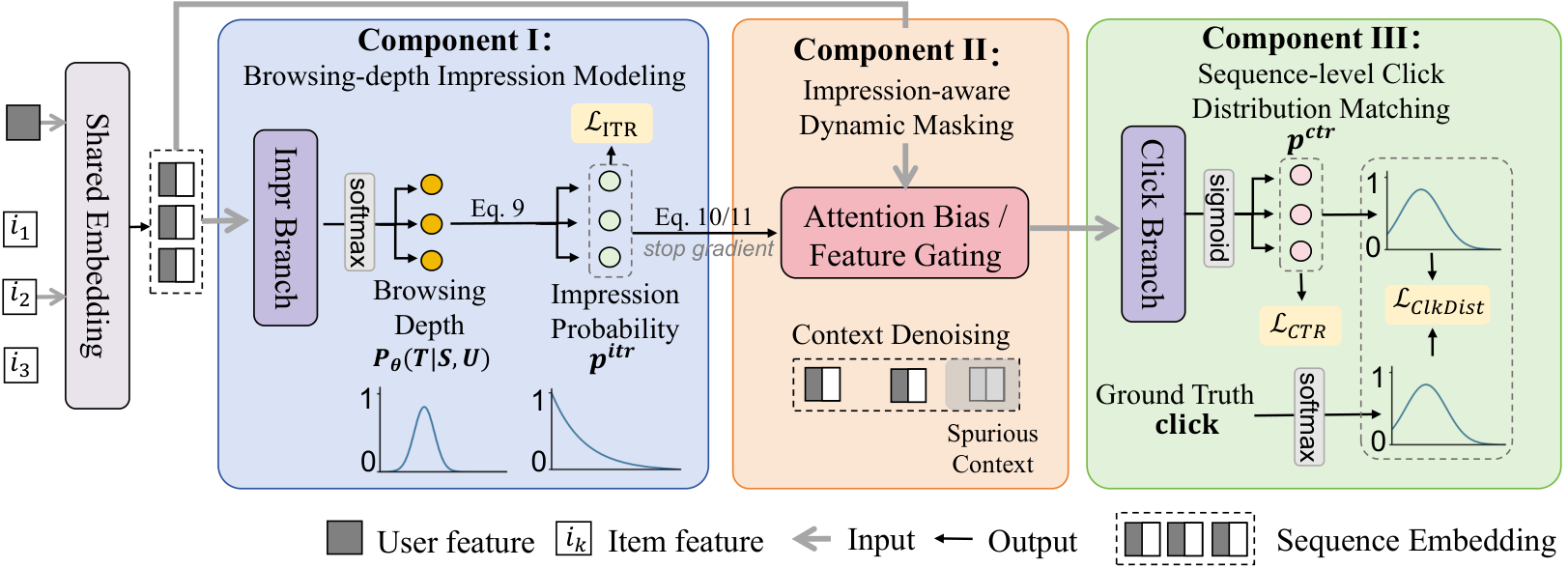
Unmodified author PNG from the original paper, Figure 2. Copyright remains with the authors.
Equations¶
For depth \(T\) in \(1,\ldots,L\), reach is \(r_k=\sum_{t\ge k}\Pr(T=t)\). It is nonincreasing, with \(r_1=1\). Joint click probability is \(r_k\sigma(z_k)\). The attention branch adds \(\log(r_a r_b+\epsilon)\); the feature branch multiplies by \(\alpha r_k+1-\alpha\). Both detach \(r\).
Equation 12 normalizes observed clicks by their total, uses a uniform target for no-click slates, and takes \(\mathrm{KL}(y\|p)\) against \(p=\mathrm{softmax}(z/\tau)\). The implementation follows the equation, not a literal second softmax on binary labels inferred from the diagram. The training objective combines impression BCE, conditional click BCE on reached positions, and listwise KL.
Published offline and online results¶
Table 2 reports Transformer SeqAUC moving from 81.31% to 85.84%. In §5.5, the Taobao Guess You Like experiment used 5% traffic for 14 days, comparing against the production Transformer evaluator with the generator fixed. The authors report impressions +0.58%, clicks +0.70%, revenue +3.67%, LT-14d +0.23%, and less than 0.5 ms added mean response time, followed by full deployment. These are paper results, not local measurements.
Local reproduction boundary¶
The component consumes synthetic depth and click logits and binary observations. It implements the tail sum, detached gates, losses and joint utility in Eqs. 8–13. A log-tail/log-head BCE avoids early probability saturation. The contract rejects clicks outside the reached prefix, gaps in the prefix, and zero-depth records, which the paper's depth support does not model.
Three seeds check arithmetic, zero-click targets, finite gradients and detachment; no generator, embeddings or trained click network is supplied. No CTR or SeqAUC gains, production A/B, or Evolve promotion is claimed. The private seven-day corpus has 48.38M users and 141.79M slates, with six backbone families and a production control. That complete experiment is not reproduced (review DONE); no checkpoints or data were downloaded.