TriGen: separate immediate triggers from persistent preferences
L1 differentiable conditioning components, diagnostic only. Local Eqs.4–8 structures, not a full encoder/decoder or recommender training. The full industrial matrix is too costly and is not reproduced (review DONE).
Paper information
| Field | Value |
|---|---|
| Paper | TriGen: A Generative Paradigm for Trigger-Induced Recommendation; fixed v1 |
| Company / institution | First author Muyu Zou, Alibaba International Digital Commerce Group; Nankai University and independent-researcher collaborators |
| Original publication | 2026-11-12 07:07:10 UTC, arXiv v1 |
| Authors' code | No verified TriGen implementation found in the fixed source/author entry points as of 2026-11-15; framework/baseline links are not a method release |
| Code license / revision | No verified method code; not applicable |
| Local adapter / key | trigen; standalone conditioning, adapter: null |
| Local code | src/auto_research/reproductions/trigen_components.py: tail_inject, rotary, DualPathConditioner, condition_decoder_inputs |
| Local evidence | CPU, CUDA, real GPU receipt; not recall or revenue |
Original paper summary
Background and main changes
A recent product-page click signals intent but should not erase all historical preferences. Simply appending a trigger mixes immediate steering and long-term continuity. TriGen repeats the trigger at a fixed-window tail with RoPE, then separately extracts trigger-query and default-query conditions from pristine history, fuses them with an input-dependent router and applies independent PFFNs per SID level.
Tail-injected encoder input is distinct from the raw history read by both conditioning paths. The default history branch must not change with the trigger. RoPE transforms queries/keys, not arbitrary sinusoidal additions to embeddings.
flowchart TD
    H[Pristine history] --> T[Drop oldest N append N trigger copies same length]
    T --> E[Full encoder absent QK RoPE kernel supplied]
    H --> Q[Trigger and default query attentions]
    G[Trigger embedding] --> Q
    Q --> R[Pool paths across levels then per-level sigmoid router]
    R --> P[Independent level PFFNs]
    P --> I[BOS or observed-prefix embedding plus condition]
    I --> D[Full decoder absent]
Key original figure
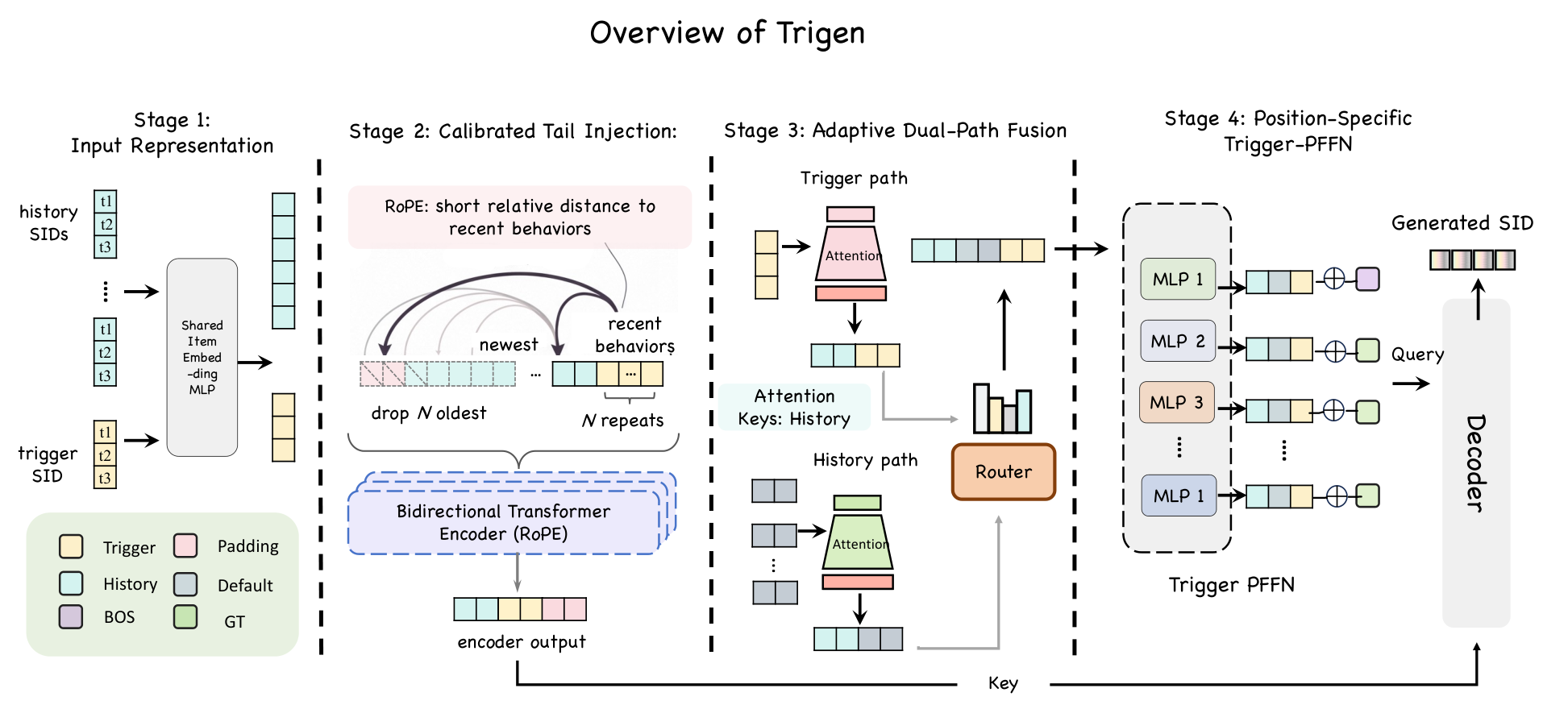
Fixed v1 original Figure 2 PNG, not redrawn. Copyright belongs to the authors; provenance records hashes and visual review. Teacher-forced known prefixes in the source do not authorize future labels at inference.

Core equations
Section 4 Eq.4 preserves a window of M positions:
Both Eq.5 paths read pristine H:
Eq.6 pools across levels before producing per-level gates:
Eqs.7–8 apply independent MLPs, then add conditions to shifted decoder inputs: c-tilde_l=MLP_l(c_l), x1=e(BOS)+c-tilde1, xl=e(y_l-1)+c-tilde_l. A shared MLP is not position-specific. MLP internals are unspecified; the local configurable two-layer GELU is an explicit choice, not recovered author code. Inference accepts generated/observed prefixes, never future target SIDs.
Offline and online results
The source compares trigger-free, append, conditioning and history-attention baselines on public/industrial data with recall/NDCG ablations. Industrial recall is multi-positive and cannot be compared with random local tensors.
Section 5.5 reports June 28–July 2, 2026, six Southeast Asian markets, 10% random traffic per bucket. Control is deployed GR+trigger append, with identical upstream sources/downstream serving. All-country revenue gains range +1.64% to +8.16%; traffic-weighted revenue is +3.27%, GMV +0.90%, p<0.05. GMV improves in four of six countries, not all. Serving is about 10.5ms; full production deployment starts July. These are author results, not a business lift reproduced by local conditions.
Local reproduction
Data protocol and code mapping
Tiny random histories/triggers pass through real dual attention, pooled routing, separate PFFNs and backward with padding masks. Tail injection, Q/K RoPE and BOS/observed-prefix conditioning are independently callable. There is no complete bidirectional encoder, causal decoder, SID tokenizer, semantic dataset or recommendation loss.
PYTHONPATH=src python -m pytest tests/reproductions/test_nov15_recommendation_components.py -q
PYTHONPATH=src python -c 'from auto_research.reproductions.trigen_components import diagnostic; print(diagnostic(42, device="cpu"))'
Results, negative controls and boundaries
Checks cover fixed-context tail replacement, padding isolation, trigger-independent default history, input-dependent routing, independent level parameters, BOS conditioning, RoPE relative-score invariance to common position shifts and finite gradients. No optimization loop or real item returns are supplied. CUDA forward/backward needs actual A100/A30 evidence; component gradients do not establish recommendation capability or Evolve integration.
High-cost full experiment
Appendix D's 1.51M public configuration still requires quantization, 15 epochs, multiple baselines, five seeds and ablations. The industrial eight-level-SID long-history models train on eight L20s and private production data. Full industrial multi-arm/online experiments are too costly, not reproduced (review DONE). Only bounded tensor verification is run; no data/model downloads, full exploratory training or automatic retries.