KuaiRecV2: daily validation and one-retrieval multi-task evaluation
L0 finite protocol interface, diagnostic only. No KuaiRecV2 download, model integration or benchmark run. Full continual training/evaluation is too costly and is not reproduced (review DONE). Included as public evaluation infrastructure, not misrepresented as industrial A/B.
Paper information
| Field | Value |
|---|---|
| Paper | KuaiRecV2: Benchmarking Large-Scale Continual Learning for Diversified and Multi-task Recommendation; fixed v1 |
| Company / institution | First author Chenxu Li, University of Science and Technology of China, with Kuaishou Technology collaboration; not duplicated across every coauthor affiliation |
| Original publication | 2026-11-12 13:39:12 UTC, arXiv v1 |
| Authors' code | The paper links cxli2333/KuaiRecV2, but GitHub API returned 404 during review. Accessible implementation/data, license and SHA are unverified; not downloaded or successfully integrated |
| Local adapter / key | kuairec-v2-protocol; adapter: null, evaluation interface, not a model |
| Local code | src/auto_research/reproductions/kuairec_v2_protocol.py: daily_leave_one_out, full_month_score, single_retrieval_evaluate_all |
| Local metrics | CPU protocol diagnostics; finite examples are not official FullMonth/leaderboard results |
Original paper summary
Background and main changes
Static item pools and one-shot splits can hide continual-learning problems. KuaiRecV2 supplies thirty days, rolling seven-day creation windows, cross-day histories and multi-behavior feedback to expose adaptation/forgetting after candidate-pool changes.
Three protocol details matter: the last interaction per user per day is validation; FullMonth aggregation weights validation instances, not days equally; each request retrieves once and reuses that list for all behavior subsets. Separate favorable click/like lists violate this contract. Local code supplies these finite interfaces, not data ingestion or a continual learner.
flowchart LR
    L[External prepared interactions] --> S[Group by day and user]
    S --> V[Last daily interaction validation others train]
    R[One model-produced list per request] --> E[Evaluator-private targets and behavior subsets]
    V --> E
    E --> D[Daily HR and NDCG]
    D --> M[Weight by daily validation-instance count]
Key original figure
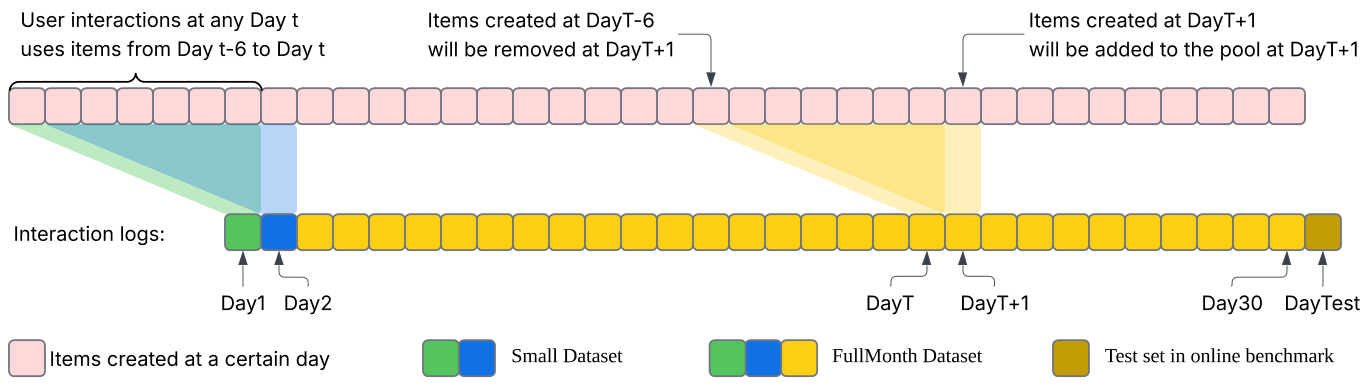
Original SVG from fixed v1 Figure 1, rendered to PNG without redrawing. Copyright belongs to the authors; source/render hashes are in assets/provenance.json. The online-benchmark hold-out test differs from daily validation.
Core equations
Section 3.1 sorts each day/user group by timestamp, placing its last interaction in validation and preceding interactions in training. Exact timestamp ties are rejected because no unique source tie-break is specified. Earlier-day validation labels are not automatically recycled into later training/history.
N_t counts validation instances. NDCG uses the standard rank discount for one held-out positive; missed targets score zero. Behavior subsets reuse one request list and are selected using evaluator-private labels. Duplicate recommendations are rejected. Appendix D does not uniquely specify every token-diversity aggregation/normalization; these are explicitly not implemented, rather than invented as official metrics.
Offline and online results
FullMonth has 484,045,145 interactions, 124,055 users and 24,898,648 items; Small still contains 38,955,949 interactions. Author comparisons of SASRec/GRURec and generative baselines discuss dynamic-pool drops, continual adaptation, diversity and multi-task tradeoffs. The repository/data are unverified locally, and source tables are not reproduced. No production A/B is reported. This is a public-evaluation-infrastructure exception, not a relaxed industrial A/B gate.
Local reproduction
Data protocol and code mapping
Interaction contains user/day/timestamp/item only. The split has no model. The finite evaluator separates absent retrieval producers from private target labels; gold belongs only in evaluation and must not be sent back to an agent/generator. Callers must enforce actual execution/data isolation; interface shapes alone do not prove nonleakage.
PYTHONPATH=src python -m pytest tests/reproductions/test_nov15_recommendation_components.py -q
PYTHONPATH=src python -c 'from auto_research.reproductions.kuairec_v2_protocol import diagnostic; print(diagnostic(42))'
Results, negative controls and boundaries
Four finite interactions check daily rather than global splitting and train/validation separation. Two requests check shared-list behavior HR/NDCG. A one-versus-three-instance weighting case rejects macro averaging. Tests reject task-specific lists, duplicate recommendations and ambiguous ties. No ingestion, seven-day pool builder, cross-day history, model checkpoints or training/forgetting curves are supplied. CPU L0 only, not Evolve or leaderboard capability.
High-cost full experiment
Appendix E's thirty-day stream spans millions/tens of millions of items, Qwen2.5-0.5B SFT/RL, groups of eight, beam50 and default eight-GPU distributed evaluation. FullMonth has about 484 million interactions and the official link is currently unverified. The full benchmark is too costly, not reproduced (review DONE) on one A100/A30 or a Mac. No synthetic split substitutes for official results; no downloads, exploratory runs or automatic retries.