IntentFlow: An Intent-Driven Real-Time Multimodal Search System with Image-Text Queries at Xiaohongshu
L1 bounded mechanism component, not a capability benchmark or Evolve promotion.
Paper information
| Field | Content |
|---|---|
| Paper | IntentFlow: An Intent-Driven Real-Time Multimodal Search System with Image-Text Queries at Xiaohongshu; fixed v1 |
| Institution | First author Dongjia Zhao: Xiaohongshu; fixed-v1 byline checked |
| First publication | 2026-11-16 03:17:14 UTC, arXiv v1 |
| Original source code | No publicly verifiable paper-specific author implementation found in the fixed paper and linked sources. Cited dependencies or integration claims are not verified paper-specific code. |
| Local adapter / key | intentflow; adapter is null, not a complete model |
| Local implementation | src/auto_research/reproductions/intentflow_components.py |
Paper summary
Motivation and changes
Finding an exact item, styling an outfit and seeking usage information require different evidence even for the same image. IntentFlow unifies intent hierarchy, verified three-grade relevance, agentic data construction, multimodal retrieval and intent-conditioned reranking. After indexing, query-only upper-layer LoRA and six-expert residual projections avoid recomputing the document corpus.
Original figure
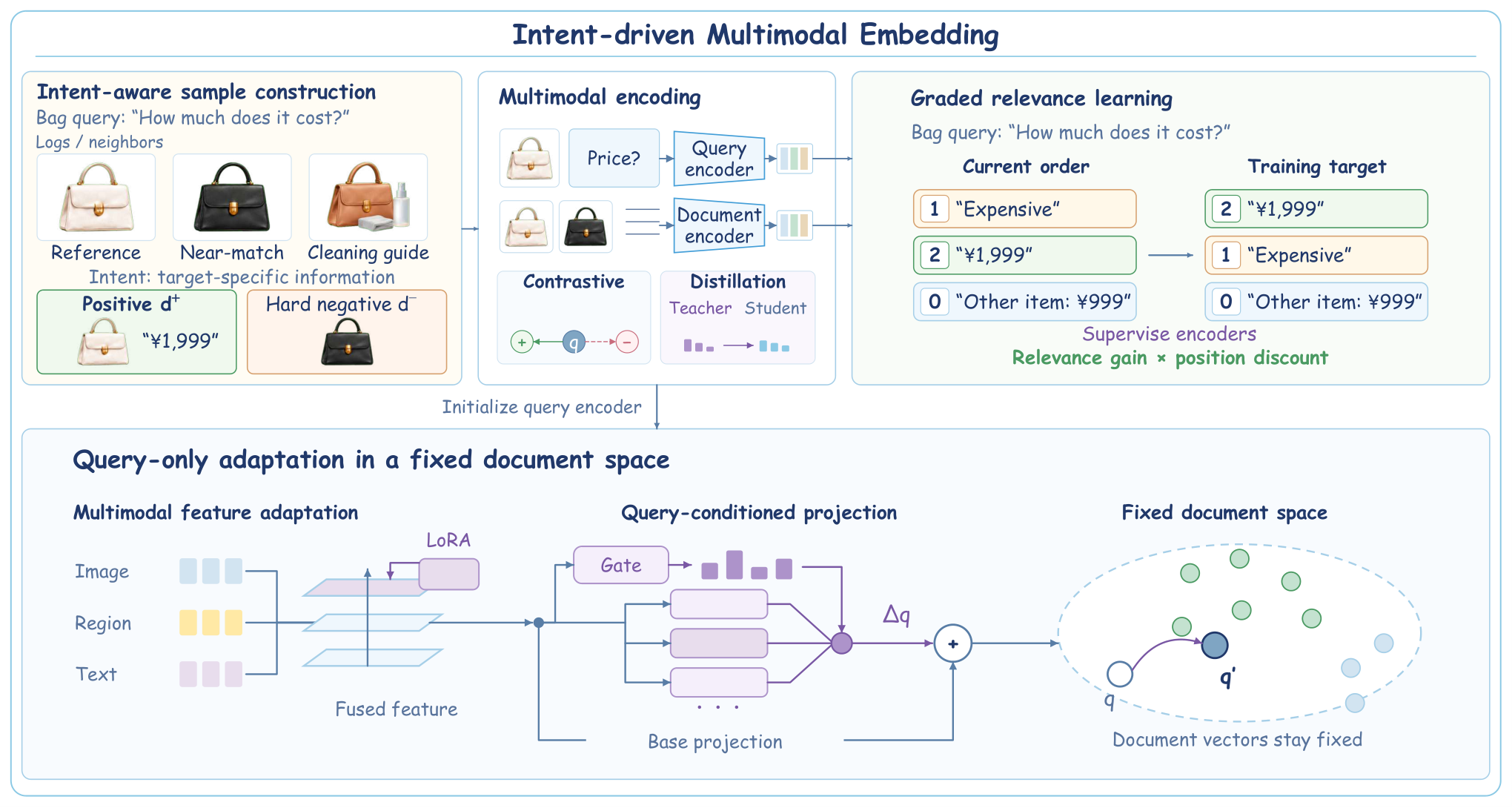
Image from the original paper; copyright belongs to the original authors. Original asset/PDF crop, not local results. Provenance and SHA256.
Core formulas
Eqs16,18–21 and24 are implemented: one query gate mixes two shared-bottleneck branches (paper ranks8/64), retaining a frozen base projection. Both distillation directions share valid candidate sets and detach the teacher. CSLS subtracts only offline document density relative to a training-query bank. Zero-initialized up projections are a local stability convention, not an initialization specified by the paper or a complete model recipe.
Author results
Table1 uses the same production control in user-level A/B: recognition+reranking yields relative Top4QCTR/QCTR/dwell lifts21.65%/15.12%/9.66%; adding retrieval yields28.17%/18.96%/12.56%. These cumulative configurations do not isolate retrieval alone. End-to-end P50 is1.07s; component quantiles cannot simply be added.
Local implementation and boundaries
Data protocol and code mapping
Inputs are externally supplied fused features and candidate scores. No rules impersonate the0.8B recognizer, and the full LoRA/VLM, agentic verification or NDCG-weighted training chain is absent. Unchanged document tensors in diagnostics do not establish improved semantic retrieval.
PYTHONPATH=src python -c 'from auto_research.reproductions.intentflow_components import diagnostic; print(diagnostic(42, device="cpu"))'
Results, controls and limits
L1 bounded mechanism component, not a capability benchmark or Evolve promotion. Seeds42/43/44 check explicit fixtures/small-tensor arithmetic and gradients, not three independent model-capability trials. CPU and actual GPU evidence remain separate. Author scores must not populate local dashboards.
High-cost full experiments
0.8B multimodal full-parameter students,2Bteacher, agentic evidence acquisition and ten-billion-entry production index; no vision model or intent classifier is replaced by rules Not reproduced due to high cost; review DONE. No automatic training/retry queue and no blocking of declared review closure.
Same-topic comparison
WeSearch constrains candidates by clusters and atomic matching; IntentFlow defines evidence required by the request and adapts query encoding to a fixed document space. Candidate organization and intent-supervised representations differ, and component gradients prove neither online lift.