From Relevance to Utility: Rubric Alignment in Yuanbao Search
L1 bounded mechanism component, not a capability benchmark or Evolve promotion.
Paper information
| Field | Content |
|---|---|
| Paper | From Relevance to Utility: Rubric Alignment in Yuanbao Search; fixed v1 |
| Institution | First author Yu Lu: Tencent; fixed-v1 byline checked |
| First publication | 2026-11-17 10:00:05 UTC, arXiv v1 |
| Original source code | No publicly verifiable paper-specific author implementation found in the fixed paper and linked sources. Cited dependencies or integration claims are not verified paper-specific code. |
| Local adapter / key | yuanbao-rubric; adapter is null, not a complete model |
| Local implementation | src/auto_research/reproductions/yuanbao_rubric_components.py |
Paper summary
Motivation and changes
Pointwise relevance need not supply useful evidence for downstream reasoning. Yuanbao builds query-specific weighted positive and negative rubrics, distills labels for retrieval and four-head ranking, and trains subset selection with set-level rewards. Below-mean rollouts imitate the best in-group trajectory with reward-gap weights instead of receiving negative-advantage suppression.
Original figure
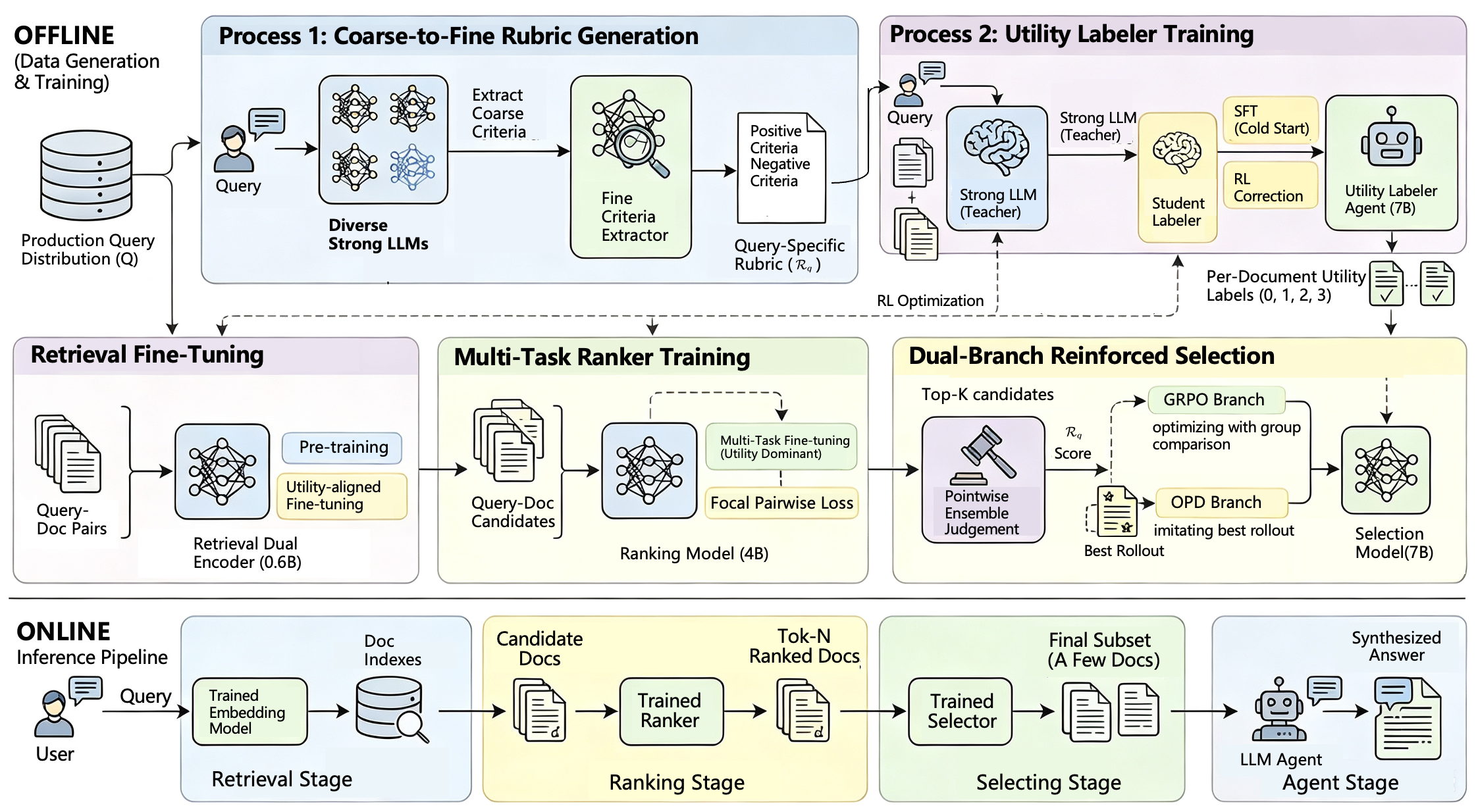
Image from the original paper; copyright belongs to the original authors. Original asset/PDF crop, not local results. Provenance and SHA256.
Core formulas
Sections2.1 and Eqs4–6 are implemented. Positive criteria can be covered collectively and any document can trigger a deduction. Focal pairwise ranking uses a label-gap minus score-gap hinge, not ordinary CE. Each selection branch has its own mean; poor-rollout weights multiply the same best-trajectory token NLL. Padding, empty branches and tied zero updates are preserved. Reference KL is an explicit caller input, not an invented estimator.
Author results
Section3.2/Table2 reports14-day A/B on5% production traffic, approximately2.8M queries: retrieval/ranking/selection individually improve GSB by0.40%/3.94%/4.82%, while the full pipeline improves8.52%. Their9.16% sum is not the end-to-end gain. These are author production measurements, not local results.
Local implementation and boundaries
Data protocol and code mapping
No rubric generator, DeepSeek judge, Qwen encoder or real search is run. Diagnostics check best-trajectory imitation gradients, absent poor-trajectory imitation gradients, detached rewards and zero padding gradients; these are not answer-accuracy scores.
PYTHONPATH=src python -c 'from auto_research.reproductions.yuanbao_rubric_components import diagnostic; print(diagnostic(42, device="cpu"))'
Results, controls and limits
L1 bounded mechanism component, not a capability benchmark or Evolve promotion. Seeds42/43/44 check explicit fixtures/small-tensor arithmetic and gradients, not three independent model-capability trials. CPU and actual GPU evidence remain separate. Author scores must not populate local dashboards.
High-cost full experiments
610M production query/document pairs; 0.6B/4B/7B pipeline with DeepSeek-V4-Flash judge; production corpus and14-day5% traffic test are unavailable locally Not reproduced due to high cost; review DONE. No automatic training/retry queue and no blocking of declared review closure.
Same-topic comparison
WeSearch narrows candidates using clusters and atomic document matching; Yuanbao aligns upstream labels with final subset rewards. They are not the same SID/retrieval architecture, and neither local ADC nor the dual-branch loss replaces end-to-end search validation.