MLE Agents: Autonomous ML Engineering in Large-scale Recommendation Systems
l0_interface: bounded component/interface diagnostic, not complete capability evidence or Evolve promotion.
Paper information
| Field | Content |
|---|---|
| Paper | arXiv fixed v1; full text |
| Institution | First author Matthew Li: Meta Platforms |
| First publication | 2026-11-18 06:00:43 UTC; separate from announcement/directory dates |
| Original source code | No accessible paper-specific author implementation found in fixed v1 and linked sources; dependency repositories do not count as this paper code. |
| Local adapter / key | mle-agents; adapter=null, independent component only |
| Local implementation | src/auto_research/reproductions/mle_agents_components.py |
Paper summary
Motivation and changes
Meta combines hypotheses, code changes, training and metric inspection in a human-on-the-loop development cycle. Version2.0 nominally evaluates seven candidates and a variance probe in parallel, using weighted NE calibrated against online outcomes instead of click AUPRC alone. A failure blocklist, structured outputs and recent uncarried winners limit stale context. Engineers still review the final model and conduct a separate online experiment.
Original figure
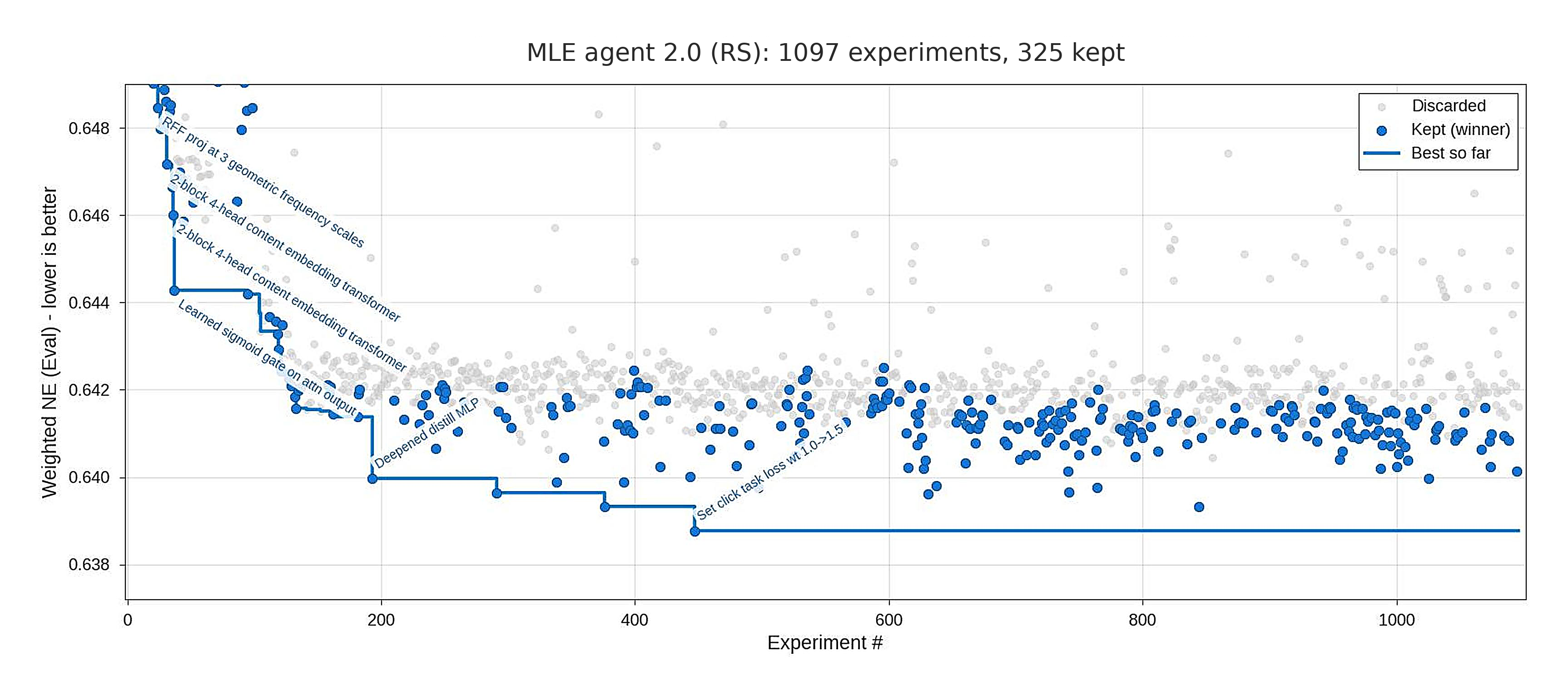
From the original paper; copyright belongs to the original authors. Original asset/PDF crop, not local results. Provenance.
Core formulas
Section1.2 defines the0.3/0.7 objective; section3.5 compares a candidate to its same-iteration variance probe, not an arbitrary old baseline. Completion needs two independent signals and each candidate makes one coherent change. The0.0005 threshold is estimated from historical training noise, not a significance test or a universal constant. The interface reports offline search admission and required human review without launching jobs or production changes.
Author results
Of1097 completed candidates,325 were accepted, with155 additional probes; weighted NE changed from0.6611 to0.6388. Production A/B over more than one week reports relative search-session lift+0.23%±0.15 (95% interval, Fieller method), alongside a time-to-render guardrail regression. The15.6% versus29.6% acceptance comparison also changes the objective and budget, so it is not a controlled ablation or an online-success rate.
Local implementation and boundaries
Data protocol and code mapping
Only the objective and completion/admission interface run locally. There are no Claude research calls, candidate generation, distributed private-data training, online A/B or executable new Evolve search strategy. Fixture inputs are not Meta model measurements.
PYTHONPATH=src python -c 'from auto_research.reproductions.mle_agents_components import diagnostic; print(diagnostic(42, device="cpu"))'
Results, controls and limits
Seeds42/43/44 check arithmetic, protocols, negative controls and gradients, not independent capability trials. CPU diagnostics. CPU-only protocols need no GPU or fabricated CUDA record.
High-cost full experiments
Section3.3 reports median training/evaluation time3.54hours per candidate. The full campaign completed1252 jobs on hundreds of millions of private examples and production traffic; one GPU cannot reproduce it. Not reproduced due to high cost; review DONE. No automatic retry/training queue. Passing the small component does not change that disposition.
Same-topic comparison
EvoPilot fixes a matched control/treatment contract and rejects mismatched evidence; MLE Agents emphasizes objective calibration and same-iteration noise probes. Neither treats a completed job as a launchable conclusion, and calibrated objectives do not replace artifact consistency checks.