X-split Argus: Learning Reusable History Tokens for Efficient CTR Prediction
l1_mechanism: bounded component/interface diagnostic, not complete capability evidence or Evolve promotion.
Paper information
| Field | Content |
|---|---|
| Paper | arXiv fixed v1; full text |
| Institution | First author Alexander Ploshkin: not listed in fixed v1; not inferred from names or an earlier paper |
| First publication | 2026-11-18 11:58:37 UTC; separate from announcement/directory dates |
| Original source code | No accessible paper-specific author implementation found in fixed v1 and linked sources; dependency repositories do not count as this paper code. |
| Local adapter / key | xsplit-argus; adapter=null, independent component only |
| Local implementation | src/auto_research/reproductions/xsplit_argus_components.py |
Paper summary
Motivation and changes
A candidate-independent causal encoder retains the lastK states of older history. Serving encodes only the most recentM events, and candidate tokens cross-attend to both memories. Offline caching is a serving execution choice, not a reason to detach the compressor during training. A supervised click head and an L1 raw-logit distillation head share representations; only the supervised head serves predictions.
Original figure
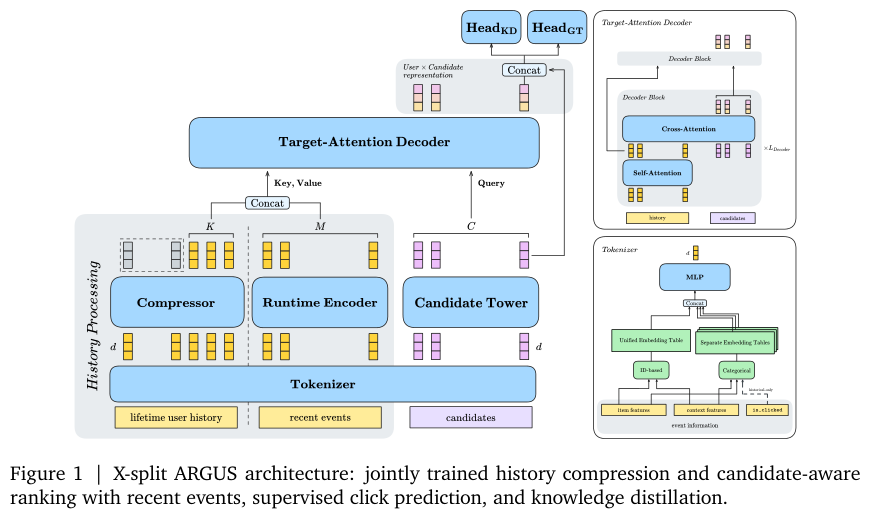
From the original paper; copyright belongs to the original authors. Original asset/PDF crop, not local results. Provenance.
Core formulas
Eqs1–11 require causal, candidate-independent history states and strictly pretarget memory. The default boundary ismax(0,t−1−M); a serving snapshot may overlap recent events or leave a gap. Shared causal local-attention training and serving on only the lastM events have different left boundaries/receptive fields. KD is raw-logit L1, not BCE or KL. Only negatives are smoothed and teacher logits are detached. The small network reduces depth/dimension but executes real attention, separate heads and gradients.
Author results
Section5.1 reports seven-day stable user-hash A/B,6% of the advertising surface per arm: relative ACV+4.65% and clicks+2.96%,p<0.001, with a reverse test one month later. Serving the same traffic needs15% more online GPUs, not a cost reduction. The fixed PDF byline lists no institution; the Yandex affiliation of the earlier ARGUS paper does not establish this paper affiliation.
Local implementation and boundaries
Data protocol and code mapping
Inputs are explicit small event/candidate features. Teacher training, vocabularies, daily caching, RTB data and serving are absent. Changing target/future feedback leaves predictions invariant and KD reaches the compressor; neither check establishes NE or ACV gains.
PYTHONPATH=src python -c 'from auto_research.reproductions.xsplit_argus_components import diagnostic; print(diagnostic(42, device="cpu"))'
Results, controls and limits
Seeds42/43/44 check arithmetic, protocols, negative controls and gradients, not independent capability trials. CPU diagnostics. CUDA needs actual A100/A30 execution evidence, never CPU substitution.
High-cost full experiments
The paper uses one year/8192 events, six1024-wide layers in each history encoder, private RTB data and recurring precomputation. Full training and production A/B exceed this single-device batch budget. Not reproduced due to high cost; review DONE. No automatic retry/training queue. Passing the small component does not change that disposition.
Same-topic comparison
Earlier ARGUS factorizes the next event as feedback then item. X-split focuses on candidate-independent cached history and candidate-specific click-logit distillation, so token ordering and heads are not interchangeable. Their local negative results/diagnostics are not a matched capability comparison.