DNA: Unlocking Depth Scaling in CTR Models
l1_mechanism: diagnostic component/interface only, not a complete capability reproduction. Full experiment: high cost, not reproduced (review DONE).
Paper information
| Field | Value |
|---|---|
| Paper link | arXiv:2611.25659v1; fixed PDF |
| Company / institution / school | Caiyuan Li: Alibaba Group (fixed-v1 PDF byline) |
| Original publication date | 2026-11-19T07:40:54Z (arXiv v1); announced2026-11-20 |
| Original source code | No verified author method code found in fixedv1/associated sources; arXiv feedback GitHub is not author code. |
| Local adapter / key | dna; adapter: null; not Evolve-integrated |
| Local reproduction code directory | src/auto_research/reproductions/dna_components.py |
Original paper summary
Background and principal changes
DNA couples request U and history S as candidate-independent streams. Each layer lets request U and candidate F separately read the same history K/V, then history tokens read the newly updated U. The next layer sees request-shaped history instead of another projection of fixed S0. Request/history states are shared across candidates within that request.
flowchart LR
 S[Incoming history Sl] --> K[Group specific K V shared per request]
 K --> U[Request read produces Ul plus1]
 K --> F[Candidate read produces Fl plus1]
 U --> B[Composite projection update of every history token]
 S --> B
 B --> N[Next layer history]
 F --> P[Candidate head with final shared request]
 U --> P
Original paper figure
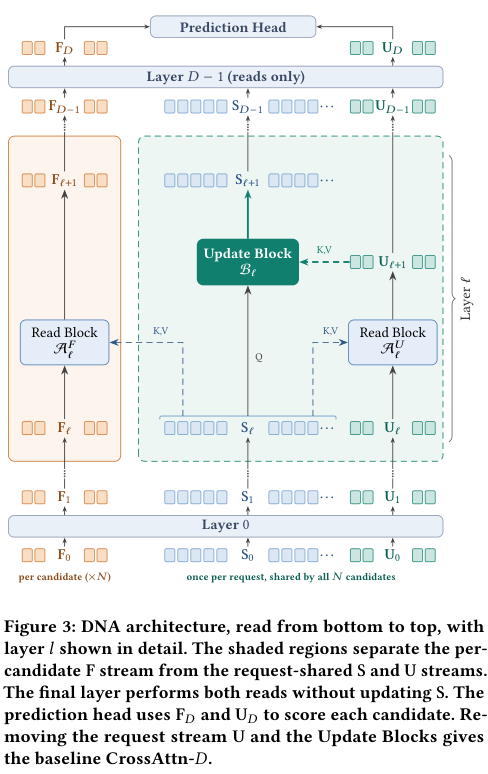
Original PDF crop, no semantic editing; author evidence, not a local result. Provenance; copyright remains with the authors.
Core equations
Depth D contains D request reads, D candidate reads and D-1 history updates; the final layer does not update an unused S. Reads use group-specific K/V projections and token-specific SwiGLUs. Updates apply composite K/V projections to concatenated request tokens, group-specific FFNs and padding zeroing. QKNorm and head scaling are retained.
Paper offline and online results
At matched forward-compute tiers, reported AUC gains over CrossAttn are0.08–0.26percentage points. Taobao DNA-4 versus production CrossAttn-2 reports relative CTR+0.8% and GMV+0.5%; duration, traffic share and CI are not supplied in that section. At5,000 candidates, DNA-4 costs4.70T FLOPs/request versus78.41T for DNA-T-4. Sharing is within a request, not unconditional reuse across new requests.
Local reproduction
Data protocol and code mapping
Executes small differentiable attention, group-specific projections, token-specific SwiGLUs, composite request projections and D-1 updates. Controls compare batched/individual candidates, padding invariance, request-dependent history and finite gradients. score returns logits, not click probabilities; BCEWithLogits stably incorporates Eq13's sigmoid. Local QKNorm is per-head L2 normalization times learned scales. Width/depth are reduced. Explicit generated tokens replace HHFT inputs; private CTR training, the512-wide production model and serving benchmarks are absent. Fixture BCE is not CTR capability.
PYTHONPATH=src python -c 'from auto_research.reproductions.dna_components import diagnostic; print(diagnostic(42, device="cpu"))'
PYTHONPATH=src python -m pytest tests/test_nov20_root_components.py -q
Seeds42/43/44 check deterministic contracts/generated tensors, not independent capability comparisons. CUDA paths require separate real-GPU receipts; CPU results do not substitute.
Same-topic comparison and boundaries
LONGER compresses long-history interaction into a smaller query/token path. DNA retains history tokens and updates each from a few request tokens before the next read. Both exploit candidate sharing, but share different states at different points. Local mechanism checks do not rank their recommendation quality.
High-cost full experiment
Paper DNA-4 has roughly1.267B dense parameters excluding embedding tables, width512, eight heads, thousand-token histories, private Taobao training and multiple depth/compute comparisons. Full training/A/B is not reproduced. Tiny CPU/CUDA three-seed mechanisms should take under30seconds without model/data downloads or APIs.
Configuration-based cost judgment, not measured full-run duration. High cost, not reproduced (review DONE); no automatic retry/implementation queue or capability/Evolve promotion.