BST
Core-mechanism reproduction. Candidate token, positional encoding, and behavior Transformer.
Paper information
| Field | Value |
|---|---|
| Paper | arXiv 1905.06874 |
| Affiliations | Alibaba |
| First public release | 2019-05-15 (arXiv v1) |
| Authors' code | No author code linked by the paper as of 2026-08-09. |
| Adapter / method | bst |
| Local code | src/auto_research/reproductions/bst/ |
Original paper
Background and contribution
Use self-attention over behaviors and the candidate together, rather than fixed pooling or single-target attention.
flowchart LR
  H[Behavior and position] --> T[Transformer encoder]
  C[Candidate token] --> T
  T --> M[Sequence and candidate fusion] --> P[CTR]
Key figure from the paper
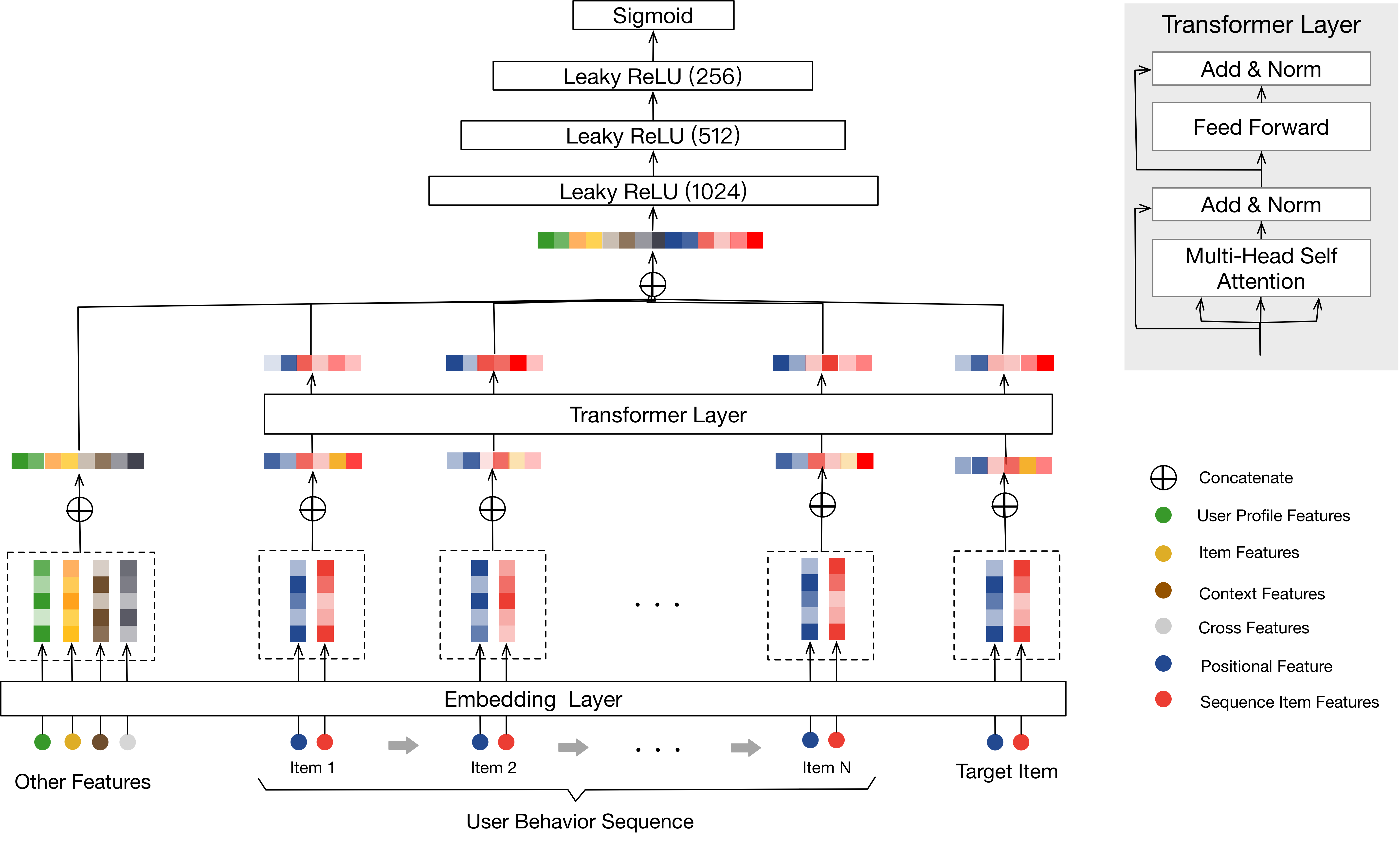
Original Figure 1: BST architecture. From the paper; copyright belongs to the authors. Not a local result.
Core mechanism
\[
H'=\operatorname{softmax}\!\left(\frac{QK^\top}{\sqrt d}\right)V,\qquad
\hat y=\sigma(\operatorname{MLP}([h_{\rm cand},\operatorname{pool}(H')])).
\]
Paper results
The Taobao recommendation A/B reports 7.57% higher CTR than WDL.
Local reproduction
Compare DIN with candidate-in-encoder Transformer. Three-seed NDCG@10 was +20.29% relative. See structured metrics.
Reproduction limits
Public data replace Taobao logs. User profiles, context features, and production inference were not reproduced.