SIM: Search-based User Interest Modeling with Lifelong Sequential Behavior Data for CTR Prediction
Core mechanism on public data; online and local evidence are separate.
Paper information
| Field | Details |
|---|---|
| Paper | CIKM 2020 |
| Institution | Alibaba. |
| First public release | 2020-06-10 (arXiv v1) |
| Author code | No official author code linked by the paper as checked on 2026-08-09. |
| Local adapter or method key | sim |
| Local reproduction code | src/auto_research/reproductions/sim/ |
Paper method and evidence
Use the candidate item as a query. The General Search Unit retrieves a relevant subsequence from lifelong history; the Exact Search Unit attends to that subsequence for the candidate.
flowchart LR
  Q[Candidate query] --> G[General Search Unit]
  H[Lifelong behavior] --> G
  G --> S[Relevant subsequence]
  S --> E[Exact Search Unit]
Original paper figure
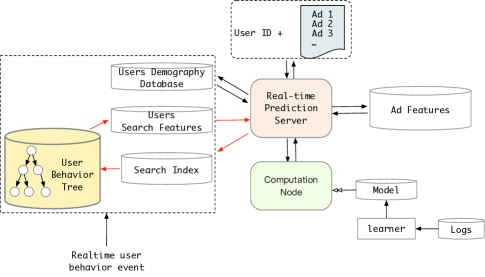
The original figure shows general search and exact candidate attention. From the original paper; copyright remains with the authors.
Core equation
Reported results
Main Alibaba display-ad traffic reported CTR +7.1%, RPM +4.4%, and histories up to 54,000 events.
Local reproduction
Shared transition + content is the baseline; SIM changes only the core mechanism. On MovieLens-100K full-catalog ranking, NDCG@10 0.0354 → 0.0471 (+32.97%). Fixed metrics.
This exercises candidate-conditioned retrieval on public data, not private logs or online serving. The local relative change is not the original traffic lift.