Visual Instruction Tuning
Core mechanism evidence. Paper and local evaluations are separate.
Paper information
| Field | Value |
|---|---|
| Paper | NeurIPS 2023 Oral |
| Affiliations | University of Wisconsin-Madison / Microsoft Research / Columbia University |
| First public release | 2023-04-17 (arXiv v1) |
| Authors' code | LLaVA. |
| Adapter / method | llava |
| Local code | src/auto_research/reproductions/llava/ |
Original paper
Background and contribution
Freeze a vision encoder and project its features to the LLM token space, then tune with GPT-4-generated multimodal instructions.
flowchart LR
  I[Image] --> V[Frozen visual encoder] --> P[Trainable projector] --> L[Instruction-tuned LM]
Key figure from the paper
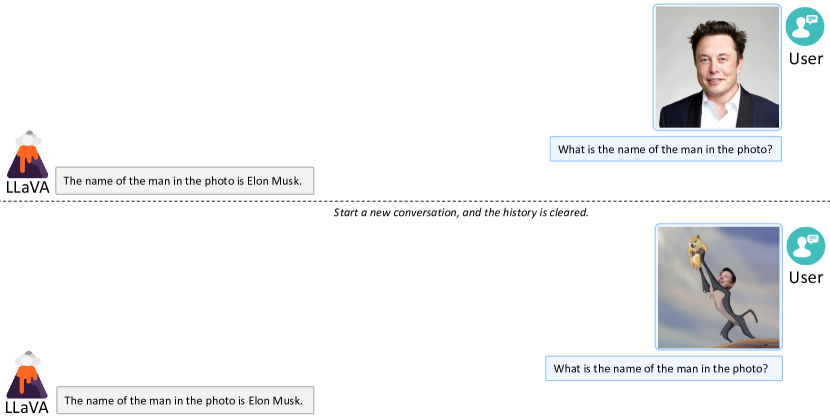
Original Figure 6: Visual Instruction Tuning. From the paper; copyright belongs to the authors. Not a local result.
Core mechanism
\[
H_v=W_pE_v(I),\quad\mathcal L=-\sum_t\log p_\theta(y_t|H_v,x,y_{<t}).
\]
Paper results
The synthetic instruction set achieves 85.1% relative to GPT-4; LLaVA+GPT-4 gives 92.53% ScienceQA.
Local reproduction
Fashion-MNIST QA: linear projector versus LLaVA-style two-layer MLP, same encoder/head/budget. Test drops 46.8%→43.4% (−3.4 pp); shuffled images 10.6%. Metrics.
Reproduction limits
Real pixels and frozen small patch encoder; no GPT-4 data generation or LLaVA-13B. Single-seed projector regression is not large-model instruction tuning.