Medusa: Simple LLM Inference Acceleration Framework with Multiple Decoding Heads
Core mechanism on public data, not production kernel performance.
Paper information
| Field | Details |
|---|---|
| Paper | arXiv 2401.10774 |
| Institution | Together AI / Princeton University / University of Illinois Urbana-Champaign. |
| First public release | 2024-01-19 (arXiv v1) |
| Author code | FasterDecoding/Medusa. |
| Local adapter or method key | medusa |
| Local reproduction code | src/auto_research/reproductions/medusa/ |
Paper method and evidence
Add future-token heads to a frozen or jointly fine-tuned backbone. Verify candidate branches together with tree attention to reduce serial decoding steps.
flowchart LR
  H[Backbone state] --> F[Multiple future-token heads]
  F --> T[Candidate tree]
  T --> V[Parallel backbone verification]
Original paper figure
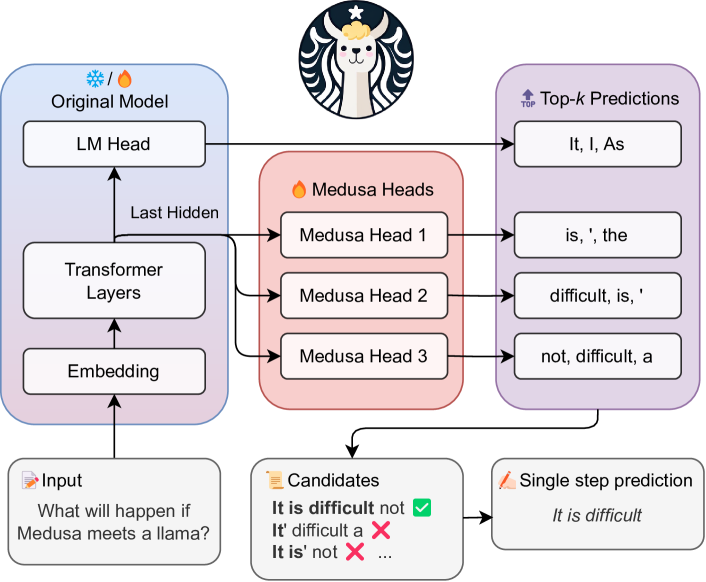
The original figure shows multi-head proposals and tree verification. From the original paper; copyright remains with the authors.
Core equation
Reported results
The paper reports over 2.2× speedup for Medusa-1 and 2.3–3.6× for Medusa-2 while retaining generation quality.
Local reproduction
Compare single-head greedy with three future heads and tree verification: local backbone_calls 160.0000 → 80.0000 (-50.00%). Fixed metrics.
The WikiText-2 token transition model exercises future heads, candidate trees and backbone checks; no GPU tree-attention kernel or measured paper-scale latency.