MSD: Distilling LLM knowledge into an alignable, cacheable CTR model
Fidelity: Full core pipeline. The local run executes teacher knowledge generation, autoregressive T5 distillation, q/v-LoRA CTR alignment, multilevel adapters, frequency-adaptive caching and online computation, and relevant-history fusion. Production ad features and cache services are not reproduced.
Paper information
| Field | Value |
|---|---|
| Paper link | arXiv 2412.06860 |
| Organization | Meituan |
| First published | 2024-12-09 (arXiv v1) |
| Original author code | No official or author code was provided in the paper (checked 2026-08-09). |
| Adapter | msd |
| Local reproduction code | src/auto_research/reproductions/msd/ |
Original paper summary
Background and main changes
Calling a large model directly in CTR ranking is effective but too expensive, while a static embedding cache cannot adapt to the CTR objective. MSD's MKDM uses a large teacher to generate keywords and reasoning for users and items, then a smaller student learns those outputs autoregressively. MKIM aligns the distilled student to CTR with LoRA and combines user, target, and history features through adapters. Popular items use precomputed embeddings, low-frequency items and cache misses are encoded online, and fusion uses only the history most relevant to the target.
flowchart LR
  P["sampled user/item prompts"] --> T["LLM teacher knowledge generation"]
  T --> D["autoregressive student distillation"]
  D --> L["q/v-LoRA CTR alignment"]
  C["popular-item embedding cache"] --> G["frequency-adaptive gate"]
  L --> G
  H["history embeddings"] --> K["top-k target-relevant fusion"]
  G --> R["CTR ranker"]
  K --> R
Key figure from the paper
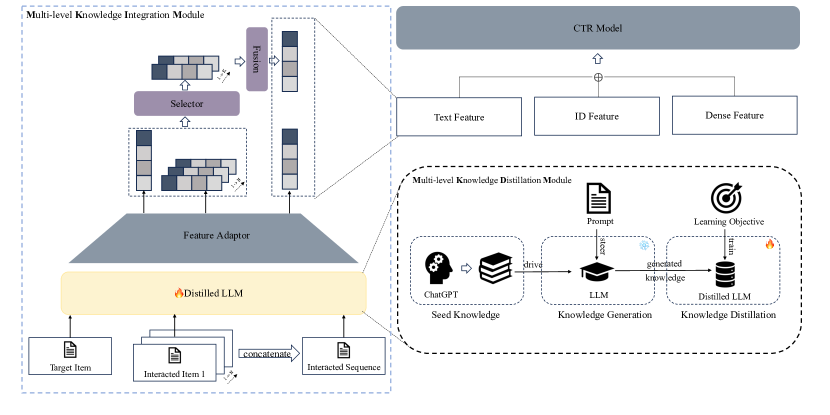
Original Figure 2 (architecture): Main modules and their connections. Image from the original paper; copyright belongs to the authors. Click the image for its source.
Core equations
Distillation trains the student on teacher-generated token sequences:
CTR alignment freezes the backbone and learns low-rank updates:
The frequency gate chooses cached or online LoRA embeddings and fuses the top-k relevant history:
Offline and online results in the paper
KDD Cup 2012 AUC: 0.7763 for DeepFM, 0.7846 for PRINT, and 0.7871 for MSD. On Meituan's private data, DeepFM reaches 0.6938 versus 0.7087 for MSD. Removing LoRA, item fusion, or user knowledge yields 0.7075, 0.7069, or 0.7054 respectively.
Meituan search ads A/B, 2024-10-20 to 10-30: CTR +2.12%, CPM +2.59%. The paper reports 35ms for the baseline and 37.2ms for MSD.
Local reproduction
Control: ID-only CTR ranker versus full MSD. AUC rises from 0.68449 to 0.69510 (+1.55%). This ablates LLM distillation and cached semantic features jointly, not MSD against DIN.
MovieLens-100K titles, genres, and time-ordered interactions define a CTR task. The SmolLM2-135M-Instruct teacher generates knowledge for 30 users and 160 frequency-stratified items. T5-small distills autoregressively for 32 steps. The frozen student then gets 147,456 q/v-LoRA parameters and 100 steps of CTR alignment. Popular items use cached embeddings; low-frequency items retain the online LoRA path. The history contributes the top-3 items by semantic similarity to the target.
| Method | AUC mean ± std | train+eval seconds mean |
|---|---|---|
| ID CTR | 0.684486 ± 0.005765 | about 1.1 |
| MSD | 0.695098 ± 0.024651 | about 22.0 |
Mean relative AUC lift is +1.55%, positive for 2/3 seeds but negative for seed 44, so it is not stable. Distillation losses fall from 2.40/2.38/2.36 to 1.55/1.13/1.17, confirming actual teacher-to-student training. Local times do not reproduce production efficiency: the run retains the frequency gate and cache semantics but not Meituan's asynchronous batching or online embedding service. See metrics/movielens-100k-seeds42-44.json.
pip install -e '.[plum]'
for seed in 42 43 44; do
  AUTO_RESEARCH_MSD_USERS=30 AUTO_RESEARCH_MSD_TEACHER_ITEMS=160 \
  AUTO_RESEARCH_MSD_DISTILL_STEPS=32 AUTO_RESEARCH_MSD_STEPS=100 \
  auto-research reproduce --paper msd --dataset-dir data --seed "$seed"
done
Teacher text, student checkpoints, cached embeddings, and raw runs stay in Git-ignored directories. Only aggregate metrics are committed.