OneRec: Session-wise generative recommendation with preference alignment
Fidelity: Full core pipeline. The code trains RQ Semantic IDs, a session-wise encoder–decoder, sparse MoE, a personalized reward model, and self-hard DPO, with smaller models, sessions, and public data.
Paper information
| Field | Value |
|---|---|
| Paper link | arXiv 2502.18965 |
| Organization | Kuaishou |
| First published | 2025-02-26 (arXiv v1) |
| Original author code | No official or author code was provided in the paper (checked 2026-08-09). |
| Adapter | onerec |
| Local reproduction code | src/auto_research/reproductions/onerec/ |
Original paper summary
Background and main changes
Multistage retrieve–rank systems optimize separate objectives. Pointwise next-item generation also struggles to keep an entire session coherent and diverse. OneRec represents items with three-level RQ Semantic IDs, uses MoE to generate a full session of 5 target items, and trains a personalized reward model for watch and interaction metrics. Iterative Preference Alignment (IPA) chooses self-hard winners and losers from 128 beam-search sessions from the current model and uses just 1% of examples for iterative DPO.
flowchart LR
  A["256-item user history"] --> B["RQ Semantic IDs"]
  B --> C["MoE session generator"]
  C --> D["128 beam sessions"]
  D --> E["personalized multi-task reward model"]
  E --> F["self-hard winner / loser pairs"]
  F --> G["1% iterative DPO"]
  G --> C
  C --> H["single-stage online recommendation"]
Key figure from the paper
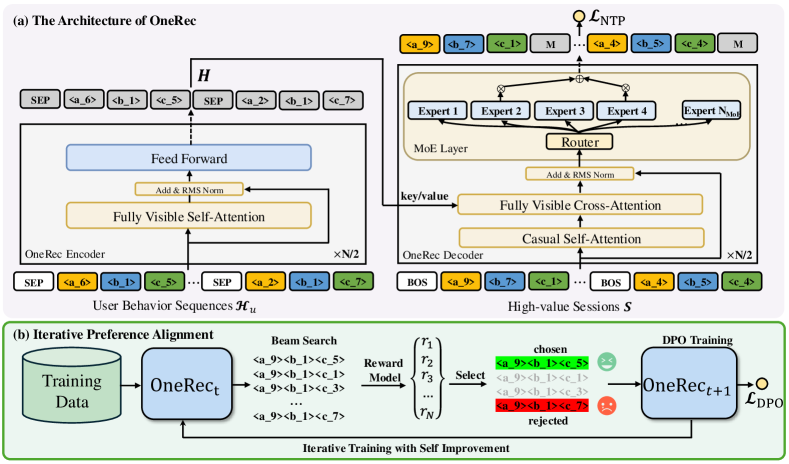
Original Figure 2 (architecture): Main modules and their connections. Image from the original paper; copyright belongs to the authors. Click the image for its source.
Core equations
OneRec concatenates the \(L\)-level SIDs of \(m\) target items into a session and optimizes:
The reward model predicts SWT, VTR, WTR, and LTR for generated sessions. The IPA update uses:
Offline and online results in the paper
OneRec-1B reaches maximum SWT/LTR of 0.1529/0.0660 versus 0.1368/0.0579 for TIGER-1B. With IPA it reaches 0.1933/0.1203. Compared with OneRec-1B, IPA improves max SWT and max LTR by 4.04% and 5.43%; using 1% DPO examples reaches about 95% of the best result at higher sampling rates.
Kuaishou uses 1% traffic for a strict A/B test on its main surface:
| Model | Total watch time | Average view duration |
|---|---|---|
| OneRec-0.1B | +0.57% | +4.26% |
| OneRec-1B | +1.21% | +5.01% |
| OneRec-1B + IPA | +1.68% | +6.56% |
Local reproduction
Control: Session-generator SFT versus OneRec with the reward model and self-hard DPO. NDCG@10 falls from 0.01565 to 0 (-100%). This ablates preference alignment; it is not a comparison with DIN.
MovieLens-1M trains a three-level RQ-VAE with SID codebooks [256,128,64]. The 96-dimensional, 2-layer encoder–decoder has 4 top-1 sparse experts and generates sessions of 3 items. The run performs 240 steps of session SFT and 120 steps of personalized reward modeling. From 12-beam sessions it selects 96 self-hard winner/loser pairs for 80 DPO steps. Test generation admits only catalog SID prefixes.
| Stage | Hit@10 | NDCG@10 | Head share@10 | Valid session |
|---|---|---|---|---|
| Session generator SFT | 0.0200 | 0.0157 | 0.4372 | 1.0000 |
| + iterative preference alignment | 0.0000 | 0.0000 | 0.1047 | 1.0000 |
SID uniqueness is 90.80%. Final SFT loss is 5.1333. Reward loss falls only from 0.6939 to 0.6804, while DPO loss drops from 0.1358 to 0.00054. Head share falls from 43.72% to 10.47%, but NDCG@10 also falls from 0.0157 to 0. The small reward model does not discriminate well enough and the policy over-optimizes it. The local result rejects this DPO setup; it does not verify IPA gains. The earlier heuristic NDCG +28.78% claim was withdrawn.
See metrics/movielens-1m-seed42.json. Full run:
pip install -e '.[neural-recs]'
AUTO_RESEARCH_ONEREC_CHECKPOINTS=runs/onerec-checkpoints/seed-42 \
auto-research reproduce --paper onerec --dataset-dir data --seed 42
Data, RQ-VAE, generator/reward checkpoints, and raw outputs stay in Git-ignored data/ and runs/. The MR includes code, docs, and sanitized metrics only.